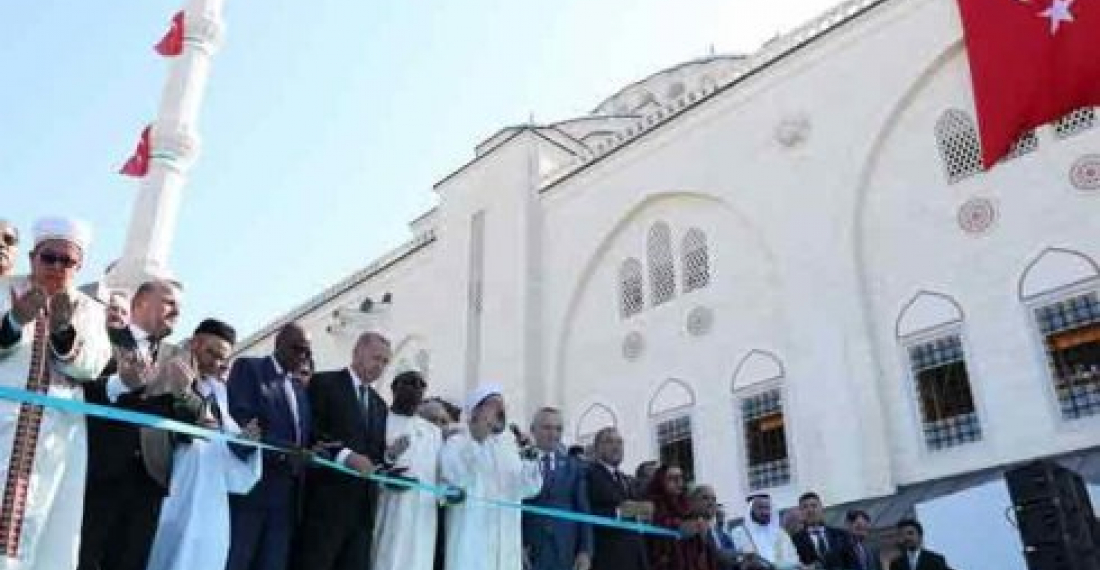
Erdogan opens Turkey's largest Mosque complex

Turkish president, Recip Tayip Erdogan, on Friday (3 May) officially inaugurated Turkley's largest Mosque complex, situated on the Asian side of the city of Istanbul.The mosque has the capacity to accommodate 63,000 people at the same time. Situated on Istanbul's Camlica Hill in the Asian side of the city the Mosque is built in the Ottoman-Seljuk style of architecture, and can be easily viewed from every corner of the city.

The Mosque complex includes a museum of Turkish Islamic art, a library, an art gallery, a conference hall, workshops as well as a car park with a 3,500-car capacity.

It has six minarets representing the six beliefs of Islam. Four minarets are 107.1 meters tall, a tribute to the 1071 Manzikert victory of the Seljuk Turks against the Byzantine army that opened up Anatolia for Turkish domination.

Its 72-meter-high main dome represents 72 nations living in the city. The second dome with a diameter of 34 meters represents the car license plate number of Istanbul.

There are 16 names of Allah inscribed inside the dome, symbolizing the number of states founded by Turks.

A three-piece finial on the main dome, weighing 4.5 tons and at a height of 7.77 meters is the largest of its kind.

A 17,000-square-meter carpet rolled out at the mosque is a specially designed hand-knotted carpet. The minbar of the mosque, a pulpit from which sermons of Friday and religious festivals are delivered, is 21 meters high and can be reached by elevator.

In a powerful speech during the inauguration, President Erdogan slammed those who attack innocent civilians in the name of jihad. Attacking innocent worshippers is terror and murder, not jihad, the president said

"No one can attack the places of worship on the grounds of jihad. The massacre of innocents is not jihad but terror, brutality and murder," he said.

The president recalled the recent killings in New Zealand and in Sri Lanka and called for a principled stance on all terrorist attacks. "The terrorist attacks in Sri Lanka with the massacre in New Zealand once again revealed the size of the threat. No one has the luxury to use ‘but' words in the face of terror," the president stated. "After that, no state can make a good or bad distinction among terrorists. A more principled, consistent, clear attitude towards terrorist organizations is now required," he said.

"The perpetrators of these attacks on both mosques and churches have the same mindset," he said. Turkey will continue to fight against neo-Nazi terror, Erdoğan said, suggesting that "even some western countries show a double standard on this issue."

In his speech president Erdogan hailed the construction of the new mosque. "The mosque will add beauty to Istanbul ... We are proud of this work," Erdoğan said addressing attendees at the ceremony.

The ceremony was attended by Albanian President Ilir Meta, President of Guinea Alpha Conde, President of Senegal Macky Sall, Palestinian Prime Minister Mohammad Ibrahim Ishtiyya, President of the Executive Committee of Afghanistan Abdullah Abdullah, Azerbaijani Parliament Speaker Oktay Esadov, Bosnia-Herzegovina Presidency Council Member Sefik Jafarovic, Bosnia and Herzegovina Peoples Assembly President Bakir Izetbegovic, Libyan Parliament Speaker Halid Elmeshri and Tunisia Al Nahda Movement Leader Rashid al-Ghannouchi.

source: commonspace.eu with agencies

photo: Turkish president Recip Tayip Erdogan inaugurating the new Camlika Mosque in Istanbul on 3 May 2019 (picture courtesy of Anadolu News Agency, Ankara) 
Related articles

Editor's choice
News
Borrell tells the European Parliament that the situation in Afghanistan was critical, but the EU will remain engaged

Borrell tells the European Parliament that the situation in Afghanistan was critical, but the EU will remain engaged

Borrell underlined that the European Union will make every effort to support the peace process and to remain a committed partner to the Afghan people. "Of course, we will have to take into account the evolving situation, but disengagement is not an option.  We are clear on that: there is no alternative to a negotiated political settlement, through inclusive peace talks.
Editor's choice
News
NATO Chief says war is on Europe's doorstep, and warns against complacency

NATO Chief says war is on Europe's doorstep, and warns against complacency

Russia could attack a Nato country within the next five years, the Secretary General of NATO, Mark Rutte, said in a stark new warning. "Nato's own defences can hold for now," Rutte warned in Berlin, but conflict was "next door" to Europe and he feared "too many are quietly complacent, and too many don't feel the urgency, too many believe that time is on our side. "Russia is already escalating its covert campaign against our societies," Rutte said in a speech in Germany. "We must be prepared for the scale of war our grandparents or great-grandparents endured." Earlier this month, Russia's President Vladimir Putin said his country was not planning to go to war with Europe, but it was ready "right now" if Europe wanted to - or started a war. But similar reassurances were given by Moscow in 2022, just before 200,000 Russian troops crossed the border and invaded Ukraine. Putin has accused European countries of hindering US efforts to bring peace in Ukraine - a reference to the role Ukraine's European allies have recently played in trying to change a US peace plan to end the war, whose initial draft was seen as favouring Russia. But Putin was not sincere, Nato's secretary-general said in the German capital, Berlin. Supporting Ukraine, he added, was a guarantee for European security. "Just imagine if Putin got his way; Ukraine under the boot of Russian occupation, his forces pressing against a longer border with Nato, and the significantly increased risk of an armed attack against us." Russia's economy has been on a war footing for more than three years now - its factories churn out ever more supplies of drones, missiles and artillery shells. According to a recent report by the Kiel Institute for the World Economy, Russia has been producing each month around 150 tanks, 550 infantry fighting vehicles, 120 Lancet drones and more than 50 artillery pieces. The UK, and most of its Western allies, are simply not anywhere near this point. Analysts say it would take years for Western Europe's factories to come close to matching Russia's mass-production of weapons. "Allied defence spending and production must rise rapidly, our armed forces must have what they need to keep us safe," the Nato chief said.

Popular

Editor's choice
News
NATO Chief says war is on Europe's doorstep, and warns against complacency

NATO Chief says war is on Europe's doorstep, and warns against complacency

Russia could attack a Nato country within the next five years, the Secretary General of NATO, Mark Rutte, said in a stark new warning. "Nato's own defences can hold for now," Rutte warned in Berlin, but conflict was "next door" to Europe and he feared "too many are quietly complacent, and too many don't feel the urgency, too many believe that time is on our side. "Russia is already escalating its covert campaign against our societies," Rutte said in a speech in Germany. "We must be prepared for the scale of war our grandparents or great-grandparents endured." Earlier this month, Russia's President Vladimir Putin said his country was not planning to go to war with Europe, but it was ready "right now" if Europe wanted to - or started a war. But similar reassurances were given by Moscow in 2022, just before 200,000 Russian troops crossed the border and invaded Ukraine. Putin has accused European countries of hindering US efforts to bring peace in Ukraine - a reference to the role Ukraine's European allies have recently played in trying to change a US peace plan to end the war, whose initial draft was seen as favouring Russia. But Putin was not sincere, Nato's secretary-general said in the German capital, Berlin. Supporting Ukraine, he added, was a guarantee for European security. "Just imagine if Putin got his way; Ukraine under the boot of Russian occupation, his forces pressing against a longer border with Nato, and the significantly increased risk of an armed attack against us." Russia's economy has been on a war footing for more than three years now - its factories churn out ever more supplies of drones, missiles and artillery shells. According to a recent report by the Kiel Institute for the World Economy, Russia has been producing each month around 150 tanks, 550 infantry fighting vehicles, 120 Lancet drones and more than 50 artillery pieces. The UK, and most of its Western allies, are simply not anywhere near this point. Analysts say it would take years for Western Europe's factories to come close to matching Russia's mass-production of weapons. "Allied defence spending and production must rise rapidly, our armed forces must have what they need to keep us safe," the Nato chief said.