The entire Russian Black Sea Fleet starts drills

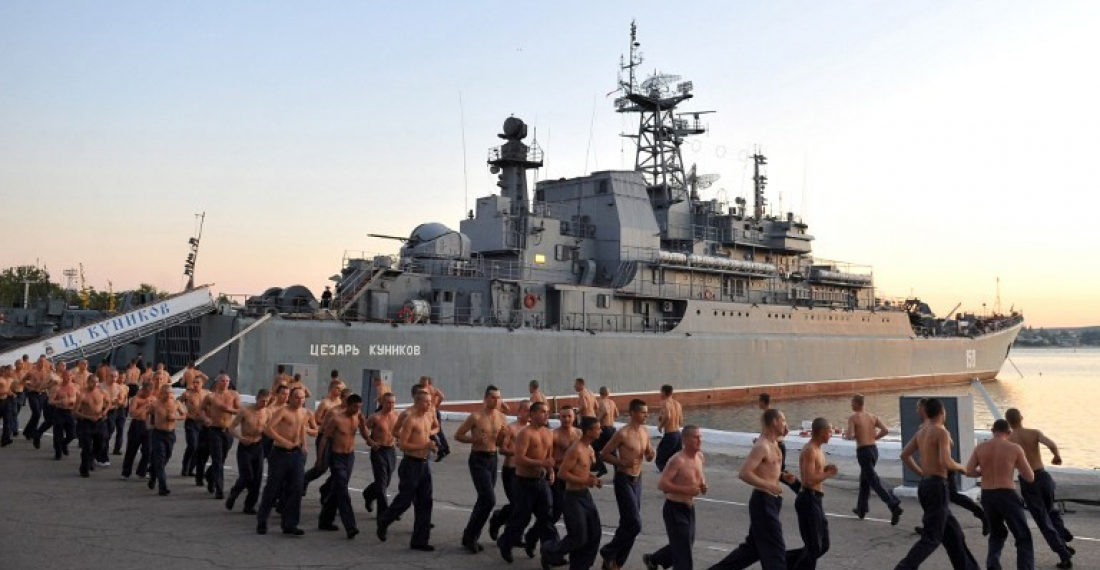
The entire Russian Black Sea Fleet on Thursday started drills at sea or on naval bases to practice naval battles and emergency clean-up efforts, the Fleet’s press office reported on Thursday.

 "A part of the ships is staying at combat training naval ranges and holding comprehensive shipborne drills for conducting a naval battle, air and anti-saboteur defense, eliminating sea and coastal targets, defending a ship during its anchorage in an unsafe roadstead and carrying out maneuvering in various conditions," the press office said in a statement.

"The other part of the Fleet’s forces is carrying out measures at naval bases where the sailors are practicing organizing everyday intra-ship activity, eliminating a notional fire or hull breaches as part of shipborne drills for ship damage control," the statement reads.

The drills involve the entire stock of the Black Sea Fleet’s ships, including the frigates Admiral Makarov and Admiral Grigorovich, the guard ship Pytlivy, the patrol vessel Dmitry Rogachyov, the missile corvettes Orekhovo-Zuyevo and Ingushetia, and also large amphibious assault ships, small anti-submarine warfare ships, submarines, minesweepers and the Fleet’s auxiliary vessels, the press office specified.

Aircraft and helicopters of the Black Sea Fleet’s naval aviation and air defense forces are providing support for the ships’ deployment to the sea, it said.

Earlier this week NATO Secretary-General Jens Stoltenberg criticised Russia for violating the territorial integrity of Georgia and Ukraine and said NATO was responding by building up its own deterrence posture, whilst continuing to seek dialogue with Russia.

"We see how Russia has deployed troops in violation of the wishes of different governments in our close neighbourhood, how Russia has illegally annexed Crimea, how they continue to destabilise eastern Ukraine, how there are Russian troops in parts of Georgia, and also how there are troops in Moldova, in Transnistria. And this is a violation of the territorial integrity of Moldova and is yet another example of how Russia far too often does not respect international law and the territorial integrity of countries, including Moldova."

The Russian Black Sea Fleet has 68 warships and more than 200 other ships, boats, submarines and support vessels. It is based in the port of Sevastopol in Crimea with other bases in Feodosia and Donuzlav, both also in Crimea and  Novorossiysk  in Krasnodar Krai. The fleet is led by Vice Admiral Igor Vladimirovich Osipov and has over 25,000 seamen and marines.

source: commonspace.eu with TASS (Moscow) and agencies

photos: Ship and sailors of Russia's Black Sea Fleet (archive pictures)
Related articles

Editor's choice
News
Borrell tells the European Parliament that the situation in Afghanistan was critical, but the EU will remain engaged

Borrell tells the European Parliament that the situation in Afghanistan was critical, but the EU will remain engaged

Borrell underlined that the European Union will make every effort to support the peace process and to remain a committed partner to the Afghan people. "Of course, we will have to take into account the evolving situation, but disengagement is not an option.  We are clear on that: there is no alternative to a negotiated political settlement, through inclusive peace talks.
Editor's choice
News
NATO Chief says war is on Europe's doorstep, and warns against complacency

NATO Chief says war is on Europe's doorstep, and warns against complacency

Russia could attack a Nato country within the next five years, the Secretary General of NATO, Mark Rutte, said in a stark new warning. "Nato's own defences can hold for now," Rutte warned in Berlin, but conflict was "next door" to Europe and he feared "too many are quietly complacent, and too many don't feel the urgency, too many believe that time is on our side. "Russia is already escalating its covert campaign against our societies," Rutte said in a speech in Germany. "We must be prepared for the scale of war our grandparents or great-grandparents endured." Earlier this month, Russia's President Vladimir Putin said his country was not planning to go to war with Europe, but it was ready "right now" if Europe wanted to - or started a war. But similar reassurances were given by Moscow in 2022, just before 200,000 Russian troops crossed the border and invaded Ukraine. Putin has accused European countries of hindering US efforts to bring peace in Ukraine - a reference to the role Ukraine's European allies have recently played in trying to change a US peace plan to end the war, whose initial draft was seen as favouring Russia. But Putin was not sincere, Nato's secretary-general said in the German capital, Berlin. Supporting Ukraine, he added, was a guarantee for European security. "Just imagine if Putin got his way; Ukraine under the boot of Russian occupation, his forces pressing against a longer border with Nato, and the significantly increased risk of an armed attack against us." Russia's economy has been on a war footing for more than three years now - its factories churn out ever more supplies of drones, missiles and artillery shells. According to a recent report by the Kiel Institute for the World Economy, Russia has been producing each month around 150 tanks, 550 infantry fighting vehicles, 120 Lancet drones and more than 50 artillery pieces. The UK, and most of its Western allies, are simply not anywhere near this point. Analysts say it would take years for Western Europe's factories to come close to matching Russia's mass-production of weapons. "Allied defence spending and production must rise rapidly, our armed forces must have what they need to keep us safe," the Nato chief said.

Popular

Editor's choice
News
NATO Chief says war is on Europe's doorstep, and warns against complacency

NATO Chief says war is on Europe's doorstep, and warns against complacency

Russia could attack a Nato country within the next five years, the Secretary General of NATO, Mark Rutte, said in a stark new warning. "Nato's own defences can hold for now," Rutte warned in Berlin, but conflict was "next door" to Europe and he feared "too many are quietly complacent, and too many don't feel the urgency, too many believe that time is on our side. "Russia is already escalating its covert campaign against our societies," Rutte said in a speech in Germany. "We must be prepared for the scale of war our grandparents or great-grandparents endured." Earlier this month, Russia's President Vladimir Putin said his country was not planning to go to war with Europe, but it was ready "right now" if Europe wanted to - or started a war. But similar reassurances were given by Moscow in 2022, just before 200,000 Russian troops crossed the border and invaded Ukraine. Putin has accused European countries of hindering US efforts to bring peace in Ukraine - a reference to the role Ukraine's European allies have recently played in trying to change a US peace plan to end the war, whose initial draft was seen as favouring Russia. But Putin was not sincere, Nato's secretary-general said in the German capital, Berlin. Supporting Ukraine, he added, was a guarantee for European security. "Just imagine if Putin got his way; Ukraine under the boot of Russian occupation, his forces pressing against a longer border with Nato, and the significantly increased risk of an armed attack against us." Russia's economy has been on a war footing for more than three years now - its factories churn out ever more supplies of drones, missiles and artillery shells. According to a recent report by the Kiel Institute for the World Economy, Russia has been producing each month around 150 tanks, 550 infantry fighting vehicles, 120 Lancet drones and more than 50 artillery pieces. The UK, and most of its Western allies, are simply not anywhere near this point. Analysts say it would take years for Western Europe's factories to come close to matching Russia's mass-production of weapons. "Allied defence spending and production must rise rapidly, our armed forces must have what they need to keep us safe," the Nato chief said.