Denmark to invest in long-range weapons for first time citing Russia threat

Denmark announced that it would for the first time acquire "long-range precision weapons", citing the need to deter Russia, as Moscow's ambassador to Copenhagen called the move "pure madness". Prime Minister Mette Frederiksen told a press conference on Wednesday  17th September that the move was a paradigm shift in Danish defence policy. "For the first time, Denmark is to build up military capacity in the form of long-range precision weapons," she told reporters. Frederiksen added that Russia would constitute a threat to Denmark and Europe "for years to come" and a decision was made to create a "credible deterrence".

"With these weapons, the defence forces will be able to hit targets at long range and, for example, neutralise enemy missile threats," she added, saying the weapons could for example be either missiles or drones.

Vladimir Barbin, the Russian ambassador to Denmark, called the Danish justification about the need to be able to strike distant targets "pure madness". "No one, anywhere, ever in the world has considered threatening a nuclear power publicly. These statements will undoubtedly be taken into account," Barbin said in a written statement on Telegram.

"From now on, we must assume that Denmark is not only considering the possibility of a direct military confrontation with Russia, but is also preparing for such a scenario," he added.

Speaking to broadcaster DR, Frederiksen said the ambassador's comments should be interpreted as a threat. "Russia is trying to threaten Europe and NATO into not defending our people and borders. Of course, we will not be intimidated," she told the broadcaster.

Denmark's defence ministry said in a statement it would start looking into which long-range weapons best suited the country's needs. Rearmament has become a government priority under Social Democrats leader Frederiksen in the wake of Russia's full-scale invasion of Ukraine in February 2022.

Last week, Denmark said it would invest some 58 billion kroner ($9.2 billion) in European-made air and missile defence systems. In February, Frederiksen said Denmark would allocate an extra 50 billion kroner to defence spending over the next two years, urging the military to "buy, buy, buy".

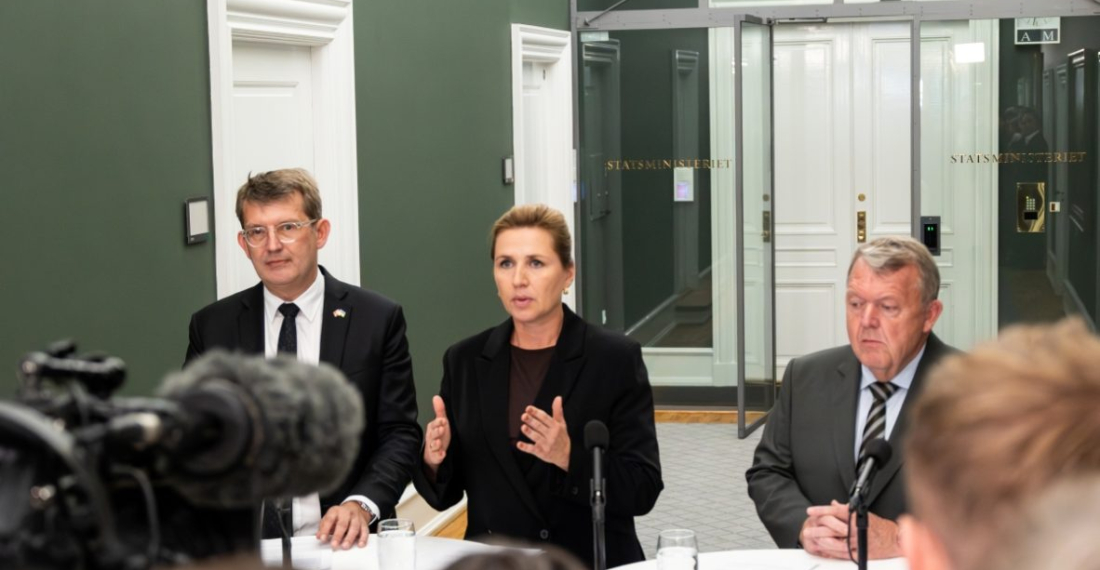
Source: commonspace.eu with AFP and agencies. Photo: Doorstep press briefing on Danish defence initiatives with prime minister Mette Frederiksen, defence minister Troels Lund Poulsen, and foreign minister Lars Loekke Rasmussen. [Kristian Tuxen Ladegaard Berg/NurPhoto via Getty Images]

Related articles

Editor's choice
News
Borrell tells the European Parliament that the situation in Afghanistan was critical, but the EU will remain engaged

Borrell tells the European Parliament that the situation in Afghanistan was critical, but the EU will remain engaged

Borrell underlined that the European Union will make every effort to support the peace process and to remain a committed partner to the Afghan people. "Of course, we will have to take into account the evolving situation, but disengagement is not an option.  We are clear on that: there is no alternative to a negotiated political settlement, through inclusive peace talks.
Editor's choice
News
Mystery surrounds the crash of a Turkish airline in Georgia which resulted in the death of 20 Turkish Airforce personnel

Mystery surrounds the crash of a Turkish airline in Georgia which resulted in the death of 20 Turkish Airforce personnel

​ Twenty Turkish Airforce personnel died when a military plane crushed on the Georgian side of the Azerbaijan - Georgia border on Tuesday (11 November). The C130 took off from Ganja and was heading to Merzifon, transporting service members that had participated in Azerbaijan's Victory Day celebrations. Half an hour after takeoff, the aircraft lost altitude and broke apart in mid-air over a mountainous area on the Georgian border. Lockheed C130 Hercules have been in service with Turkey since the 1960s and are considered among the most reliable in their class. However, some of these aircraft are 50–60 years old. In October, the Turkish Ministry of Defense announced plans to replace them with new C130J Super Hercules models, with deliveries expected to begin in the coming years. All aircraft fragments have already been collected for technical examination. The cause of the crash has not yet been officially determined. A Turkish expert and retired military officer Coşkun Başbuğ noted on CNN Türk, a technical malfunction "should be ruled out" as the cause of the crash. "Various possibilities should be considered, but the first thing to consider is that the C-130 is a time-tested military transport aircraft, the last known incident involving which occurred in 1982." "A technical malfunction should be ruled out as the cause of the crash. The same applies to weather conditions, as the relevant authorities would have reported bad weather. The remaining theories include a mid-air collision, sabotage, or an attack," he emphasized. Former Turkish Armed Forces Logistics Commander and retired Army General Erdoğan Karakuş stated in an interview with Turkish television that although the C-130 aircraft are old, they have undergone a complete modernization in Turkey, and their technical condition is thoroughly inspected before each flight. The Turkish Air Force is expected to operate the C-130 aircraft until 2040. ​

Popular

Editor's choice
News
Mystery surrounds the crash of a Turkish airline in Georgia which resulted in the death of 20 Turkish Airforce personnel

Mystery surrounds the crash of a Turkish airline in Georgia which resulted in the death of 20 Turkish Airforce personnel

​ Twenty Turkish Airforce personnel died when a military plane crushed on the Georgian side of the Azerbaijan - Georgia border on Tuesday (11 November). The C130 took off from Ganja and was heading to Merzifon, transporting service members that had participated in Azerbaijan's Victory Day celebrations. Half an hour after takeoff, the aircraft lost altitude and broke apart in mid-air over a mountainous area on the Georgian border. Lockheed C130 Hercules have been in service with Turkey since the 1960s and are considered among the most reliable in their class. However, some of these aircraft are 50–60 years old. In October, the Turkish Ministry of Defense announced plans to replace them with new C130J Super Hercules models, with deliveries expected to begin in the coming years. All aircraft fragments have already been collected for technical examination. The cause of the crash has not yet been officially determined. A Turkish expert and retired military officer Coşkun Başbuğ noted on CNN Türk, a technical malfunction "should be ruled out" as the cause of the crash. "Various possibilities should be considered, but the first thing to consider is that the C-130 is a time-tested military transport aircraft, the last known incident involving which occurred in 1982." "A technical malfunction should be ruled out as the cause of the crash. The same applies to weather conditions, as the relevant authorities would have reported bad weather. The remaining theories include a mid-air collision, sabotage, or an attack," he emphasized. Former Turkish Armed Forces Logistics Commander and retired Army General Erdoğan Karakuş stated in an interview with Turkish television that although the C-130 aircraft are old, they have undergone a complete modernization in Turkey, and their technical condition is thoroughly inspected before each flight. The Turkish Air Force is expected to operate the C-130 aircraft until 2040. ​