


Critics of Armenian President keep up pressure

There are some indications that the hostage situation in the Erebuni District of the Armenian Capital Yerevan may be coming to a close.

It was reported on Saturday morning that the armed men holding a number of policemen at the station they attacked last Sunday have released two policemen, and are ready to release the remaining two senior officers soon. The kidnappers are however demanding access to the media before they release the last two hostages. It is not clear what will happen to the armed men but it is likely that they will be charged with the murder of a police officer who was killed at the start of the incident on Sunday.

The end of the stand-off however will not mean the end of the political crisis that it has triggered in Armenia. Over the last week it has become clear that the armed men involved in the incident have considerable sympathy among Armenian society, if not for their methods, at least for the cause that they are upholding, namely to bring down the government of President Serzh Sargsyan, and more specifically to reject the ideas being currently discussed aimed at resolving the Nagorno-Karabakh conflict. It is understood that these ideas, articulated by Russian Foreign Minister Sergei Lavrov, require Armenia to return to Azerbaijan large chunks of the territory that it has occupied for more than two decades around Nagorno-Karabakh itself.

On Friday, Opposition MP Nikol Pashinyan called for the resignation of Serzh Sargsyan and urged peaceful protests against concessions in the Nagorno-Karabakh negotiations.

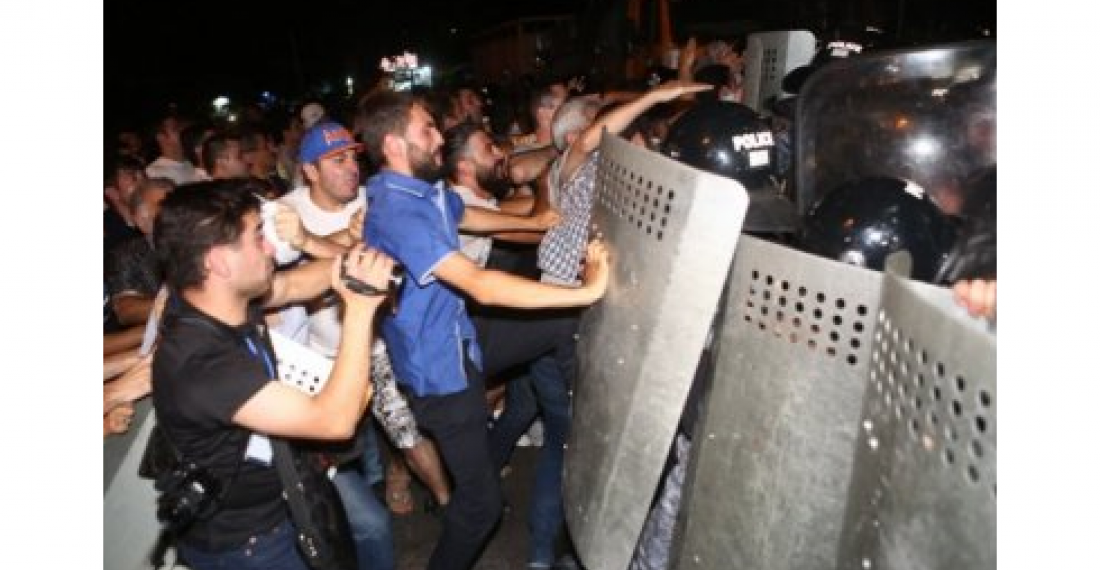
So far the public protests around the Eerebuni Police Station have only attracted a few hundred people, but the government is concerned that it may snowball into something much bigger. There have been nightly scuffles between demonstrators and police, with injuries on both sides. Hundreds have been arrested and many claim they were beaten up by the police when in custody. On Friday, President Sargsyan, breaking his silence on the matter, noted the importance of doing everything for a peaceful solution to the crisis .

The Armenian President said that the idea that problems could be solved through violence and force is very dangerous, and is fraught with serious consequences for the entire country.

"I urge all members of our society to exercise their political and civil rights exclusively in a peaceful way and within the law," Sargsyan said.
The President also urged the personnel of the law enforcement agencies to exercise restraint and act "within the rule of law". He assured that the government would act patiently "without making society a hostage", and would not act "in a traditional way for such situations".

Source: commonspace.eu with agencies

Photo: Stand-off between demonstrators and police outside the Erebuni Police Station where armed men are holding several policemen hostage. (picture courtesy of mediamax)
 

Related articles

Editor's choice
News
Borrell tells the European Parliament that the situation in Afghanistan was critical, but the EU will remain engaged

Borrell tells the European Parliament that the situation in Afghanistan was critical, but the EU will remain engaged

Borrell underlined that the European Union will make every effort to support the peace process and to remain a committed partner to the Afghan people. "Of course, we will have to take into account the evolving situation, but disengagement is not an option.  We are clear on that: there is no alternative to a negotiated political settlement, through inclusive peace talks.
Editor's choice
News
NATO Chief says war is on Europe's doorstep, and warns against complacency

NATO Chief says war is on Europe's doorstep, and warns against complacency

Russia could attack a Nato country within the next five years, the Secretary General of NATO, Mark Rutte, said in a stark new warning. "Nato's own defences can hold for now," Rutte warned in Berlin, but conflict was "next door" to Europe and he feared "too many are quietly complacent, and too many don't feel the urgency, too many believe that time is on our side. "Russia is already escalating its covert campaign against our societies," Rutte said in a speech in Germany. "We must be prepared for the scale of war our grandparents or great-grandparents endured." Earlier this month, Russia's President Vladimir Putin said his country was not planning to go to war with Europe, but it was ready "right now" if Europe wanted to - or started a war. But similar reassurances were given by Moscow in 2022, just before 200,000 Russian troops crossed the border and invaded Ukraine. Putin has accused European countries of hindering US efforts to bring peace in Ukraine - a reference to the role Ukraine's European allies have recently played in trying to change a US peace plan to end the war, whose initial draft was seen as favouring Russia. But Putin was not sincere, Nato's secretary-general said in the German capital, Berlin. Supporting Ukraine, he added, was a guarantee for European security. "Just imagine if Putin got his way; Ukraine under the boot of Russian occupation, his forces pressing against a longer border with Nato, and the significantly increased risk of an armed attack against us." Russia's economy has been on a war footing for more than three years now - its factories churn out ever more supplies of drones, missiles and artillery shells. According to a recent report by the Kiel Institute for the World Economy, Russia has been producing each month around 150 tanks, 550 infantry fighting vehicles, 120 Lancet drones and more than 50 artillery pieces. The UK, and most of its Western allies, are simply not anywhere near this point. Analysts say it would take years for Western Europe's factories to come close to matching Russia's mass-production of weapons. "Allied defence spending and production must rise rapidly, our armed forces must have what they need to keep us safe," the Nato chief said.

Popular

Editor's choice
News
NATO Chief says war is on Europe's doorstep, and warns against complacency

NATO Chief says war is on Europe's doorstep, and warns against complacency

Russia could attack a Nato country within the next five years, the Secretary General of NATO, Mark Rutte, said in a stark new warning. "Nato's own defences can hold for now," Rutte warned in Berlin, but conflict was "next door" to Europe and he feared "too many are quietly complacent, and too many don't feel the urgency, too many believe that time is on our side. "Russia is already escalating its covert campaign against our societies," Rutte said in a speech in Germany. "We must be prepared for the scale of war our grandparents or great-grandparents endured." Earlier this month, Russia's President Vladimir Putin said his country was not planning to go to war with Europe, but it was ready "right now" if Europe wanted to - or started a war. But similar reassurances were given by Moscow in 2022, just before 200,000 Russian troops crossed the border and invaded Ukraine. Putin has accused European countries of hindering US efforts to bring peace in Ukraine - a reference to the role Ukraine's European allies have recently played in trying to change a US peace plan to end the war, whose initial draft was seen as favouring Russia. But Putin was not sincere, Nato's secretary-general said in the German capital, Berlin. Supporting Ukraine, he added, was a guarantee for European security. "Just imagine if Putin got his way; Ukraine under the boot of Russian occupation, his forces pressing against a longer border with Nato, and the significantly increased risk of an armed attack against us." Russia's economy has been on a war footing for more than three years now - its factories churn out ever more supplies of drones, missiles and artillery shells. According to a recent report by the Kiel Institute for the World Economy, Russia has been producing each month around 150 tanks, 550 infantry fighting vehicles, 120 Lancet drones and more than 50 artillery pieces. The UK, and most of its Western allies, are simply not anywhere near this point. Analysts say it would take years for Western Europe's factories to come close to matching Russia's mass-production of weapons. "Allied defence spending and production must rise rapidly, our armed forces must have what they need to keep us safe," the Nato chief said.

