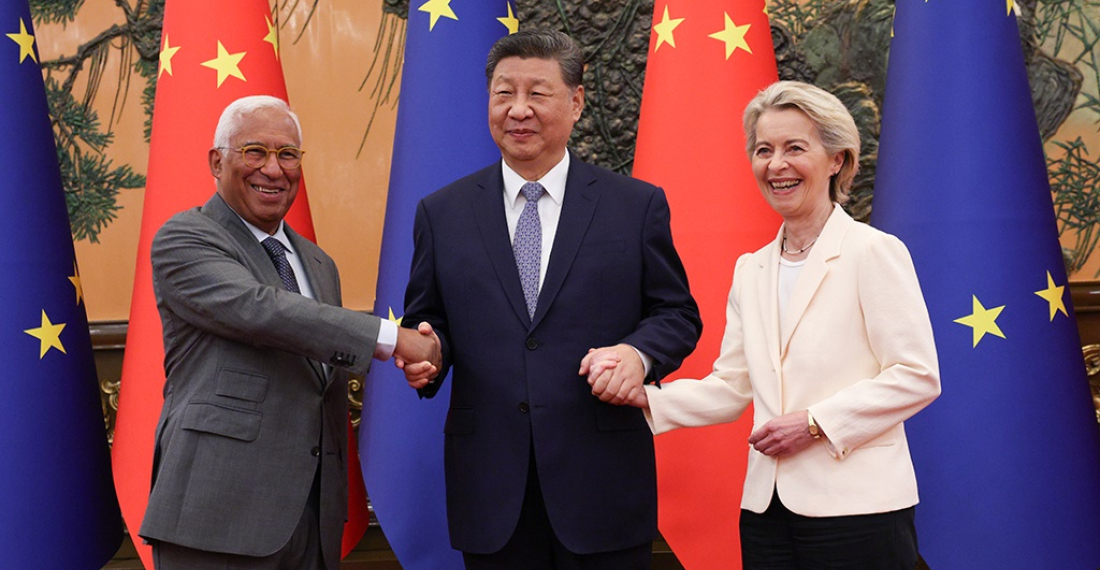
China and the European Union have issued a joint call to action on climate change during an otherwise tense bilateral summit in Beijing on Thursday 24 July but major disagreements remain over trade and the war in Ukraine. The two sides issued a joint statement on climate change, urging more emission cuts and greater use of green technology and affirming their support for the Paris Climate Agreement as well as calling for strong action at the upcoming COP30 climate summit in Brazil. European Council President António Costa called on China to use its influence over Russia to bring an end to the war in Ukraine, a long-standing plea from European leaders that is likely to fall once again on deaf ears.
Their climate agreement was a silver lining on a stormy day where European leaders demanded a more balanced relationship with China in talks with President Xi Jinping, AP reported. “In the fluid and turbulent international situation today, it is crucial that all countries, notably the major economies, maintain policy continuity and stability and step up efforts to address climate change,” the joint statement said.
They highlighted trade in their opening remarks, calling for concrete progress to address Europe’s yawning trade deficit with China. “As our cooperation has deepened, so have the imbalances,” European Commission President Ursula von der Leyen said. “We have reached an inflection point. Rebalancing our bilateral relation is essential. Because to be sustainable, relations need to be mutually beneficial.”
Expectations were low ahead of the talks, initially supposed to last two days but scaled back to one. They come amid financial uncertainty around the world, wars in the Middle East and Ukraine, and the threat of U.S. tariffs. Neither the EU nor China is likely to budge on key issues, AP reports.
President Xi called for deeper cooperation between China and Europe to provide stability in an increasingly complex world. Both sides should set aside differences and seek common ground, he said, a phrasehe often uses in relationships like the one with the EU, according to AP.
China is willing to strengthen coordination on climate and make greater contributions to addressing climate change, he said, but he pushed back against EU restrictions on Chinese exports.
“We hope the EU will keep its trade and investment markets open, refrain from using restrictive economic and trade tools and provide a good business environment for Chinese companies to invest and develop in Europe,” he said, according to a readout posted online by state broadcaster CCTV.
The EU, meanwhile, has concerns about a looming trade battle with the United States. “Europe is being very careful not to antagonize President Trump even further by looking maybe too close to China, so all of that doesn’t make this summit easier,” said Fabian Zuleeg, chief economist of the European Policy Center, quoted by AP. “It will be very hard to achieve something concrete.”
China’s stance has hardened on the EU, despite a few olive branches, like the suspension of sanctions on European lawmakers who criticized Beijing’s human rights record in Xinjiang province, where it is accused of a widespread campaign of repression against the Uyghurs.
The summit ended with almost no movement on the major issues of trade, electric vehicles, or Russia, said Noah Barkin, an analyst at the Rhodium Group think tank quoted by AP. Rather, frustration from the EU was glaringly obvious “after years in which its concerns have been largely ignored by Beijing.”
He said the Europeans will likely use more “trade defense tools in the months ahead, including a debate over expanding safeguards and new cases under the bloc’s foreign subsidies regulation.”
Like the U.S., the EU runs a massive trade deficit with China, around 300 billion euros last year. It relies heavily on China for critical minerals and the magnets made from them for cars and appliances. When China curtailed the export of those products in response to Trump’s tariffs, European automakers cried foul.
China agreed during the summit to to start “an upgraded export supply mechanism” to fast-track exports of critical minerals, von der Leyen said. Details of the arrangement were not immediately made public. Barkin said he doubted the mechanism would be “a miracle solution for what may become a go-to coercion tool for Beijing in the years ahead.”
The rapid growth in China’s market share in Europe has sparked concern that Chinese cars will eventually threaten the EU’s ability to produce its own green technology to combat climate change. Business groups and unions also fear that the jobs of 2.5 million auto industry workers could be put in jeopardy, as well those of 10.3 million more people whose employment depends indirectly on EV production.
China bristles at EU sanctions over Russia’s war against Ukraine. The latest package included two Chinese banks that the EU accused of links to Russia’s war industry. China’s Commerce Ministry protested the listing and vowed to respond with “necessary measures to resolutely safeguard the legitimate rights and interests of Chinese enterprises and financial institutions.”
Buffeted between a combative Washington and a hardline Beijing, the EU has more publicly sought new alliances elsewhere, inking a trade pact with Indonesia and drafting trade deals with South America and Mexico, the AP reports.
Costa and von der Leyen visited Tokyo the day before their meetings in Beijing, launching an alliance with Japan to boost economic cooperation, defend free trade and counter unfair trade practices. “Both Europe and Japan see a world around us where protectionist instincts grow, weaknesses get weaponized, and every dependency exploited,” von der Leyen said. So it is normal that two like-minded partners come together to make each other stronger.”