Chaos in Romania after Calin Georgescu is barred from presidential election rerun

Chaos broke out in Romania’s capital Sunday evening as incensed supporters of the far-right populist Calin Georgescu protested the electoral body’s decision to reject his candidacy in a presidential election rerun. He won the first round of last year’s race before a top court annulled the election. The 62-year-old Georgescu filed his candidacy on Friday in the capital, Bucharest. The Central Election Bureau, also known by its Romanian acronym BEC, had 48 hours to register or reject it.

In its decision, the BEC cited the country’s Constitutional Court ruling last year to cancel the election, arguing it was ordered due to “the candidate’s failure to comply with electoral regulations. It would be unacceptable for the restarted election process to consider the same individual as eligible for the presidency,” BEC said. The decision can be appealed before the Constitutional Court within 24 hours.

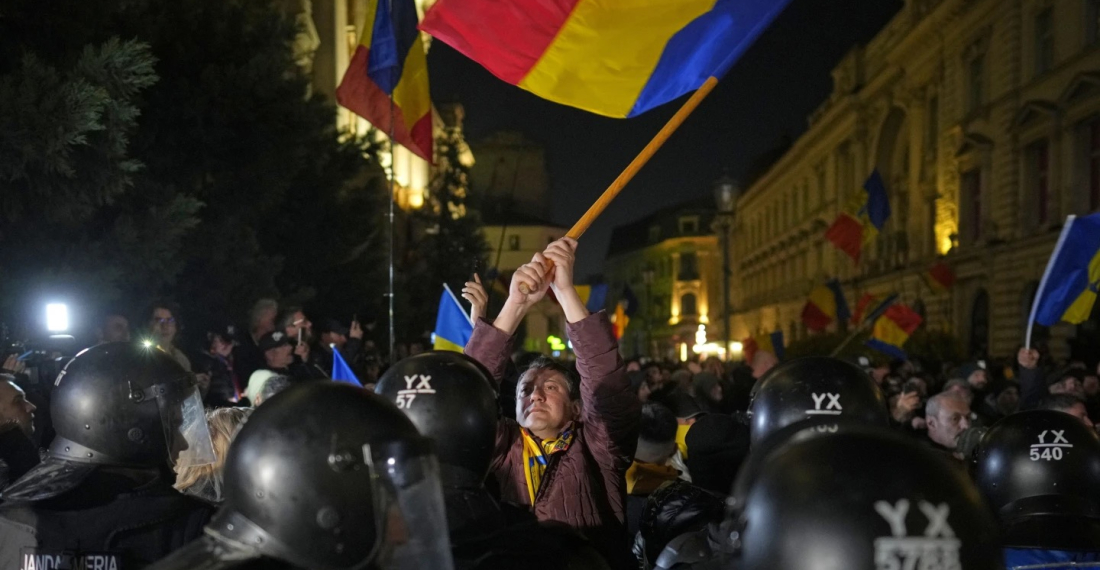
Hundreds of protesters gathered outside BEC’s headquarters to express anger over its decision, with many waving Romanian flags and chanting: “The last resort is another revolution!” Some protesters threw broken paving stones and other objects at the scores of riot police dispatched to the area, overturned a news vehicle and set a bush ablaze.

Georgescu reacted to the decision Sunday by calling it “a direct blow to the heart of democracy worldwide! I have one message left! If democracy in Romania falls, the entire democratic world will fall! This is just the beginning. It’s that simple!” he said in a post on X. “Europe is now a dictatorship, Romania is under tyranny!”

The BEC’s rejection of Georgescu’s candidacy came after the Constitutional Court annulled the first-round results two days before the 8th December runoff, after allegations emerged that Russia had run a coordinated online campaign to promote the outsider who ran as an independent.

The court’s unprecedented decision plunged the European Union and NATO member country into a protracted political crisis. Last month, prosecutors launched a criminal investigation against Georgescu, accusing him of “incitement to actions against the constitutional order,” supporting fascist groups and false declarations of electoral campaign funding and asset disclosures.

Before the Nov. 24 election, Georgescu, who is under judicial control and has repeatedly denied any wrongdoing, had polled in single digits and declared zero campaign spending. Allegations quickly emerged of electoral violations and Russian interference. Moscow denied that it had meddled in the election. Georgescu has praised Russian President Vladimir Putin and questioned Ukraine’s statehood, but says that he’s not pro-Russia.

The first round of the rerun is scheduled for May 4. If no candidate wins more than 50 per cent of the ballots, a runoff will follow on May 18. The deadline for presidential candidacy applications is March 15 at midnight.

George Simion, the leader of the far-right Alliance for the Unity of Romanians, who had backed Georgescu’s bid, reacted to the BEC’s decision on Sunday by calling it “a new abuse and a continuation of the coup d’état.” “Down with Ciolacu, down with the dictators!” he said in a post on Facebook, referring to Prime Minister Marcel Ciolacu.

Since Romania canceled the election, Georgescu has become a cause célèbre among the far right, with support coming from prominent figures such as U.S. Vice President JD Vance and Elon Musk, who have both strongly criticized Romania for annulling the vote. Musk reacted to the BEC decision in a repost of the news on X, saying: “This is crazy!”

Incumbent Bucharest Mayor Nicusor Dan also filed his candidacy on Friday as an independent under the campaign slogan “Honest Romania.” The BEC registered his candidacy on Sunday.  Crin Antonescu, the joint presidential candidate backed by Romania’s governing coalition — comprised of the Social Democratic Party, the National Liberal Party, and the small ethnic Hungarian UDMR party — also registered his presidential bid on Sunday.
Source: commonspace.eu with agencies. Photo: A supporter of Georgescu during a protest on 9 March 2025. AP/Vadim Ghirda

Related articles

Editor's choice
News
Borrell tells the European Parliament that the situation in Afghanistan was critical, but the EU will remain engaged

Borrell tells the European Parliament that the situation in Afghanistan was critical, but the EU will remain engaged

Borrell underlined that the European Union will make every effort to support the peace process and to remain a committed partner to the Afghan people. "Of course, we will have to take into account the evolving situation, but disengagement is not an option.  We are clear on that: there is no alternative to a negotiated political settlement, through inclusive peace talks.
Editor's choice
News
NATO Chief says war is on Europe's doorstep, and warns against complacency

NATO Chief says war is on Europe's doorstep, and warns against complacency

Russia could attack a Nato country within the next five years, the Secretary General of NATO, Mark Rutte, said in a stark new warning. "Nato's own defences can hold for now," Rutte warned in Berlin, but conflict was "next door" to Europe and he feared "too many are quietly complacent, and too many don't feel the urgency, too many believe that time is on our side. "Russia is already escalating its covert campaign against our societies," Rutte said in a speech in Germany. "We must be prepared for the scale of war our grandparents or great-grandparents endured." Earlier this month, Russia's President Vladimir Putin said his country was not planning to go to war with Europe, but it was ready "right now" if Europe wanted to - or started a war. But similar reassurances were given by Moscow in 2022, just before 200,000 Russian troops crossed the border and invaded Ukraine. Putin has accused European countries of hindering US efforts to bring peace in Ukraine - a reference to the role Ukraine's European allies have recently played in trying to change a US peace plan to end the war, whose initial draft was seen as favouring Russia. But Putin was not sincere, Nato's secretary-general said in the German capital, Berlin. Supporting Ukraine, he added, was a guarantee for European security. "Just imagine if Putin got his way; Ukraine under the boot of Russian occupation, his forces pressing against a longer border with Nato, and the significantly increased risk of an armed attack against us." Russia's economy has been on a war footing for more than three years now - its factories churn out ever more supplies of drones, missiles and artillery shells. According to a recent report by the Kiel Institute for the World Economy, Russia has been producing each month around 150 tanks, 550 infantry fighting vehicles, 120 Lancet drones and more than 50 artillery pieces. The UK, and most of its Western allies, are simply not anywhere near this point. Analysts say it would take years for Western Europe's factories to come close to matching Russia's mass-production of weapons. "Allied defence spending and production must rise rapidly, our armed forces must have what they need to keep us safe," the Nato chief said.

Popular

Editor's choice
News
NATO Chief says war is on Europe's doorstep, and warns against complacency

NATO Chief says war is on Europe's doorstep, and warns against complacency

Russia could attack a Nato country within the next five years, the Secretary General of NATO, Mark Rutte, said in a stark new warning. "Nato's own defences can hold for now," Rutte warned in Berlin, but conflict was "next door" to Europe and he feared "too many are quietly complacent, and too many don't feel the urgency, too many believe that time is on our side. "Russia is already escalating its covert campaign against our societies," Rutte said in a speech in Germany. "We must be prepared for the scale of war our grandparents or great-grandparents endured." Earlier this month, Russia's President Vladimir Putin said his country was not planning to go to war with Europe, but it was ready "right now" if Europe wanted to - or started a war. But similar reassurances were given by Moscow in 2022, just before 200,000 Russian troops crossed the border and invaded Ukraine. Putin has accused European countries of hindering US efforts to bring peace in Ukraine - a reference to the role Ukraine's European allies have recently played in trying to change a US peace plan to end the war, whose initial draft was seen as favouring Russia. But Putin was not sincere, Nato's secretary-general said in the German capital, Berlin. Supporting Ukraine, he added, was a guarantee for European security. "Just imagine if Putin got his way; Ukraine under the boot of Russian occupation, his forces pressing against a longer border with Nato, and the significantly increased risk of an armed attack against us." Russia's economy has been on a war footing for more than three years now - its factories churn out ever more supplies of drones, missiles and artillery shells. According to a recent report by the Kiel Institute for the World Economy, Russia has been producing each month around 150 tanks, 550 infantry fighting vehicles, 120 Lancet drones and more than 50 artillery pieces. The UK, and most of its Western allies, are simply not anywhere near this point. Analysts say it would take years for Western Europe's factories to come close to matching Russia's mass-production of weapons. "Allied defence spending and production must rise rapidly, our armed forces must have what they need to keep us safe," the Nato chief said.