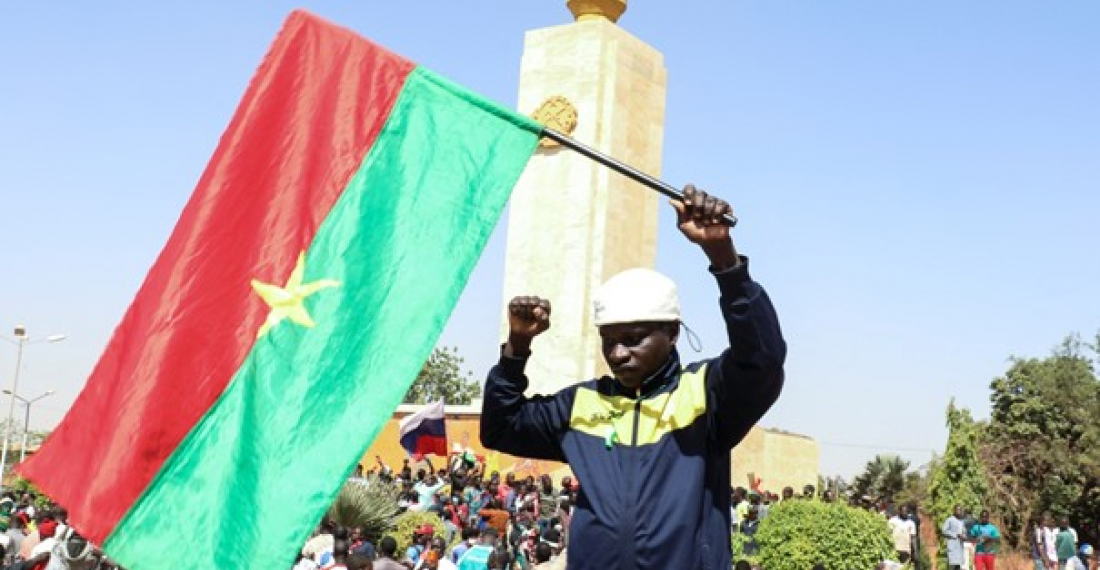
The transitional military leadership in Burkina Faso has appointed Albert Ouédraogo, 53, as Prime Minister of the Sahel country.
Although many contenders for the post had a greater name recognition, it was finally Ouédraogo, a relative newcomer, who was chosen by Lieutenant Colonel Paul-Henri Damiba - the transitional president, to manage the three-year democratic transition which is supposed to see a return to civilian government and constitutional order in Burkina Faso.
As the head of a consulting firm named IPSO and a Professor of accounting at the University of Ouagadougou before his appointment, his profile is considered more technical than political. He thus contrasts drastically with the profiles of the two previous Prime Ministers – Christophe Dabiré and Lassina Zerbo - both of whom are considered part of the country's political elite.
In a statement published on the 3rd of March, the interim President pledged his confidence in the new Prime Minister, who he said had a « solid experience in the field of public administration management, development projects and private companies ».
The appointment of the 25 members of the interim government and the profiles of the 71 MPs will be scrutinised by the local and international media as a first indication of the political orientation of the new military junta.
According to the magazine Jeune Afrique, among the 71 deputies, sixteen will be from the army, thirteen from civil society and eight seats will be reserved for members of political parties.
This distribution seems to signal a desire to move away from the previous political elite and instead include military and civil society professionals within government circles. The new Prime Minister, Albert Ouédraogo, considered close to Pierre Claver Damiba, the former President of the West African Development Bank and uncle of the current head of the military junta, Paul-Henri Damiba, illustrates this new approach.
The new orientation that does not appeal to the sitting politicians, such as Boubacar Sannou, Vice-President of the Congress for Democracy and Progress, former President Blaise Compaoré's party, who admits to having "the impression that politicians are not welcome in this transition".
After the coup of 24 January 2022 - the fourth in West Africa in less than 18 months - the leader of the rebellion Paul-Henri Damiba signed a charter guaranteeing elections in 36 months.
Once a region that had a reputation as the continent's "coup belt”, West Africa has been weakened by the numerous attacks perpetrated by armed militants linked to Al-Qaeda and the Islamic State who have killed more than 2,000 people and caused the displacement of more than 1.5 million citizens in the past seven years.
The appointment of the new prime minister is further evidence of the current government's desire to distance itself from the local police elite, with public opinion seemingly supporting this move on social media, judging that since the political parties have failed to ensure the security of Burkinabes, it is time to trust the military junta to try to do so.
However observers note that if future government appointments follow the same apolitical path, it will be worth watching to ensure that this imbalance between military and politicians does not weaken the junta's commitment to the transition and does not constitute a new democratic drift.