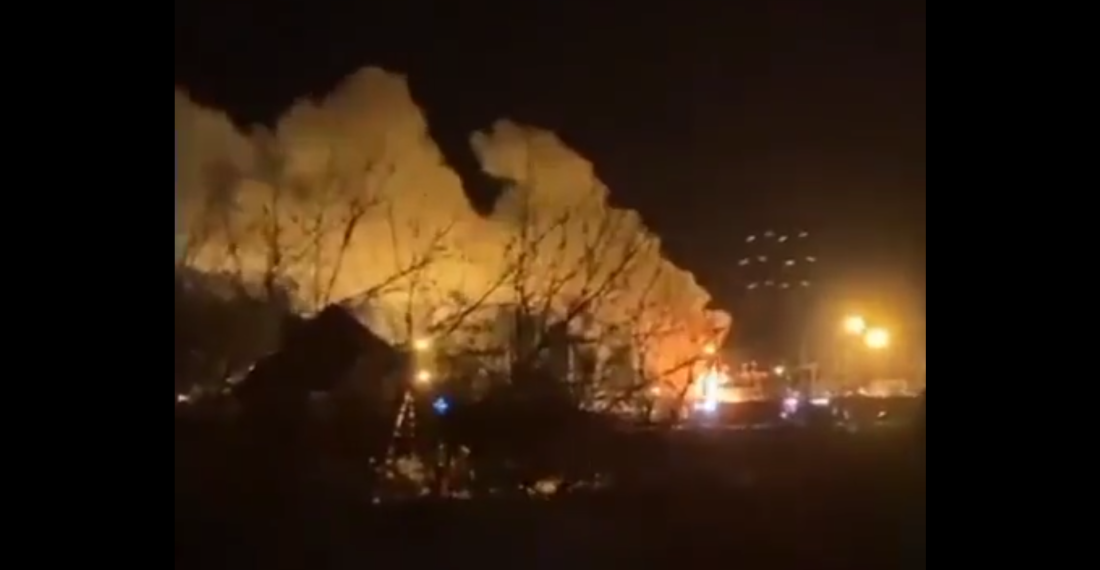
Blackouts in Russian city of Belgorod after suspected Ukrainian drone strikes

Various media are reporting that Ukraine has launched a drone strike on power stations in the Russian city of Belgorod and the surrounding area overnight on Monday (17 April). Neither Ukraine nor Russia has officially confirmed the strikes.

Shortly after the strikes local Telegram channels reported problems with electricity supply in parts of the city.

The regional governor Vyacheslav Gladkov confirmed that "two fires were recorded at civilian facilities" in Belgorod and Belgorod district, but stopped short of specifying exactly what caused the fires.

In the past, suspected Ukrainian strikes inside Russian territory have rarely, if ever, been admitted as such by Russian authorities. 

"There are no casualties. All emergency services are on site, the fire is being put out," Gladkov said.

Drone sightings and explosions in Russian border regions

Recently there has been an increase in reports of drone sightings and explosions in Russian regions bordering Ukraine, including in Belgorod Oblast.

Last week on Monday (10 April), a UAV carrying an explosive device fell on an airfield in Belgorod, damaging a fence and signal cable.

Over the winter, Russia launched months of attacks across critical civilian infrastructure, including power stations, across the whole of Ukraine in an apparent attempt to deprive Ukrainians of electricity during the colder months, and to demoralise them into submission.

Last night's strike suspected Ukainian strike in Belgorod, which is a major electric powered railway logistics hub for the Russia, could be a test "to see how long it takes Russia to repair the substation, plus listen to Russian cellphone communications related to it for cues as to Russia's electrical supply chain", according to U.S. analyst Trent Telenko.

Ukraine counteroffensive to begin in "near future"

Following reports that increasing amounts of western-donated military hardware are arriving in Ukraine, the Ukrainian Prime Minister Denis Shmyhal said in Washington D.C. on Friday (14 April) that their much-anticipated counteroffensive "will take place in the near future".

"We are aiming to implement all our plans and achieve our victory," Shmyhal said.

source: commonspace.eu with agencies
photo: Twitter

Related articles

Editor's choice
News
European leaders set out their plan for Ukraine

European leaders set out their plan for Ukraine

The leaders of Germany, Denmark, Finland, France, Italy, Netherlands, Norway, Poland, Sweden, and United Kingdom, together with the President of the European Council, and the President of the European Commission, o  Monday (15 December) issued a statement, outlining their plan for Ukraine. In their statement, Chancellor Merz, Prime Minister Frederiksen, President Stubb, President Macron, Prime Minister Meloni, Prime Minister Schoof, Prime Minister Støre, Prime Minister Tusk, Prime Minister Kristersson, Prime Minister Starmer, as well as President Costa and President von der Leyen spoke about "Peace for Ukraine". The Leaders welcomed significant progress on President Trump’s efforts to secure a just and lasting peace in Ukraine. They also welcomed the close work between President Zelenskyy’s and President Trump’s teams as well as European teams over the recent days and weeks. They agreed to work together with President Trump and President Zelenskyy to get to a lasting peace which preserves Ukrainian sovereignty and European security. Leaders appreciated the strong convergence between the United States, Ukraine and Europe. Leaders agreed that ensuring the security, sovereignty, and prosperity of Ukraine was integral for wider Euro-Atlantic security. They were clear that Ukraine and its people deserved a prosperous, independent, and sovereign future, free from fear of future Russian aggression. Both the US and European leaders committed to work together to provide robust security guarantees and economic recovery support measures for Ukraine in the context of an agreement on ending the war. This would include commitments to: Provide sustained and significant support to Ukraine to build its armed forces, which should remain at a peacetime level of 800,000 to be able to deter conflict and defend Ukraine’s territory. A European-led ‘multinational force Ukraine’ made up from contributions from willing nations within the framework of the Coalition of the Willing and supported by the US. It will assist in the regeneration of Ukraine’s forces, in securing Ukraine’s skies, and in supporting safer seas, including through operating inside Ukraine. (Click the image to read the statement in full).

Popular