


Azerbaijani Defence Minister convenes meeting of senior military officials to discuss combat readiness

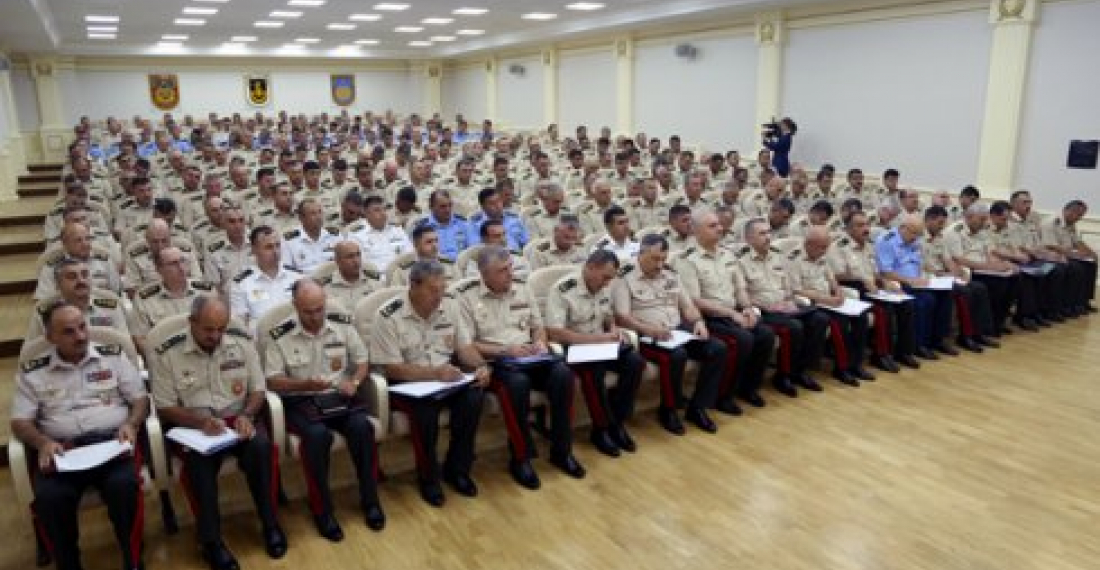
Azerbaijan's Defence Minister, General Zakir Hasanov on Tuesday (30 August) chaired an enlarged meeting of the Azerbaijani Defence Ministry to discuss the combat readiness of the country's armed forces.

According to a report on the website of the Azerbaijani Ministry of Defence the meeting was attended by deputy defence ministers, commanders of military formations and corps, heads of main departments, departments and services of the ministry, chiefs of staff and other senior officials.

According to the report "the defence minister gave officials further instructions on strengthening the front line defence in areas liberated in the April clashes" as well as a number of logistical and personnel issues.

Commonspace.eu political editor said that "the few hundred hectares of land that were retaken by Azerbaijan during the intensified fighting on the line of contact in the Karabakh conflict zone in April have become of huge psychological importance for both the Armenians and the Azerbaijanis and there is clearly concern in Baku that the Armenians may launch an operation to regain this territory. If this were to happen it is likely fighting will quickly spread to other areas. Over the last few weeks the situation on the line of contact has been reasonably calm as both sides respond to efforts by Russia to move the peace process forward, but only the most optimistic think that this situation can last, unless there is a breakthrough in the negotiations".

source: commonspace.eu

photos 1 and 2: An enlarged meeting of the Azerbaijani Ministry of Defence Collegium held in Baku on 30 August 2016 (picture courtesy of the press service of the Minisrty of Defence of Azerbaijan).
 

Related articles

Editor's choice
News
The great American love-in in the South Caucasus has ended

The great American love-in in the South Caucasus has ended

US Vice President J.D, Vance has ended his whirlwind visit to the South Caucasus having been in Armenia on Monday (9th February), and Azerbaijan on Tuesday (10th February). It was a big success. Vance was on his best behavior, and went out of his way to be nice and complimentary to his hosts. In Yerevan, the Vice President and Armenia’s Prime Minister Nikol Pashinyan signed a joint statement on the completion of negotiations on a 123 Agreement, which establishes a legally binding framework for peaceful nuclear cooperation between the U.S. and partner countries. While in Azerbaijan, Vance and Azerbaijani President Ilham Aliyev signed a Strategic Partnership Charter between the U.S. and Azerbaijan that covers regional connectivity, economic investment, and security and defense issues.  The guests were happy, and the hosts were delighted. Now it is time to put what was agreed in practice. That will be more challenging.

Popular

Editor's choice
Interview
Thursday Interview: Murad Muradov

Thursday Interview: Murad Muradov

Today, commonspace.eu starts a new regular weekly series. THURSDAY INTERVIEW, conducted by Lauri Nikulainen, will host  persons who are thinkers, opinion shapers, and implementors in their countries and spheres. We start the series with an interview with Murad Muradov, a leading person in Azerbaijan's think tank community. He is also the first co-chair of the Action Committee for a new Armenian-Azerbaijani Dialogue. Last September he made history by being the first Azerbaijani civil society activist to visit Armenia after the 44 day war, and the start of the peace process. Speaking about this visit Murad Muradov said: "My experience was largely positive. My negative expectations luckily didn’t play out. The discussions were respectful, the panel format bringing together experts from Armenia, Azerbaijan, and Turkey was particularly valuable during the NATO Rose-Roth Seminar in Yerevan, and media coverage, while varied in tone, remained largely constructive. Some media outlets though attempted to represent me as more of a government mouthpiece than an independent expert, which was totally misleading.  Overall, I see these initiatives as important steps in rebuilding trust and normalising professional engagement. The fact that soon a larger Azerbaijani civil society visits to Armenia followed, reinforces the sense that this process is moving in the right direction." (click the image to read the interview in full)

