Azerbaijan hosts Syrian-Israeli ministerial meeting to discuss security situation in Southern Syria

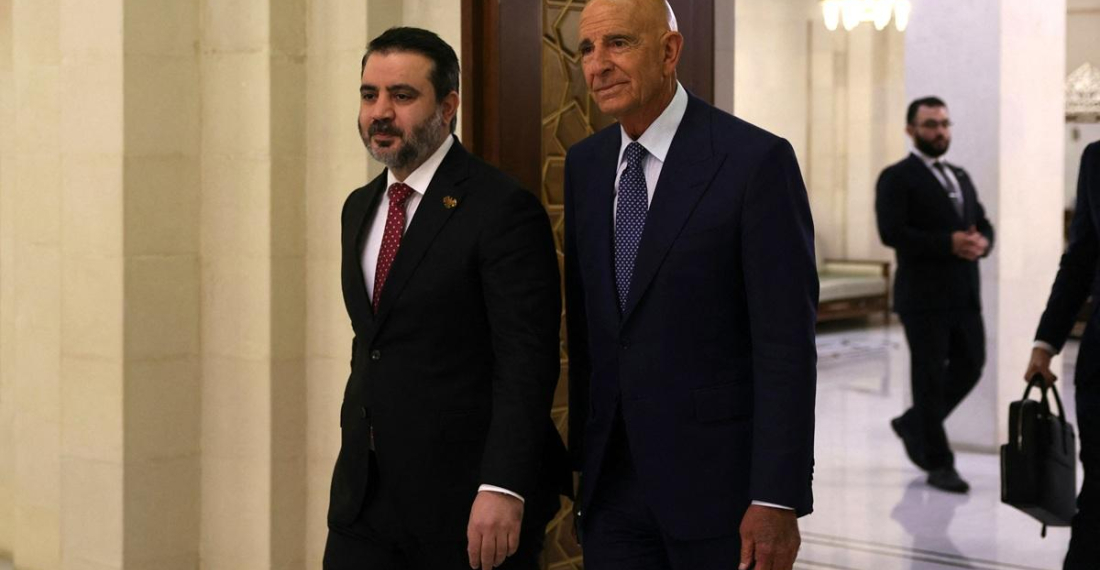
A Syrian-Israeli ministerial meeting is taking place place on Thursday 31 July in Baku to discuss security matters in southern Syria, a diplomat told AFP. The meeting between Syrian Foreign Minister Asaad al-Shaibani and Israeli Minister of Strategic Affairs Ron Dermer follows a similar meeting between the two ministers in Paris last week. It will take place after an unprecedented visit by al-Shaibani to Moscow on Thursday, added the diplomat, who requested anonymity due to the sensitivity of the matter. Israel and Syria have technically been at war since 1948. 

The Paris meeting focused mainly on "recent security developments and attempts to contain the escalation in southern Syria", according to Syrian state television. It came after deadly clashes in southern Syria's Druze-majority Sweida province which killed over 1400 people, according to the Syrian Observatory for Human Rights monitor.

The clashes initially pitted local Druze fighters against Sunni Bedouin tribes but soon saw the involvement of Syrian government forces and Israel, with the latter saying it wanted to protect the Druze.

Israel struck the Syrian presidential palace and the army headquarters in Damascus. The United States, an ally of Israel who has also expressed support for Syria's authorities, announced a ceasefire between the two sides overnight on July 18.

Before the violence in Sweida, Syrian and Israeli officials had met in Baku on July 12. Israel has occupied Syria's Golan Heights since 1967, annexing it in 1981 in a move not recognised by the international community.

The two signed a disengagement agreement a year after the 1973 war, establishing a UN-patrolled buffer zone between Syria and the occupied Golan Heights. Since the fall of longtime Syrian ruler Bashar al-Assad in December, Israel deployed its troops to the buffer zone and has carried out hundreds of strikes on Syria.

Meanwhile, Russia announced on Wednesday that Syria’s foreign minister will visit Moscow, the first official visit to Russia by an official in the new government in Damascus since former Syrian President Bashar Assad was ousted in a rebel offensive last year.

Russian Foreign Ministry spokesperson Maria Zakharova told the state news agency Tass that Foreign Minister Sergey Lavrov will host his Syrian counterpart, Asaad Al-Shibani, for talks in Moscow on Thursday. The two will discuss bilateral ties, as well as “international and regional issues,” the statement said.

There was no statement from Syria on the visit. Assad was an ally of Russia, and Moscow’s scorched-earth intervention in support of him a decade ago turned the tide of Syria’s civil war, helping to keep Assad in his seat for years. However, when insurgent groups launched a new offensive last year, Russia did not intervene again to save Assad.

Instead, Assad took refuge in Russia after his ouster. The former president later claimed in a statement posted on Facebook that he had wanted to stay in the country and continue fighting but that the Russians had pulled him out.

He said that he left Damascus for Russia’s Hmeimim air base in the coastal province of Latakia on the morning of Dec. 8, hours after insurgents stormed the capital. He hadn’t planned to flee, but the Russians evacuated him to Russia after the base came under attack.

Despite having been on opposite sides of the battle lines during the civil war, the new rulers in Damascus, headed by interim President Ahmad Al-Sharaa, have taken a pragmatic approach to relations with Moscow.

A Russian delegation visited Damascus in January, and the following month, Russia’s President Vladimir Putin had a call with Al-Sharaa that the Kremlin described as “constructive and business-like.” Some Russian forces have remained on the Syrian coast, and Russia has reportedly sent oil shipments to Syria.

Al-Sharaa publicly thanked Russia for its “strong position in rejecting Israeli strikes and repeated violations of Syrian sovereignty” after Israel intervened in clashes between Syrian government forces and armed groups from the Druze religious minority earlier this month.

Source: commonspace.eu with AFP, Arab News and agencies. Photo: Syrian Foreign Minister Asaad al-Shaibani (L) accompanies US Special Envoy to Syria Thomas Barrack, to meet the president in Damascus on July 9, 2025 - AFP.

Related articles

Editor's choice
News
Borrell tells the European Parliament that the situation in Afghanistan was critical, but the EU will remain engaged

Borrell tells the European Parliament that the situation in Afghanistan was critical, but the EU will remain engaged

Borrell underlined that the European Union will make every effort to support the peace process and to remain a committed partner to the Afghan people. "Of course, we will have to take into account the evolving situation, but disengagement is not an option.  We are clear on that: there is no alternative to a negotiated political settlement, through inclusive peace talks.
Editor's choice
News
NATO Chief says war is on Europe's doorstep, and warns against complacency

NATO Chief says war is on Europe's doorstep, and warns against complacency

Russia could attack a Nato country within the next five years, the Secretary General of NATO, Mark Rutte, said in a stark new warning. "Nato's own defences can hold for now," Rutte warned in Berlin, but conflict was "next door" to Europe and he feared "too many are quietly complacent, and too many don't feel the urgency, too many believe that time is on our side. "Russia is already escalating its covert campaign against our societies," Rutte said in a speech in Germany. "We must be prepared for the scale of war our grandparents or great-grandparents endured." Earlier this month, Russia's President Vladimir Putin said his country was not planning to go to war with Europe, but it was ready "right now" if Europe wanted to - or started a war. But similar reassurances were given by Moscow in 2022, just before 200,000 Russian troops crossed the border and invaded Ukraine. Putin has accused European countries of hindering US efforts to bring peace in Ukraine - a reference to the role Ukraine's European allies have recently played in trying to change a US peace plan to end the war, whose initial draft was seen as favouring Russia. But Putin was not sincere, Nato's secretary-general said in the German capital, Berlin. Supporting Ukraine, he added, was a guarantee for European security. "Just imagine if Putin got his way; Ukraine under the boot of Russian occupation, his forces pressing against a longer border with Nato, and the significantly increased risk of an armed attack against us." Russia's economy has been on a war footing for more than three years now - its factories churn out ever more supplies of drones, missiles and artillery shells. According to a recent report by the Kiel Institute for the World Economy, Russia has been producing each month around 150 tanks, 550 infantry fighting vehicles, 120 Lancet drones and more than 50 artillery pieces. The UK, and most of its Western allies, are simply not anywhere near this point. Analysts say it would take years for Western Europe's factories to come close to matching Russia's mass-production of weapons. "Allied defence spending and production must rise rapidly, our armed forces must have what they need to keep us safe," the Nato chief said.

Popular

Editor's choice
News
NATO Chief says war is on Europe's doorstep, and warns against complacency

NATO Chief says war is on Europe's doorstep, and warns against complacency

Russia could attack a Nato country within the next five years, the Secretary General of NATO, Mark Rutte, said in a stark new warning. "Nato's own defences can hold for now," Rutte warned in Berlin, but conflict was "next door" to Europe and he feared "too many are quietly complacent, and too many don't feel the urgency, too many believe that time is on our side. "Russia is already escalating its covert campaign against our societies," Rutte said in a speech in Germany. "We must be prepared for the scale of war our grandparents or great-grandparents endured." Earlier this month, Russia's President Vladimir Putin said his country was not planning to go to war with Europe, but it was ready "right now" if Europe wanted to - or started a war. But similar reassurances were given by Moscow in 2022, just before 200,000 Russian troops crossed the border and invaded Ukraine. Putin has accused European countries of hindering US efforts to bring peace in Ukraine - a reference to the role Ukraine's European allies have recently played in trying to change a US peace plan to end the war, whose initial draft was seen as favouring Russia. But Putin was not sincere, Nato's secretary-general said in the German capital, Berlin. Supporting Ukraine, he added, was a guarantee for European security. "Just imagine if Putin got his way; Ukraine under the boot of Russian occupation, his forces pressing against a longer border with Nato, and the significantly increased risk of an armed attack against us." Russia's economy has been on a war footing for more than three years now - its factories churn out ever more supplies of drones, missiles and artillery shells. According to a recent report by the Kiel Institute for the World Economy, Russia has been producing each month around 150 tanks, 550 infantry fighting vehicles, 120 Lancet drones and more than 50 artillery pieces. The UK, and most of its Western allies, are simply not anywhere near this point. Analysts say it would take years for Western Europe's factories to come close to matching Russia's mass-production of weapons. "Allied defence spending and production must rise rapidly, our armed forces must have what they need to keep us safe," the Nato chief said.