Azerbaijan and China sign Comprehensive Strategic Partnership

China and Azerbaijan have announced the establishment of a comprehensive strategic partnership between the two countries following talks between Chinese President Xi Jinping and Azerbaijani President Ilham Aliyev in Beijing on 23 April. During the talks, President Xi said that both sides should continuously enhance political mutual trust, deepen practical cooperation and strengthen international collaboration to open a new chapter of all-round cooperation. President Aliyev was in China for  a state visit between 22 and 24 April.

According to the Xinhua News Agency, President Xi added that China supports Azerbaijan in safeguarding its national sovereignty, independence and territorial integrity, and in continuing to follow a development path that suits its national conditions. China is willing to carry out in-depth law enforcement and security cooperation with Azerbaijan to resolutely combat the "three evil forces" of terrorism, extremism and separatism, Xi said.

He called on both sides to strengthen the alignment of development strategies, promote high-quality Belt and Road cooperation, and encourage educational, cultural, tourism, youth and sub-national cooperation.

President Aliyev said Azerbaijan and China have always respected and trusted each other in the face of changes unseen in a century, with bilateral cooperation continuously deepened, economic and trade relations developing rapidly, and local exchanges becoming closer.

According to Xinhua, Aliyev said Azerbaijan stands ready to work with China to promote the building of a comprehensive strategic partnership, expand cooperation concerning the Belt and Road Initiative, digital economy, green energy and science and technology, deepen exchanges between political parties and people of the two countries, and strengthen cooperation in international and regional affairs.

After the talks, the two heads of state signed a joint statement on establishing a comprehensive strategic partnership between the two countries, and witnessed the signing of 20 documents on cooperation in areas such as the Belt and Road Initiative, justice, green development, digital economy, intellectual property rights and aerospace.


China and Azerbaijan also signed an agreement on mutual visa exemptions for ordinary passport holders in both countries, according to the Chinese Foreign Ministry. The move comes as China has been continuously expanding visa exemptions for a growing number of countries. 

During the talks with Aliyev, Xi said China is willing to work with Azerbaijan to safeguard the international system with the United Nations at its core and the international order based on international law, firmly protect respective legitimate rights and interests, and defend international fairness and justice.

Previously on April 11 when meeting with Spanish Prime Minister Pedro Sanchez in Beijing, President Xi also said that there is no winner in a tariff war, and going against the world will only result in self-isolation, according to Xinhua. 
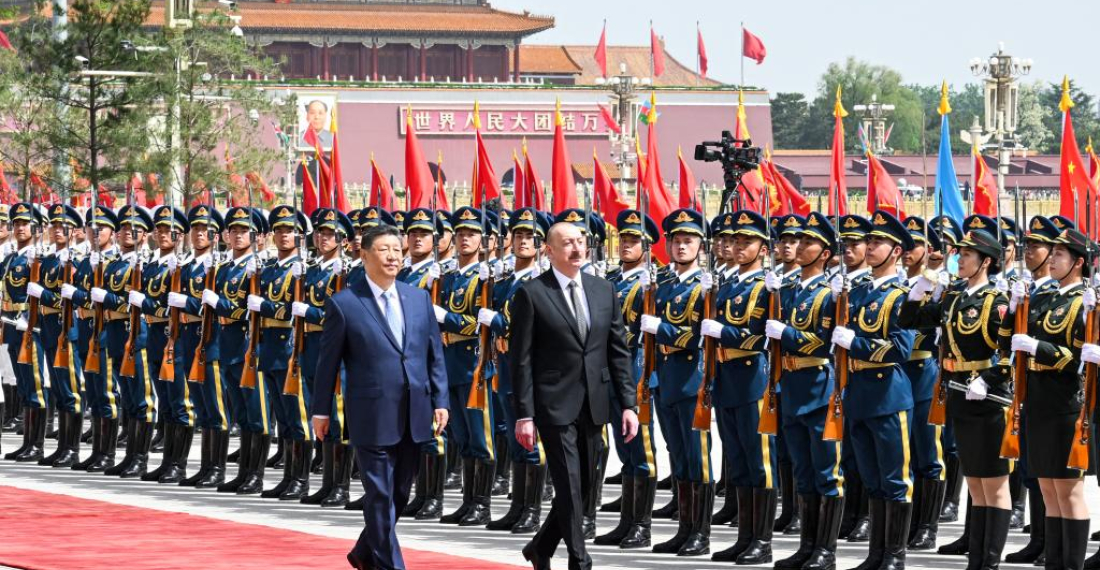
Source: commonspace.eu with agencies. Photo: Chinese President Xi Jinping holds a welcome ceremony for Azerbaijani President Ilham Aliyev at the square outside the east gate of the Great Hall of the People prior to their talks in Beijing, capital of China, April 23, 2025.  (Xinhua/Rao Aimin)

Related articles

Editor's choice
News
Borrell tells the European Parliament that the situation in Afghanistan was critical, but the EU will remain engaged

Borrell tells the European Parliament that the situation in Afghanistan was critical, but the EU will remain engaged

Borrell underlined that the European Union will make every effort to support the peace process and to remain a committed partner to the Afghan people. "Of course, we will have to take into account the evolving situation, but disengagement is not an option.  We are clear on that: there is no alternative to a negotiated political settlement, through inclusive peace talks.
Editor's choice
News
Germany accuses Russia of cyberattacks and disinformation campaign

Germany accuses Russia of cyberattacks and disinformation campaign

The German government holds Russia responsible for a cyberattack on German air traffic control, and for targeted disinformation campaigns before the last federal election. According to the German Foreign Office in Berlin, the incidents could be clearly attributed to the Russian military intelligence service, the GRU. In response, the Russian ambassador to Berlin was summoned to the Foreign Ministry. "We have been observing a massive increase in threatening hybrid activities by Russia for some time now," a spokesperson for the Foreign Ministry stated. These range from disinformation campaigns and espionage to cyberattacks and sabotage attempts. The aim is to divide society, sow distrust, and undermine confidence in democratic institutions. The spokesperson added that with these actions, Russia is "very concretely threatening our security, not only through its war of aggression against Ukraine, but also here in Germany."  The Foreign Ministry spokesperson explained that the cyberattack on air traffic control in August 2024 was clearly attributed to the hacker collective "APT28," known as "Fancy Bear," and to the responsibility of the Russian military intelligence service, the GRU. Furthermore, it could now be "conclusively stated" that Russia had attempted "to influence and destabilize both the last Federal election and the ongoing internal affairs of the Federal Republic of Germany." There was "absolutely irrefutable evidence" for this". The so-called "Storm 1516" campaign, which has been running since 2024, is allegedly backed by "reliable information" that the Moscow-based think tank "Center for Geopolitical Expertise" is behind it. The Center is also said to be supported by Russian military intelligence. Its primary aim is to influence democratic elections in the West. (Click the image to read more).

Popular

Editor's choice
News
Germany accuses Russia of cyberattacks and disinformation campaign

Germany accuses Russia of cyberattacks and disinformation campaign

The German government holds Russia responsible for a cyberattack on German air traffic control, and for targeted disinformation campaigns before the last federal election. According to the German Foreign Office in Berlin, the incidents could be clearly attributed to the Russian military intelligence service, the GRU. In response, the Russian ambassador to Berlin was summoned to the Foreign Ministry. "We have been observing a massive increase in threatening hybrid activities by Russia for some time now," a spokesperson for the Foreign Ministry stated. These range from disinformation campaigns and espionage to cyberattacks and sabotage attempts. The aim is to divide society, sow distrust, and undermine confidence in democratic institutions. The spokesperson added that with these actions, Russia is "very concretely threatening our security, not only through its war of aggression against Ukraine, but also here in Germany."  The Foreign Ministry spokesperson explained that the cyberattack on air traffic control in August 2024 was clearly attributed to the hacker collective "APT28," known as "Fancy Bear," and to the responsibility of the Russian military intelligence service, the GRU. Furthermore, it could now be "conclusively stated" that Russia had attempted "to influence and destabilize both the last Federal election and the ongoing internal affairs of the Federal Republic of Germany." There was "absolutely irrefutable evidence" for this". The so-called "Storm 1516" campaign, which has been running since 2024, is allegedly backed by "reliable information" that the Moscow-based think tank "Center for Geopolitical Expertise" is behind it. The Center is also said to be supported by Russian military intelligence. Its primary aim is to influence democratic elections in the West. (Click the image to read more).