


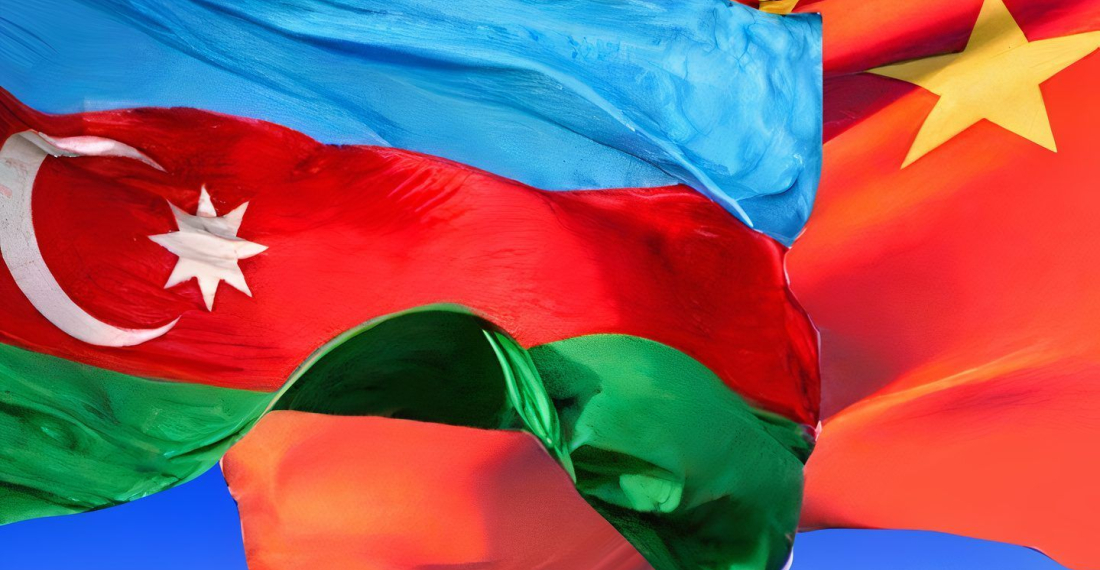
Azerbaijan and China Forge Defence Ties

At the 12th Beijing Xiangshan Forum, which was held from Wednesday to Friday (17 - 19  September), Azerbaijan’s Defence Minister, Colonel-General Zakir Hasanov, led Baku’s delegation and held high-level discussions with his Chinese counterpart on advancing joint military capabilities.

According to Azerbaijani journalist Seymur Mammadov, for Azerbaijan, the attraction of China lies not only in its growing economic power, but in its promise of defence technologies and political non-interference. He argues that sanctions, political conditions, and capacity limits constrain many Western suppliers while Russia, which was once the primary provider of military hardware to Baku, remains under international pressure and is increasingly focused on its own internal industrial demands. In this environment, Mammadov claims that China presents itself as a partner capable of offering advanced systems, unmanned aerial platforms, long-range rocket artillery, and electronic warfare systems, without the strings typically attached by Western states.

This evolving defence cooperation is no longer at the level of political rhetoric. In 2024, Baku and Beijing signed a Declaration on Strategic Partnership that explicitly includes defence and security cooperation. April 2025 saw further steps: during the “Towards a New World Order” forum, President Ilham Aliyev underlined Azerbaijan’s intent to modernise its forces with Chinese help. More tangibly, in February 2025, Azerbaijan’s state arms manufacturer Azersilah entered a deal with China’s Norinco at the IDEX defence expo in Abu Dhabi. This agreement could presage more extensive procurement and potential co-production of military hardware. Talks are underway on joint manufacturing facilities, giving Baku not only weapons but the capacity to manufacture, upgrade and perhaps export military systems.

Azerbaijan has also engaged with several leading Chinese defence industries, including Poly Technologies and China Electronics Technology Corporation (CETC), in discussions around radar, electronic warfare, UAVs and other force modernisation tools. While public announcements are limited, these ongoing contacts suggest the substance of cooperation is growing fast.

From China’s standpoint, strengthening military-technical links in the South Caucasus complements its broader Belt and Road ambitions, expanding its influence into corridors that connect Asia and Europe. Azerbaijan’s geographic location makes it a strategic node in transport, energy, infrastructure and now defence capabilities, China can embed without overt political interference.
Source: commonspace.eu with the Caspian Post and other agencies

Related articles

Editor's choice
News
Borrell tells the European Parliament that the situation in Afghanistan was critical, but the EU will remain engaged

Borrell tells the European Parliament that the situation in Afghanistan was critical, but the EU will remain engaged

Borrell underlined that the European Union will make every effort to support the peace process and to remain a committed partner to the Afghan people. "Of course, we will have to take into account the evolving situation, but disengagement is not an option.  We are clear on that: there is no alternative to a negotiated political settlement, through inclusive peace talks.
Editor's choice
News
NATO Chief says war is on Europe's doorstep, and warns against complacency

NATO Chief says war is on Europe's doorstep, and warns against complacency

Russia could attack a Nato country within the next five years, the Secretary General of NATO, Mark Rutte, said in a stark new warning. "Nato's own defences can hold for now," Rutte warned in Berlin, but conflict was "next door" to Europe and he feared "too many are quietly complacent, and too many don't feel the urgency, too many believe that time is on our side. "Russia is already escalating its covert campaign against our societies," Rutte said in a speech in Germany. "We must be prepared for the scale of war our grandparents or great-grandparents endured." Earlier this month, Russia's President Vladimir Putin said his country was not planning to go to war with Europe, but it was ready "right now" if Europe wanted to - or started a war. But similar reassurances were given by Moscow in 2022, just before 200,000 Russian troops crossed the border and invaded Ukraine. Putin has accused European countries of hindering US efforts to bring peace in Ukraine - a reference to the role Ukraine's European allies have recently played in trying to change a US peace plan to end the war, whose initial draft was seen as favouring Russia. But Putin was not sincere, Nato's secretary-general said in the German capital, Berlin. Supporting Ukraine, he added, was a guarantee for European security. "Just imagine if Putin got his way; Ukraine under the boot of Russian occupation, his forces pressing against a longer border with Nato, and the significantly increased risk of an armed attack against us." Russia's economy has been on a war footing for more than three years now - its factories churn out ever more supplies of drones, missiles and artillery shells. According to a recent report by the Kiel Institute for the World Economy, Russia has been producing each month around 150 tanks, 550 infantry fighting vehicles, 120 Lancet drones and more than 50 artillery pieces. The UK, and most of its Western allies, are simply not anywhere near this point. Analysts say it would take years for Western Europe's factories to come close to matching Russia's mass-production of weapons. "Allied defence spending and production must rise rapidly, our armed forces must have what they need to keep us safe," the Nato chief said.

Popular

Editor's choice
News
NATO Chief says war is on Europe's doorstep, and warns against complacency

NATO Chief says war is on Europe's doorstep, and warns against complacency

Russia could attack a Nato country within the next five years, the Secretary General of NATO, Mark Rutte, said in a stark new warning. "Nato's own defences can hold for now," Rutte warned in Berlin, but conflict was "next door" to Europe and he feared "too many are quietly complacent, and too many don't feel the urgency, too many believe that time is on our side. "Russia is already escalating its covert campaign against our societies," Rutte said in a speech in Germany. "We must be prepared for the scale of war our grandparents or great-grandparents endured." Earlier this month, Russia's President Vladimir Putin said his country was not planning to go to war with Europe, but it was ready "right now" if Europe wanted to - or started a war. But similar reassurances were given by Moscow in 2022, just before 200,000 Russian troops crossed the border and invaded Ukraine. Putin has accused European countries of hindering US efforts to bring peace in Ukraine - a reference to the role Ukraine's European allies have recently played in trying to change a US peace plan to end the war, whose initial draft was seen as favouring Russia. But Putin was not sincere, Nato's secretary-general said in the German capital, Berlin. Supporting Ukraine, he added, was a guarantee for European security. "Just imagine if Putin got his way; Ukraine under the boot of Russian occupation, his forces pressing against a longer border with Nato, and the significantly increased risk of an armed attack against us." Russia's economy has been on a war footing for more than three years now - its factories churn out ever more supplies of drones, missiles and artillery shells. According to a recent report by the Kiel Institute for the World Economy, Russia has been producing each month around 150 tanks, 550 infantry fighting vehicles, 120 Lancet drones and more than 50 artillery pieces. The UK, and most of its Western allies, are simply not anywhere near this point. Analysts say it would take years for Western Europe's factories to come close to matching Russia's mass-production of weapons. "Allied defence spending and production must rise rapidly, our armed forces must have what they need to keep us safe," the Nato chief said.

