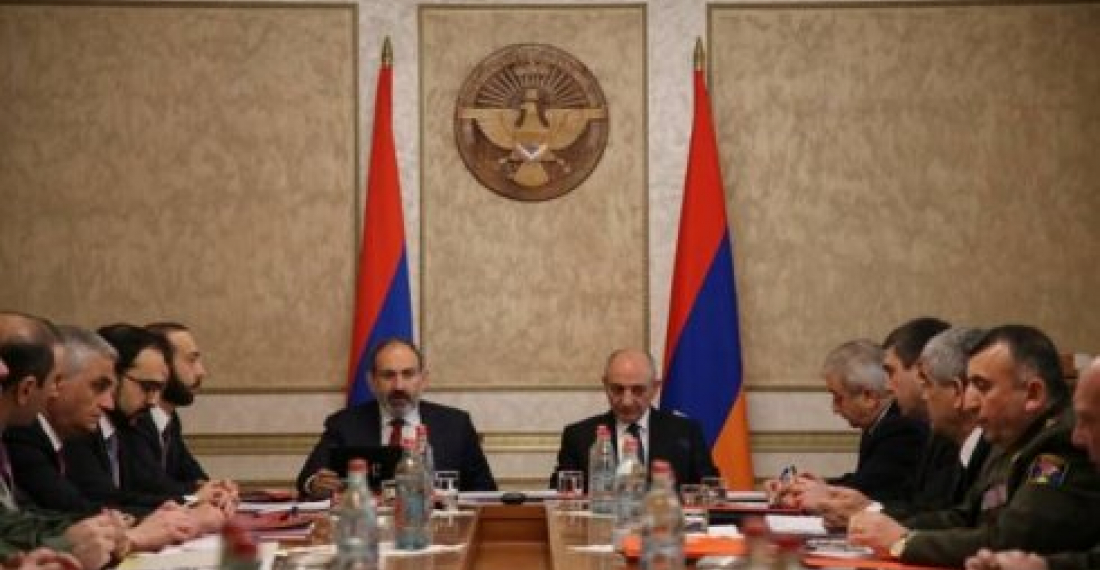
Armenian prime minister Nikol Pashinyan has pushed through his vision for a solution to the Nagorno-Karabakh conflict, convening in Stepanakert on Tuesday (11 March) a joint meeting between the National Security Council of Armenia and of security council of the self-declared Nagorno-Karabakh Republic. The meeting provided an unprecedented opportunity for the Armenian political and security elites to compare notes and present a united front following weeks of internal speculation, and confusion in the international community as to what Armenia's immediate objectives were.
The meeting opened with remarks by prime minister Pashinyan and NKR president Bako Sahakian.The semi official Armenpress news agency carried the following text of Pashinyan's speech:
"Allow me to welcome the joint session of the security councils of the Republic of Armenia and the Republic of Artsakh, which is an unprecedented event during the entire period of existence of our republics. This event has a very symbolic and on the other hand very concrete reason. This means that the relations between Armenia and Artsakh are entering a new qualitative phase. As to what other manifestations this phase can have in the future is perhaps among the important topic of our today's discussion", Pashinyan said.
This is my first visit to Artsakh after the 2018 December 9 parliamentary election in Armenia, and I would like to emphasize that the My Step Alliance has received a strong mandate from the people in the parliamentary election for increasing the level of the topic matter of the Republic of Artsakh and making steps aimed at the involvement of Artsakh, as the main party to the conflict, in the NK conflict settlement process. These are points that had a key significance in the My Step Alliance's campaigning message.
The Government of Armenia and myself, as the prime minister who received the vote of confidence of the people, will therefore make coherent steps in this direction, and this issue remains one of the important points of our discussions with Azerbaijani President Ilham Aliyev and the OSCE Minsk Group Co-Chairs. I find it noteworthy that Artsakh's involvement in the negotiations process isn't a whim for us, and not even a precondition, it is a simple recording of a fact that Artsakh's involvement has key importance in the settlement of the NK conflict.
This stance expresses our respect not only to Artsakh's people and their rights, but also to all our colleagues who participate in the negotiations process, because we are truly interested and are willing to reach an exclusively peaceful settlement of the issue and we have faith in the negotiations process, the efficiency of which is a highly important priority for us, while in terms of efficiency of the negotiations process this issue has key importance.
The circle of negotiations known up to this point, basically, involve all stakeholder parties except of one. Azerbaijan, in person of President Aliyev, is represented in these negotiations. The latter, by the way, is also representing as he himself likes to say the Azerbaijani community of Nagorno Karabakh, because the representatives of this community, being citizens of Azerbaijan, have voted in the Azerbaijani presidential election and therefore have given the President of Azerbaijan the authority to represent them, therefore the presence of the Azerbaijani president at the negotiations table also provides the presence of Azerbaijanis who have lived in Karabakh in the past.
The Republic of Armenia, in person of the Prime Minister, is also represented in these negotiations, who proceeds as a representative elected by the people of the Republic of Armenia in the given case. Therefore, the people of Armenia are also represented in the negotiations process.
The international community, in person of the OSCE Minsk Group Co-Chairmanship, is also represented in the negotiations process. This all, of course, is good and extremely important, and we highly appreciate the efforts that the OSCE Minsk Group Co-Chairing countries have contributed and continue contributing in the settlement process. But the main issue is the following - who is representing the people of Artsakh, like they say in certain cases the Armenians of Karabakh in the negotiations process?
The problem is that today there is no representative in the negotiations process to have the authority and legitimacy to represent the people of Artsakh, because no subject having the authority or vote of the people of Artsakh or, as some of our colleagues prefer to say, the Armenians of Karabakh, is present at the negotiations table.
I've numerously said that the Prime Minister of Armenia cannot implement such authority due to the simple fact that the people of Artsakh do not vote in elections in Armenia and thus the Prime Minister of Armenia isn't included in the circle of persons authorized to represent the people of Artsakh. And this isn't a matter of whim or precondition, this is a matter of simple legitimacy, and legitimacy is a key factor of modern relations, not only domestic but intergovernmental and international relations.
By the way, all the commentaries claiming that this way the Republic of Armenia or the Prime Minister is shaking off responsibility and placing it on the government or people of Artsakh are absurd. In order not to leave space for any manipulation I find it noteworthy to emphasize that the Republic of Armenia has been, is and will remain the number one guarantor of Artsakh's security and will continue its involvement in the peace process.
The next highly important question that requires an answer is the following - does the Government of Armenia accept the 3 principles and 6 elements of the OSCE Minsk Group Co-Chairs as a basis for negotiations process? This is truly a highly important question, but in response to this question we need important clarifications. And what might these principles mean practically, and who has the right to interpret them? This is important, because the way these principles Azerbaijan is interpreting is unacceptable for us. We certainly can proceed with our own interpretation of these principles, but this has no sense because our goal isn't an verbal altercation but efficient negotiations process. And therefore, records not giving way for misinterpretations should become basis of negotiations process. But the principles and elements proposed by the Co-Chairs, as I already mentioned, have caused the most various and most differing interpretations in the past 10 years, and therefore the clarification of the so-called main contradictions, the 3 principles and 6 elements, must be the important goal of the upcoming negotiations process, and we are ready for this kind of a talk also.
The next important issue is preparation of the populations for peace. I find it noteworthy to stress that preparing the populations for peace cannot be the individual problem of a given government involved in the talks, this is a joint work. I mean, for example, preparation of the Azerbaijani community for peace must take place not only with the participation of Azerbaijan, but also the Government of Armenia. This is the very realization that forced me in autumn of 2018 to make basically an unprecedented statement in our times from parliament floor, saying that any solution of the Karabakh issue must be acceptable for the populations of Armenia, of Artsakh and of Azerbaijan. This was my contribution in preparing for peace not only the populations of Armenia and Artsakh but also of Azerbaijan. Regretfully, we don't see adequate statements or steps by the Azerbaijani president. Despite this, I am ready to continue dialogue not only with the Azerbaijani president, but also the people of Azerbaijan, because I am sure that the people of Azerbaijan are as much peace-loving as the people of Armenia and the people of Artsakh", he said.
Commonspace.eu political editor said in a comment that Nikol Pashinyan is positioning himself ahead of the expected summit with the Azerbaijani president, which is likely to happen soon. It is interesting that he made it a point in the speech to emphasise his mandate as a result of his overwhelming parliamentary victory in December. This was a message to his many vocal critics who keep projecting Pashinyan as some kind of usurper.
Throughout the last year Pashinyan has projected two parallel arguments: the first that the leadership of the Karabakh Armenians need to be in the talks and have a defining say in any end game; the second that he was willing to take a new approach to the issue, including direct talks with his Azerbaijani counterpart, and explaining that for any deal to be successful it needs to be approved by what he sees are the three constituencies: Armenians,Azerbaijanis and Karabakh Armenians. In Baku they have not quite made up their mind whether Pashinyan is a statesman or a charlatan. They will be reading the speech in Stepanakert very carefully. Not surprisingly there will be different interpretations. In the end president Aliyev will have to decide if he can do business with Pashinyan, or whether to dismiss the whole thing as a charade.
source: commonspace.eu
photo: The security councils of Armenia and NKR held an unusual joint session in Stepanakert on 12 March 2019 (picture courtesy of Armenpress news agency, Yerevan)