


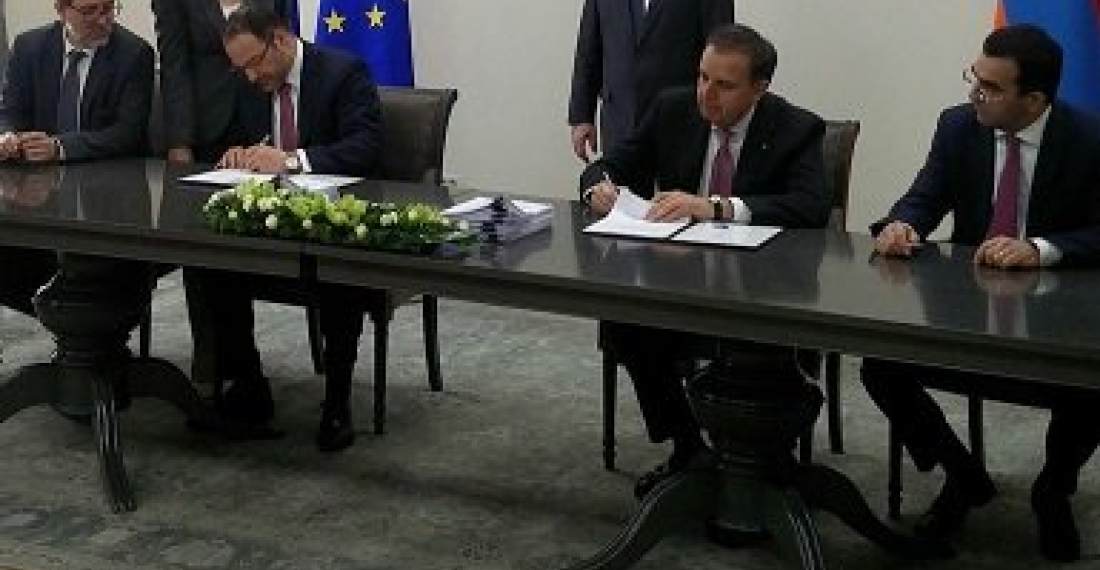
Armenia and EU initial "Comprehensive and Enhanced Partnership Agreement"

After four years of uncertaintly following Armenia's decision to abort at the last minute negotiations on an Association agreement with the EU the two sides now have a new framework of co-operation. The European Union and Armenia on Tuesday  (21 March) issued this joint statement:

On 21st of March at a ceremony held at the Ministry of Foreign Affairs in Yerevan, on behalf of the Republic of Armenia Chief negotiator Garen Nazarian, Deputy Foreign Minister and Trade lead negotiator Garegin Melkonian, First Deputy Minister of Economic Development and Investments and on behalf of the European Union (EU) Chief negotiator Luc Devigne, Deputy Managing Director in the European External Action Service and Trade lead negotiator Petros Sourmelis, Head of Unit in the European Commission, initialled the Armenia - EU Comprehensive and Enhanced Partnership Agreement (CEPA).

The Agreement will be an important step to broaden the scope of bilateral relations between Republic of Armenia and the European Union.

It will strengthen the political dialogue and set a solid basis for the continuation of economic and social reforms. Strong commitments to democracy, human rights, and the rule of law, underpin the new agreement and Armenia-EU future cooperation. The CEPA will also create the framework for stronger cooperation in sectors such as energy, transport and the environment, for new opportunities in trade and investments, and for increased mobility for the benefit of the citizens.

Relations between Armenia and the EU have seen a significant strengthening in recent years. The CEPA is a joint endeavour, which will further deepen their relations within the larger framework of the revised European Neighbourhood Policy and Eastern Partnership. The CEPA will offer EU and Armenia a platform to bring their relations to a new, higher level.

Sources close to the European Union told commonspace.eu that it will take some time before the agreement is signed, ratified by all the EU member states and starts to be implemented. 

source; commonspace.eu

photo: The initiallling of the new Armenia - EU Comprehensive and Enhanced Partnership Agreement at the Foreign Ministry in Yerevan on Tuesday 21 March 2017.

Related articles

Editor's choice
News
Aden under curfew, as problem in Yemen's south deepens

Aden under curfew, as problem in Yemen's south deepens

The port city of Aden, in Yemen's south, has been put under curfew, as the rift in the country between  the Saudi led coalition which  backs Yemen's presidential governing council, and the southern forces led by the Southern Transitional Council (STC), deepens. Abdul Rahman al-Mahrami, a member of the Yemeni Presidential Governing Council and commander of the al-Amalik brigades, has ordered a curfew in the temporary capital, Aden, "to maintain security". "A curfew has been imposed throughout Aden Governorate from 9:00 p.m. to 6:00 a.m., in accordance with the instructions of Commander Abdul Rahman al-Mahrami, a member of the Presidential Management Council," the statement said. It states that only security and military personnel, as well as medical and technical teams with approved permits, will be allowed to move in the area during these hours. Yemen's presidential council, which is backed by Saudi Arabia and which already is in a struggle with the Houthi Movement in the north of the country who also occupy the capital Sanaa, two days ago issued an order for the arrest of the head of the Southern Transitional Council (STC),, Aidarous al Zubaidi. The STC have wide support among people in the South, and advocate that South Yemen restores its independence. The coalition warned of further escalation in Aden, long regarded as an STC stronghold, as the Presidential Leadership Council (PLC) chief accused STC leader Aidarous Al Zubaidi of “high treason” and announced the revocation of his membership in the governing body. The moves mark a sharp escalation in tensions within the anti-Houthi camp, despite National Shield Forces, rivals of the STC and former allies, having recently retaken control of Hadhramaut and Mahra from southern fighters. The STC’s takeover of the two regions last month angered Saudi Arabia and contributed to igniting the current internal conflict. (click the picture to read more)

Popular

Editor's choice
News
Aden under curfew, as problem in Yemen's south deepens

Aden under curfew, as problem in Yemen's south deepens

The port city of Aden, in Yemen's south, has been put under curfew, as the rift in the country between  the Saudi led coalition which  backs Yemen's presidential governing council, and the southern forces led by the Southern Transitional Council (STC), deepens. Abdul Rahman al-Mahrami, a member of the Yemeni Presidential Governing Council and commander of the al-Amalik brigades, has ordered a curfew in the temporary capital, Aden, "to maintain security". "A curfew has been imposed throughout Aden Governorate from 9:00 p.m. to 6:00 a.m., in accordance with the instructions of Commander Abdul Rahman al-Mahrami, a member of the Presidential Management Council," the statement said. It states that only security and military personnel, as well as medical and technical teams with approved permits, will be allowed to move in the area during these hours. Yemen's presidential council, which is backed by Saudi Arabia and which already is in a struggle with the Houthi Movement in the north of the country who also occupy the capital Sanaa, two days ago issued an order for the arrest of the head of the Southern Transitional Council (STC),, Aidarous al Zubaidi. The STC have wide support among people in the South, and advocate that South Yemen restores its independence. The coalition warned of further escalation in Aden, long regarded as an STC stronghold, as the Presidential Leadership Council (PLC) chief accused STC leader Aidarous Al Zubaidi of “high treason” and announced the revocation of his membership in the governing body. The moves mark a sharp escalation in tensions within the anti-Houthi camp, despite National Shield Forces, rivals of the STC and former allies, having recently retaken control of Hadhramaut and Mahra from southern fighters. The STC’s takeover of the two regions last month angered Saudi Arabia and contributed to igniting the current internal conflict. (click the picture to read more)

