Arab League welcomes back Syrian President Assad at 32nd summit in Jeddah

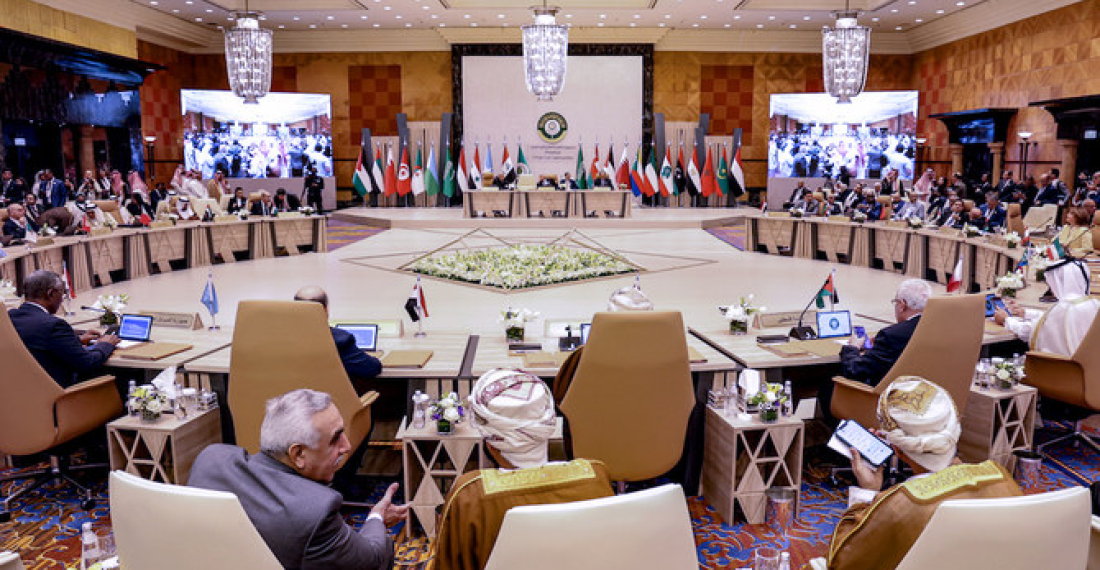
Syrian President Bashar al-Assad is attending his first Arab League summit in Jeddah, Saudi Arabia, on Friday (19 May) since his country was suspended from the group over the government's violent crackdown of pro-democracy protests in 2011 that led to the outbreak of the Syrian Civil War.

In the latest of a number of regional rapprochements, Syria was formally readmitted to the Arab League on 7 May after member states' foreign ministers voted to "resume the participation of the delegations of the government of the Syrian Arab Republic in the meetings of the Council of the League of Arab States", according to a statement. You can read more about this here.

Having been invited by Saudi Arabia as a guest of honour, Ukrainian President Volodymyr Zelensky will also be attending the summit in Jeddah on Friday.

"Home grown solutions"

The 32nd Arab League summit in the Saudi port city of Jeddah comes amid a renewed sense of purpose and unity across the Arab world. In an interview with Asharq Al-Awsat newspaper, the President of Djibouti Ismail Omar Guelleh said that he hoped the summit in Saudi Arabia "will lead to recommendations and decisions that contribute to resolving critical situations and difficult conditions faced by the Arab world, while preserving unity and solidarity among Arab brothers."

Meanwhile, Arab News reports that Saudi Arabia in particular is seeking "home-grown solutions" to regional problems, which has provided much of the impetus behind the recent diplomatic developments across the Arab world.

Speaking to Arab News, Jordanian lawmaker and political analyst Omar Ayasrah said, although previous Arab League summits had been marred by regional crises and disagreements, Friday's summit in Jeddah "seems to be different".

"It has been preceded by a number of Saudi-led initiatives and practical steps aimed first at laying down positive grounds for the meeting and consequently building a unified Arab position on regional crises and the necessary collective framework to address them," he said.

Fighting in Sudan and conflict in Yemen to feature highly

One of the biggest points of discussion will likely be the ongoing fighting between the Sudanese army and the rival paramilitary group, the Rapid Support Forces (RSF), which has rocked Sudan since 15 April. Hundreds are confirmed dead, while hundreds of thousands have been displaced amid what is becoming an increasingly dire humanitarian situation. You can read an update from 17 May on commonspace.eu here.

It is expected that member states will use the opportunity to urge the parties to engage in dialogue and resume talks brokered by Saudi Arabia. Previous ceasefires between the Sudanese army and the RSF have all failed.

On a more positive note, the ongoing peace process to resolve the conflict in Yemen is also expected to feature highly at the Arab League summit. In the run-up to the summit, Yemeni officials have said that Arab League members can assist in achieving peace by supporting current peace efforts, including a Saudi-led initiative that addresses points of contention between the Yemeni government and the Houthis.

source: commonspace.eu with agencies
photo: AFP
 

Related articles

Editor's choice
News
Borrell tells the European Parliament that the situation in Afghanistan was critical, but the EU will remain engaged

Borrell tells the European Parliament that the situation in Afghanistan was critical, but the EU will remain engaged

Borrell underlined that the European Union will make every effort to support the peace process and to remain a committed partner to the Afghan people. "Of course, we will have to take into account the evolving situation, but disengagement is not an option.  We are clear on that: there is no alternative to a negotiated political settlement, through inclusive peace talks.
Editor's choice
News
NATO Chief says war is on Europe's doorstep, and warns against complacency

NATO Chief says war is on Europe's doorstep, and warns against complacency

Russia could attack a Nato country within the next five years, the Secretary General of NATO, Mark Rutte, said in a stark new warning. "Nato's own defences can hold for now," Rutte warned in Berlin, but conflict was "next door" to Europe and he feared "too many are quietly complacent, and too many don't feel the urgency, too many believe that time is on our side. "Russia is already escalating its covert campaign against our societies," Rutte said in a speech in Germany. "We must be prepared for the scale of war our grandparents or great-grandparents endured." Earlier this month, Russia's President Vladimir Putin said his country was not planning to go to war with Europe, but it was ready "right now" if Europe wanted to - or started a war. But similar reassurances were given by Moscow in 2022, just before 200,000 Russian troops crossed the border and invaded Ukraine. Putin has accused European countries of hindering US efforts to bring peace in Ukraine - a reference to the role Ukraine's European allies have recently played in trying to change a US peace plan to end the war, whose initial draft was seen as favouring Russia. But Putin was not sincere, Nato's secretary-general said in the German capital, Berlin. Supporting Ukraine, he added, was a guarantee for European security. "Just imagine if Putin got his way; Ukraine under the boot of Russian occupation, his forces pressing against a longer border with Nato, and the significantly increased risk of an armed attack against us." Russia's economy has been on a war footing for more than three years now - its factories churn out ever more supplies of drones, missiles and artillery shells. According to a recent report by the Kiel Institute for the World Economy, Russia has been producing each month around 150 tanks, 550 infantry fighting vehicles, 120 Lancet drones and more than 50 artillery pieces. The UK, and most of its Western allies, are simply not anywhere near this point. Analysts say it would take years for Western Europe's factories to come close to matching Russia's mass-production of weapons. "Allied defence spending and production must rise rapidly, our armed forces must have what they need to keep us safe," the Nato chief said.

Popular

Editor's choice
News
NATO Chief says war is on Europe's doorstep, and warns against complacency

NATO Chief says war is on Europe's doorstep, and warns against complacency

Russia could attack a Nato country within the next five years, the Secretary General of NATO, Mark Rutte, said in a stark new warning. "Nato's own defences can hold for now," Rutte warned in Berlin, but conflict was "next door" to Europe and he feared "too many are quietly complacent, and too many don't feel the urgency, too many believe that time is on our side. "Russia is already escalating its covert campaign against our societies," Rutte said in a speech in Germany. "We must be prepared for the scale of war our grandparents or great-grandparents endured." Earlier this month, Russia's President Vladimir Putin said his country was not planning to go to war with Europe, but it was ready "right now" if Europe wanted to - or started a war. But similar reassurances were given by Moscow in 2022, just before 200,000 Russian troops crossed the border and invaded Ukraine. Putin has accused European countries of hindering US efforts to bring peace in Ukraine - a reference to the role Ukraine's European allies have recently played in trying to change a US peace plan to end the war, whose initial draft was seen as favouring Russia. But Putin was not sincere, Nato's secretary-general said in the German capital, Berlin. Supporting Ukraine, he added, was a guarantee for European security. "Just imagine if Putin got his way; Ukraine under the boot of Russian occupation, his forces pressing against a longer border with Nato, and the significantly increased risk of an armed attack against us." Russia's economy has been on a war footing for more than three years now - its factories churn out ever more supplies of drones, missiles and artillery shells. According to a recent report by the Kiel Institute for the World Economy, Russia has been producing each month around 150 tanks, 550 infantry fighting vehicles, 120 Lancet drones and more than 50 artillery pieces. The UK, and most of its Western allies, are simply not anywhere near this point. Analysts say it would take years for Western Europe's factories to come close to matching Russia's mass-production of weapons. "Allied defence spending and production must rise rapidly, our armed forces must have what they need to keep us safe," the Nato chief said.