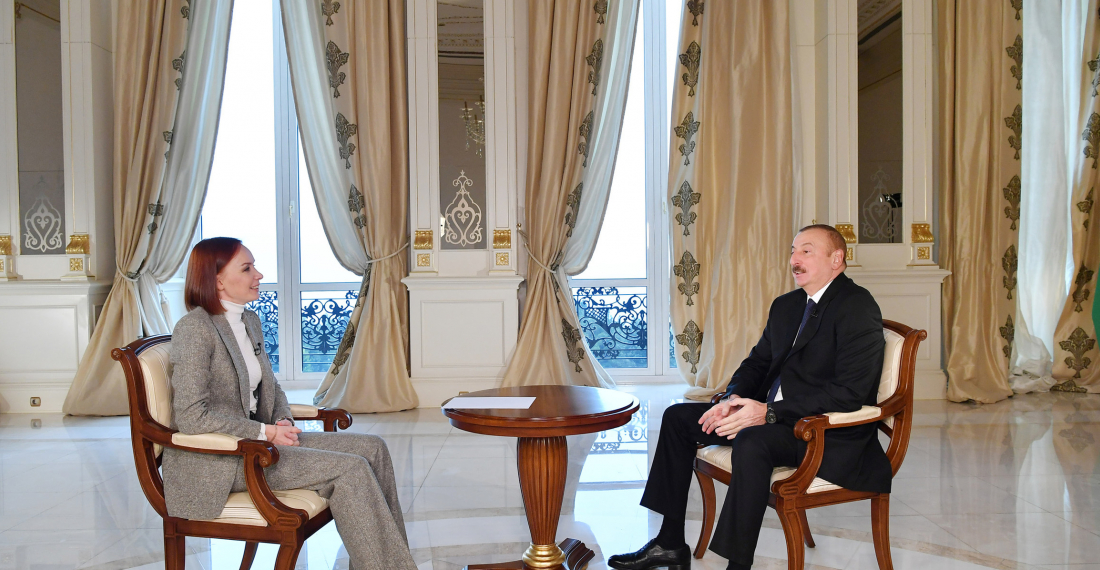
"In 2019 Azerbaijan will chair the Non-Aligned Movement, and in this regard we will increase our activity in the international arena". This was stated by Azerbaijan president Ilham Aliyev in an interview with Rossiya-24 TV station.
In the interview, Aliyev dwelled on a number of issues, including economic development, relations with Russia and criticism of the country's human rights record.
Speaking on the Nagorno-Karabakh conflict, Aliyev said:
"We hope that in 2019 there will be positive moves towards resolving the Armenian-Azerbaijani Nagorno-Karabakh conflict. I think that the events that occurred in Armenia in the spring of this year are a clear indication of the futility of Armenia's policy of maintaining the status quo. Over the years we have come a very long way in development. There is no longer parity between Armenia and Azerbaijan in terms of economic potential, and indeed any other component. I think that our policy on increasing the economic potential, energy, transport projects to a certain extent became the reason for what happened in Armenia. In addition to all other issues that troubled Armenian society, one of the factors of this spring's events was the difficult socio-economic situation, in which Armenia has fallen or has plunged itself. And this, I am deeply convinced, happened as a result of the lack of settlement of the Armenian-Azerbaijani Nagorno-Karabakh conflict. Therefore, I think that both in the society of Armenia and in the power structures there will be a greater understanding that only with a just settlement of the conflict, only after the liberation of the occupied territories, will the Armenian economy grow significantly. Otherwise, I think that it will be difficult to expect the results of serious socio-economic transformations in Armenia. Only after the liberation of the occupied territories will the Armenian economy grow significantly.
That is, we see the results of our policy, we always wanted, and want, to resolve the conflict through negotiations. But, naturally, in order to settle it through negotiations, we need some very serious levers. We have been, and will continue to pursue, a policy of demonstrating what advantages peace will bring to the region and what difficulties will exist in Armenia if peace does not exist. I am deeply convinced that the only way for the new Armenian leadership to carry out all its plans to transform the country is to resolve the conflict with Azerbaijan. And for this to happen they need to get out of the territories that do not belong to them, and to enable hundreds of thousands of Azerbaijanis to return to their lands. Therefore, there is hope that there will be more understanding in this regard. But I cannot speculate. As they say, time will tell."
Asked about his six meetings with Vladimir Putin in 2018, Aliyev said
"This year, Russian-Azerbaijani relations have developed very rapidly. Our relations, in principle, are characterised by a very dynamic development, stability, predictability. We are good neighbours and reliable friends. This has been proven more than once, and this high level of trust is first of all based on political interaction and it contributes to the implementation of many projects. You correctly noted that we met with President Vladimir Vladimirovich Putin 6 times, including as part of my official visit to Russia, and his visit to Azerbaijan, as well as at international events. Each of these meetings gave the result."
source: commonspace.eu
photo: President Ilham Aliyev of Azerbaijan gave an interview to Russia's Rossiya 24 TV station on 25 December 2018 (picture courtesy of the press service of the president of Azerbaijan).