


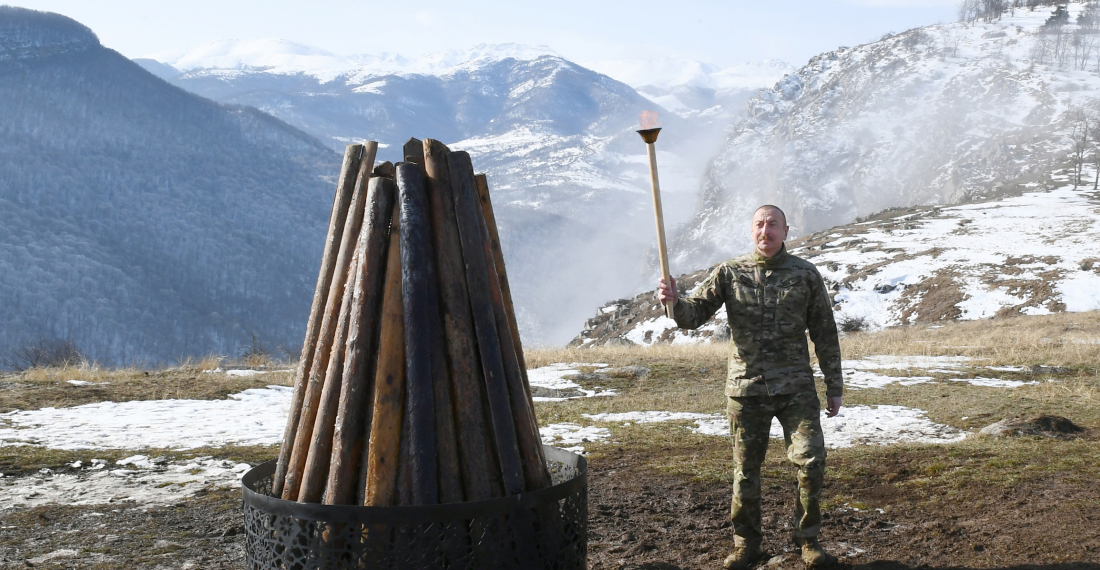
Aliyev addresses Azerbaijani people on the occasion of the Novruz holiday from the city of Shusha

In an emotional address to the nation on the occasion of the start of the traditional Novruz holiday, Azerbaijani president Ilham Aliyev addressed his countrymen from the city of Shusha in Nagorno-Karabakh, which has recently reverted back to Azerbaijani control following the 44-day Karabakh war.

The message of the president started with images of the Ilham Aliyev wearing military fatigues, together with his wife and daughter, lighting the traditional flame with the mountains of Karabakh in the background.

"This year we celebrate Novruz in Shusha, on the Cidir plain. This is a historic event. Every year since 2004, when congratulating the people of Azerbaijan on the occasion of Novruz, I have said that we will return to our native lands. I said that we will restore the territorial integrity of our country. I said that we would celebrate Novruz in Karabakh after the liberation of our lands, and today has come. Today we celebrate Novruz in our ancient city, Shusha, the cultural capital of Azerbaijan. This is a historic event. This is a great happiness. God heard the prayers of the Azerbaijani people. Every year, on the eve of Novruz, we probably all thought and said to each other, hopefully, next year we will celebrate Novruz in Karabakh, next year we will celebrate Novruz in Shusha, and today has come. After 28 years we returned to Shusha."

The president said that the liberation of territories lost to Armenia in the early 1990s was the main aim of his presidency from the very beginning:

"In recent years, I have repeatedly said in speeches and interviews that we do not need an incomplete solution. What this means is that the people of Azerbaijan probably understand very well. I said that everything should be done on time. I know what, when and how to do it. For me, there has never been a more important task than the liberation of lands. I have dedicated my entire presidency to this. Behind every decision was this goal, this goal – whether this step will bring us closer to victory or not. I said that each of us must bring victory closer every day. I have speeches, they remain in history. Every day, each of us must bring victory closer. We approached, prepared, came, defeated and destroyed the enemy. We came and stopped here."

The Novruz holiday is a big national holiday in Azerbaijan and other countries in the Black Sea, Caucasus and Central Asia and coincided with the old Persian new year. 

source: commonspace.eu with the press service of the president of Azerbaijan
photo: Azerbaijan president Ilham Aliyev lighting the traditional fire on the occasion of the start of the Novruz holiday in the city of Shusha in Nagorno-Karabakh.

Related articles

Editor's choice
News
Borrell tells the European Parliament that the situation in Afghanistan was critical, but the EU will remain engaged

Borrell tells the European Parliament that the situation in Afghanistan was critical, but the EU will remain engaged

Borrell underlined that the European Union will make every effort to support the peace process and to remain a committed partner to the Afghan people. "Of course, we will have to take into account the evolving situation, but disengagement is not an option.  We are clear on that: there is no alternative to a negotiated political settlement, through inclusive peace talks.
Editor's choice
News
NATO Chief says war is on Europe's doorstep, and warns against complacency

NATO Chief says war is on Europe's doorstep, and warns against complacency

Russia could attack a Nato country within the next five years, the Secretary General of NATO, Mark Rutte, said in a stark new warning. "Nato's own defences can hold for now," Rutte warned in Berlin, but conflict was "next door" to Europe and he feared "too many are quietly complacent, and too many don't feel the urgency, too many believe that time is on our side. "Russia is already escalating its covert campaign against our societies," Rutte said in a speech in Germany. "We must be prepared for the scale of war our grandparents or great-grandparents endured." Earlier this month, Russia's President Vladimir Putin said his country was not planning to go to war with Europe, but it was ready "right now" if Europe wanted to - or started a war. But similar reassurances were given by Moscow in 2022, just before 200,000 Russian troops crossed the border and invaded Ukraine. Putin has accused European countries of hindering US efforts to bring peace in Ukraine - a reference to the role Ukraine's European allies have recently played in trying to change a US peace plan to end the war, whose initial draft was seen as favouring Russia. But Putin was not sincere, Nato's secretary-general said in the German capital, Berlin. Supporting Ukraine, he added, was a guarantee for European security. "Just imagine if Putin got his way; Ukraine under the boot of Russian occupation, his forces pressing against a longer border with Nato, and the significantly increased risk of an armed attack against us." Russia's economy has been on a war footing for more than three years now - its factories churn out ever more supplies of drones, missiles and artillery shells. According to a recent report by the Kiel Institute for the World Economy, Russia has been producing each month around 150 tanks, 550 infantry fighting vehicles, 120 Lancet drones and more than 50 artillery pieces. The UK, and most of its Western allies, are simply not anywhere near this point. Analysts say it would take years for Western Europe's factories to come close to matching Russia's mass-production of weapons. "Allied defence spending and production must rise rapidly, our armed forces must have what they need to keep us safe," the Nato chief said.

Popular

Editor's choice
News
NATO Chief says war is on Europe's doorstep, and warns against complacency

NATO Chief says war is on Europe's doorstep, and warns against complacency

Russia could attack a Nato country within the next five years, the Secretary General of NATO, Mark Rutte, said in a stark new warning. "Nato's own defences can hold for now," Rutte warned in Berlin, but conflict was "next door" to Europe and he feared "too many are quietly complacent, and too many don't feel the urgency, too many believe that time is on our side. "Russia is already escalating its covert campaign against our societies," Rutte said in a speech in Germany. "We must be prepared for the scale of war our grandparents or great-grandparents endured." Earlier this month, Russia's President Vladimir Putin said his country was not planning to go to war with Europe, but it was ready "right now" if Europe wanted to - or started a war. But similar reassurances were given by Moscow in 2022, just before 200,000 Russian troops crossed the border and invaded Ukraine. Putin has accused European countries of hindering US efforts to bring peace in Ukraine - a reference to the role Ukraine's European allies have recently played in trying to change a US peace plan to end the war, whose initial draft was seen as favouring Russia. But Putin was not sincere, Nato's secretary-general said in the German capital, Berlin. Supporting Ukraine, he added, was a guarantee for European security. "Just imagine if Putin got his way; Ukraine under the boot of Russian occupation, his forces pressing against a longer border with Nato, and the significantly increased risk of an armed attack against us." Russia's economy has been on a war footing for more than three years now - its factories churn out ever more supplies of drones, missiles and artillery shells. According to a recent report by the Kiel Institute for the World Economy, Russia has been producing each month around 150 tanks, 550 infantry fighting vehicles, 120 Lancet drones and more than 50 artillery pieces. The UK, and most of its Western allies, are simply not anywhere near this point. Analysts say it would take years for Western Europe's factories to come close to matching Russia's mass-production of weapons. "Allied defence spending and production must rise rapidly, our armed forces must have what they need to keep us safe," the Nato chief said.

