


After fatal shootings on the front line, Yerevan and Baku exchange diplomatic fire

The foreign ministries of Armenia and Azerbaijan exchanged sharp diplomatic words over the weekend, following reports of fatal shootings in the Nagorno-Karabakh conflict zone on Thursday and Saturday, which are said to have left one casualty on each side.

On Saturday, Armenia's foreign ministry issued a toughly worded statement which said that "Armenia resolutely deplores deliberate steps by Azerbaijan in the past three days to increase tension, which manifest in dissemination of false information about its own casualties, direct calls for physical threats to the leadership of Armenia, publicly voiced by representatives of the ruling party in Azerbaijan's parliament, and significant increase in ceasefire violations, which resulted today in a killing of private Sipan Melkonyan of the Defence Army of Nagorno-Karabakh. Azerbaijan's recent actions take place against the background of the appeal of 30 May from the OSCE Minsk Group Co-Chairs to exercise maximum restraint to avoid escalation."

The Armenian statement continued:

"These latest developments defy the efforts of Armenia and Nagorno-Karabakh, under the auspices of the OSCE Minsk Group Co-Chairs to take constructive efforts towards the peaceful resolution of the conflict, to establish a conducive environment to this end, and represent a serious setback for all the efforts taken over the past months. Azerbaijan violates its own commitments undertaken in the latest Joint Statements in Milano (December, 2018), in Vienna (March, 2019) and in Moscow (April, 2019).

The deplorable actions of Azerbaijan, if not urgently addressed, may represent a serious obstacle to next steps in the settlement process. They also question the credibility of Azerbaijan and their capacity to remain faithful to commitments, as agreed in Dushanbe in September 2018 and reaffirmed in Vienna in March 2019, to observe and strengthen the ceasefire. Armenia strongly urges Azerbaijan to demonstrate genuine political will expressed in concrete and effective measures to observe the ceasefire. Azerbaijan will bear full responsibility for the risks of further escalation.

Azerbaijan's latest confrontational and dangerous actions prompt their past violence, atrocities and attempts to aggression and stand proof of the existential physical security risks to the people of Nagorno-Karabakh.

Armenia reiterates that there is no alternative to the peaceful resolution of the conflict, for which strict observance of the ceasefire is an essential condition. Under no circumstances the security of Nagorno-Karabakh and its people will be compromised.

The latest incident underlines the urgency to finalize in the shortest possible time an OSCE investigative mechanism of ceasefire violations and to expand the Office of the Personal Representative of the OSCE Chairperson in Office, in accordance with the commitment taken by Azerbaijan in Vienna and St. Petersburg in 2016.

The Ministry of Foreign Affairs of Armenia expresses its profound and most sincere condolences to the family and friends of private Sipan Melkonyan of the Defence Army of Nagorno-Karabakh."

On Sunday monring, the Azerbaijani foreign ministry issued a somehwat shorter counter statement in the form of a "commentary of the Press Service Department of the Ministry of Foreign Affairs of the Republic of Azerbaijan", in which it describes the Armenian statement as "emotional" and controversial", blaming this on the current domestic political situation in Armenia. The statement added:

"However, we are reminding that Armenia gave consent to the next meeting at the level of the ministers of foreign affairs. At the same time, the realities on the ground are still the same; the armed forces of Armenia must be withdrawn from the occupied territories of Azerbaijan. There is no other option for the further development of the region never mind who will lead Armenia in the upcoming future.

Armenia should acknowledge that the only cause of human losses, disasters and mutual discord is Armenia's aggressive policy, the occupation of the Azerbaijani territories and the policy of ethnic cleansing of local Azerbaijanis living in these territories. Armenia should not waste time searching for any other fraudulent reasons and should take results-oriented steps in the settlement of the conflict in line with the demands of the international community."

Commonspace.eu political editor said in a comment that the latest diplomatic exchanges between Baku and Yerevan appear to be different from the usual tick-tock, tit-for-tat exchanges that have characterised the public exchanges between the two countries for nearly two decades. Armenia continues to deny that it was responsible for the killing of an Azerbaijani officer on Thursday. The Armenian foreign ministry was criticised by hardliners in the former ruling Republican Party, who described as weak and late an earlier Foreign Ministry statement. The Azerbaijani statement appears more interested in focusing on political divisions in Armenia

In the context of the Karabakh conflict it is never good news when the military situation on the ground, and the politics in Baku and Yerevan, and indeed Stepanakert, get enmashed together. Last week's reported deadly incidents, coming when the OSCE Minsk Group co-Chair mediators were still in the region trying to kick start a fresh round of talks, seems to suggest that someone is trying to derail their efforts. The question remains, who and why?"

Related content: Azerbaijan says soldier killed by Armenian sniper fire

Related content: Armenian Parliament sets up committee to investigate the April 2016 military escalations

Related content: Karabakh Armenians say soldier killed by Azerbaijani fire on Saturday


source: commonspace.eu

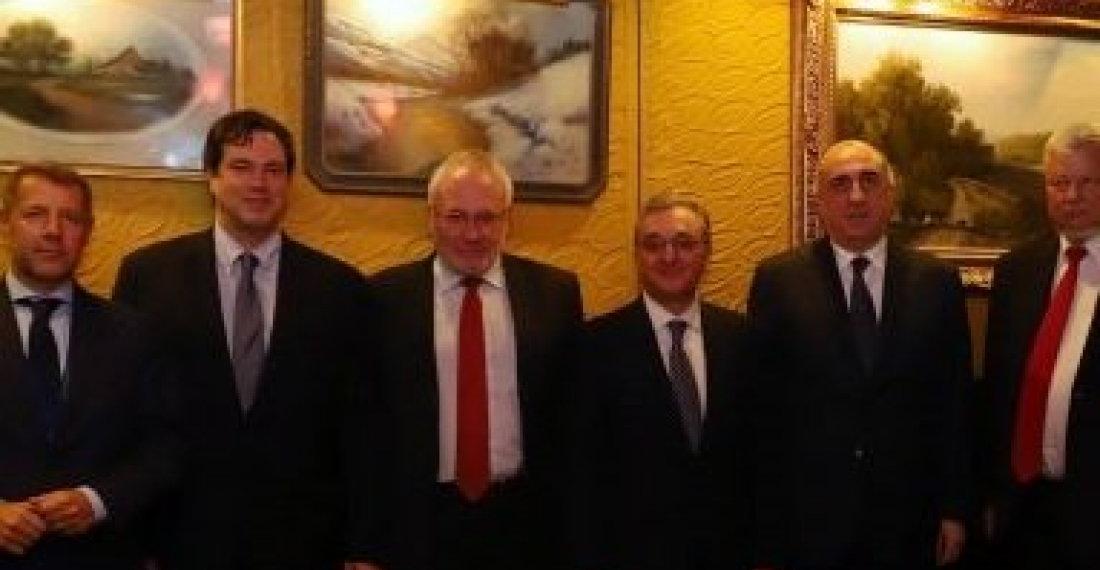
photo: The foreign ministers of Armenia and Azerbaijan and OSCE mediators at a recent meeting (archive picture)
 

Related articles

Editor's choice
News
Russia adds pressure on Armenia ahead of key elections; recalls Ambassador in Yerevan for consultations

Russia adds pressure on Armenia ahead of key elections; recalls Ambassador in Yerevan for consultations

Ahead of key parliamentary elections,scheduled to be held in Armenia on Sunday, 7 June, Russia continues to attempt to put pressure on the Armenian Government led by prime minister Nikol Pashinyan. On 30 May, Russia recalled its Ambassador to Yerevan for consultations. A terse statement, published on the website of the Russian Foreign Ministry, said, "The Ambassador of the Russian Federation to the Republic of Armenia , S.P. Kopyrkin, has been summoned to Moscow for consultations in connection with the steps taken by the Armenian leadership to move closer to the European Union, which are detrimental to cooperation within the EAEU." This followed a statement issued the day before, by the leaders of the Eurasian Economic Union (EAEU) that challenges the Armenian trajectory towards approximating to the European Union. Vladimir Putin is undertood to have personally pushed the other four EAEU leaders to issue the statement, which said: "Taking into account the significant risks to the economic security of the member states of the Eurasian Economic Union (hereinafter referred to as the Union) arising in connection with the preparation of the Republic of Armenia for accession to the European Union, as well as the need to prevent the associated damage to the member states of the Union: decided that the members of the Eurasian Intergovernmental Council from the Republic of Belarus, the Republic of Kazakhstan, the Kyrgyz Republic and the Russian Federation will report at the next meeting of the Supreme Eurasian Economic Council in December 2026 on the possible consequences of the suspension of the Treaty on the Eurasian Economic Union with respect to the Republic of Armenia. We share the position on the need to hold a national referendum in the Republic of Armenia as soon as possible on joining the European Union or continuing to be part of the Eurasian Economic Union."
Editor's choice
News
The leaders of the states of the Eurasian Economic Union issued a tough statement warning fellow-member state Armenia of the consequences of its desire to join the European Union.

The leaders of the states of the Eurasian Economic Union issued a tough statement warning fellow-member state Armenia of the consequences of its desire to join the European Union.

The leaders of the states of the Eurasian Economic Union (EEAS) issued a tough statement warning fellow-member state Armenia of the consequences of its desire to join the European Union. The stark, sharply worded,  warning, comes days before crucial parliamentary elections in Armenia, scheduled for 7 June. The full statement said, “We, the Presidents of the Republic of Belarus, the Republic of Kazakhstan, the Kyrgyz Republic and the Russian Federation, Taking into account the actions of the Republic of Armenia aimed at joining the European Union, including the approval in 2025 by the National Assembly of the Republic of Armenia and the signing by the President of the Republic of Armenia of the Law of the Republic of Armenia "On the Start of the Process of Accession of the Republic of Armenia to the European Union", as well as the confirmation by the European Union of the European aspirations of the Government of the Republic of Armenia, expressed in the joint declaration following the first Armenia-European Union summit, adopted on 5 May 2026, Taking into account the significant risks to the economic security of the member states of the Eurasian Economic Union (hereinafter referred to as the Union) arising in connection with the preparation of the Republic of Armenia for accession to the European Union, as well as the need to prevent the associated damage to the member states of the Union: decided that the members of the Eurasian Intergovernmental Council from the Republic of Belarus, the Republic of Kazakhstan, the Kyrgyz Republic and the Russian Federation will report at the next meeting of the Supreme Eurasian Economic Council in December 2026 on the possible consequences of the suspension of the Treaty on the Eurasian Economic Union with respect to the Republic of Armenia. We share the position on the need to hold a national referendum in the Republic of Armenia as soon as possible on joining the European Union or continuing to be part of the Eurasian Economic Union. Astana, May 29, 2026” A meeting of the Supreme Eurasian Economic Council was held in Astana, Kazakhstan, on May 29, 2026. The meeting of the Supreme Eurasian Economic Council in a restricted format was attended by Russian President Vladimir Putin, Belarusian President Alexander Lukashenko , Kazakh President Kassym-Jomart Tokayev , Kyrgyz President Sadyr Japarov , Armenian Deputy Prime Minister Mher Grigoryan, and Chairman of the Board of the Eurasian Economic Commission Bakytzhan Sagintayev. From the Russian side, the meeting was also attended by Deputy Prime Minister and member of the Council of the Eurasian Economic Commission Alexey Overchuk and Presidential Aide Yury Ushakov . The heads of delegations from EAEU observer states, including President of Uzbekistan Shavkat Mirziyoyev , Vice President of Cuba Salvador Valdés Mesa, Minister of Industry, Mines, and Trade of Iran Mohammad Atabak, and CIS Secretary General Sergei Lebedev, joined the expanded meeting . Following the meeting of the Supreme Eurasian Economic Council, a number of documents were signed .

Popular

Editor's choice
Interview
Thursday Interview: Murad Muradov

Thursday Interview: Murad Muradov

Today, commonspace.eu starts a new regular weekly series. THURSDAY INTERVIEW, conducted by Lauri Nikulainen, will host  persons who are thinkers, opinion shapers, and implementors in their countries and spheres. We start the series with an interview with Murad Muradov, a leading person in Azerbaijan's think tank community. He is also the first co-chair of the Action Committee for a new Armenian-Azerbaijani Dialogue. Last September he made history by being the first Azerbaijani civil society activist to visit Armenia after the 44 day war, and the start of the peace process. Speaking about this visit Murad Muradov said: "My experience was largely positive. My negative expectations luckily didn’t play out. The discussions were respectful, the panel format bringing together experts from Armenia, Azerbaijan, and Turkey was particularly valuable during the NATO Rose-Roth Seminar in Yerevan, and media coverage, while varied in tone, remained largely constructive. Some media outlets though attempted to represent me as more of a government mouthpiece than an independent expert, which was totally misleading.  Overall, I see these initiatives as important steps in rebuilding trust and normalising professional engagement. The fact that soon a larger Azerbaijani civil society visits to Armenia followed, reinforces the sense that this process is moving in the right direction." (click the image to read the interview in full)

