


A more active role by German-speaking countries in Europe’s security debate.

In this op-ed for commonspace.eu Dennis Sammut discusses the results of the meeting Foreign Ministers of German-speaking nations held in Neuchatel last week.

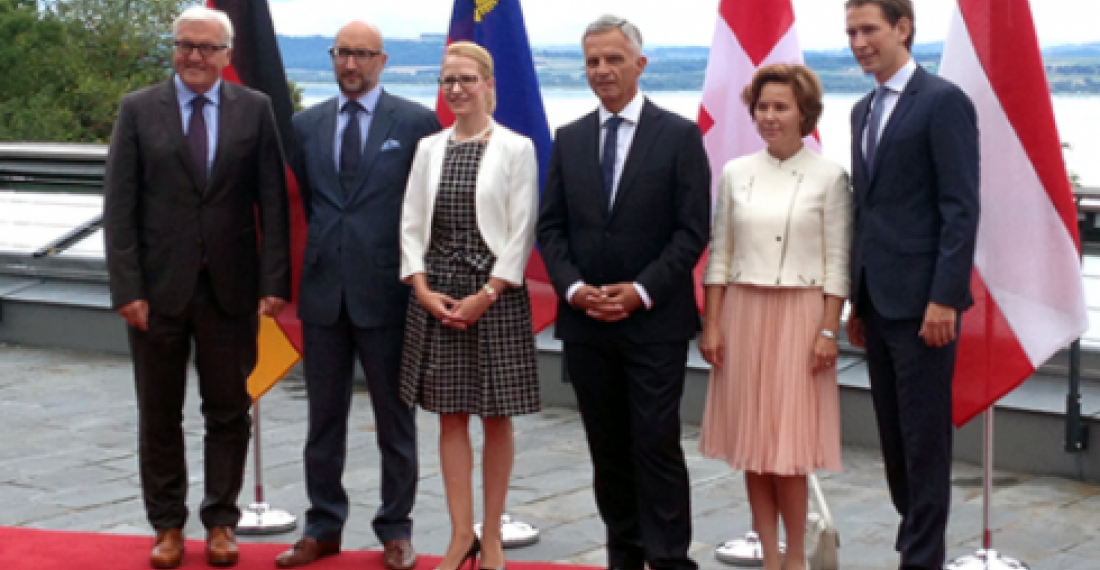
The idyllic Swiss town of Neuchatel last week hosted a meeting of the foreign ministers of the German-speaking countries. Unlike similar gatherings of their English or French counterparts, which bring together dozens of countries from all five continents, only four central European nations were present in Neuchatel: Germany, Austria, Switzerland and Liechtenstein. Yet in the current uncertainty surrounding European peace and security the cosy Neuchatel gathering was highly significant, symbolic of an increasingly important role that German speaking countries are playing in defining Europe's new security agenda.

In Neuchatel the foreign ministers touched on the promotion of the German language - an obligatory topic in such meetings - but their discussions quickly moved to the nitty gritty issues currently facing Europe, including conflicts in the Middle East, the refugee crisis on Europe's doorstep, and of course Ukraine.

Germany is preparing to take over the chairmanship of the Organisation for Security and Co-operation in Europe (OSCE) in 2016, to be followed by Austria in 2017. Switzerland chaired the OSCE in 2014, and under an ad hoc arrangement with the current Serbian chairmanship, continues to be responsible for some of the issues dealt with by the Chairmanship in 2015. In this role at the helm of Europe's leading security forum the German speaking nations are expected to show leadership, but perhaps more importantly they are expected to set the tone for the ongoing debate about the future of peace and security in Europe.

That Europe is currently facing its most serious security challenges since the end of the cold war is now well recognised. How to deal with these challenges however remains debatable, including the key question of the extent Russia's assertiveness should be confronted or engaged - although fortunately hardly anyone now thinks it is a choice of either one or the other anymore. Apart from Ukraine, several other flashpoints in the OSCE space where Russia is directly or indirectly involved, including Nagorno-Karabakh, Transdniestr, Abkhazia and South Ossetia, seem no closer to a solution than they were twenty years ago

This debate also includes the question of the future role of the OSCE - an organisation often accused of having lost its way, and which until it was given a new lease of life as a result of the Ukraine crisis, appeared to be heading for extinction. Many credit the 2014 Swiss Chairmanship with having saved the OSCE from yet another dramatic failure, similar to the one in Georgia in 2008.  Indeed the German speaking nations have in the past shown more commitment to, and engagement with, the OSCE than perhaps any other group of countries within the organisation. This looks likely to continue under the incoming German and Austrian Chairmanships and in a more co-ordinated fashion, as was stated in the final declaration of the Neuchatel meeting. The joint declaration also contains the following four specific points: a common commitment to solving the Ukrainian crisis, strengthening the OSCE's capacity for action, discussion of the future of European security, and strengthening economic connectivity within the OSCE area. The Ministers also reasserted their political support for the work of the OSCE Special Monitoring Mission in Ukraine.

The message from Neuchatel was clear. The way forward was through to resolving the current challenges is diplomatic, through "patience and perseverance". This is quickly becoming the key phrase in German Foreign Policy. Foreign Minister Frank-Walter Steinmeier alluded to this approach when addressing the OSCE Permanent Council in Vienna a few weeks ago. On that occasion he also cited the words of the late European and German statesman Willy Brandt, that "small steps were better than no steps". In Switzerland, Steinmeier highlighted the success of the Iran negotiations as an example of how patience and perseverance can succeed. The underlying message was that diplomacy does work and needs to be given a chance, and Europe should not rush into military adventures that may easily snowball into serious conflicts with unpredictable consequences.

By coincidence, or perhaps not, an experienced German, Wolfgang Ischinger, is also currently leading a review of the work of the OSCE as part of the Helsinki+40 effort to revisit the themes and tools of European peace and security forty years after the signing of the Helsinki Final Act. The panel of eminent persons writing the review are expected to report back in time for the OSCE Ministerial meeting in Belgrade in December. Germany and Austria will be well placed to push forward the suggestions coming out from the group during their Chairmanships in 2016 and 2017 respectively.

While patience and perseverance are essential requisites for successful diplomacy, vision and flexibility are similarly needed for diplomacy to succeed. The current problems facing European security should not simply be managed and contained, and handed over in neat files from one set of diplomats to another. Success still needs to be judged by the progress made to their resolution. European diplomats, be they German speaking or not, need to avoid over-emphasising process, and must not shy from addressing the core issues at the heart of ongoing problems. Overall however, a bigger role for the German speaking nations in securing future European peace and security is a welcome development

Dennis Sammut is the Executive Director of LINKS (Dialogue, Analysis and Research). He contributed this op-ed to commonspace.eu. For more information visit www.dennissammut.info

Photo: The Foreign Ministers of Germany, Liechtenstein, Switzerland and Austria at their meeting in the Swiss town of Neuchatel on 16 August 2015. (picture courtesy of the Federal Department for External Affairs of Switzerland).
 

Related articles

Editor's choice
News
UAE says it will withdraw from Yemen, but division emerges in Yemeni presidential council

UAE says it will withdraw from Yemen, but division emerges in Yemeni presidential council

In a move seen as an attempt to de-escalate a crises with Saudi Arabia, the United Arab Emirates, on Tuesday (30th December) announced that it was heeding a call to withdraw its troops from Southern Yemen. UAE says that its presence included counter-terrorism teams that were crucial in fighting against Islamist groups. UAE sources said that parts of Yemen not controlled by the Houthis have had Al Qaeda in the Arab Peninsula (AQAP) operatives using the territory to launch attacks on Europe, the US and Middle East. UAE teams have co-ordinated with American and British special forces and intelligence. The sources added that Emirati forces and their Yemeni allies also helped reverse Houthi gains in the south. including the liberation of Aden port. The small UAE contingent has remained in place since the UAE withdrew most of its military personnel in 2019. The leading English-language newspaper in Abu Dhabi, The National, said that the main UAE force was based at Riyan Mukalla International Airport, with access to fixed-wing aircraft and helicopters, but also operated smaller contingents in the port town Balhaf and Shabwa. "It is understood it also flew a number of drones from the airbase that were able to track terrorist movements, pass information back to its allies and assisted special forces' missions." Meanwhile a division has emerged in Yemen's presidential council after four members denounced what they called the 'unilateral decisions' by the chairman. Four of Yemen’s eight Presidential Leadership Council members on Tuesday denounced an announcement by the council’s chairman accusing him of breaching the governing agreement. Tension between Yemeni leaders has been rising for weeks, underscoring the fragility of the country's already fractured political landscape and further complicating efforts to confront the Iran-backed Houthi rebels. The latest rift took an unprecedented turn on Tuesday morning, marked by a Saudi-led coalition “limited operation” striking combat vehicles Riyadh linked to the Southern Transitional Council, which has three members in the PLC. The PLC Chairman, Rashad al Alimi, on Tuesday said that he was seeking to cancel the joint defence agreement with the UAE. “What has been issued … constitutes a clear violation of the Declaration of the Transfer of Power [agreement], which explicitly stipulates that the Presidential Leadership Council is a collective body whose decisions are taken by consensus, or by majority when consensus is not possible,” the statement by the four members said. “It does not, under any circumstances, allow for unilateral decision-making on sovereign, military, or major political matters." The statement was signed by STC chief Aidarous Al Zubaidi, Faraj Al Bahsani, Tariq Saleh and Abu Zaraa al Muharrami. (click the picture to read the full article).

Popular

Editor's choice
News
UAE says it will withdraw from Yemen, but division emerges in Yemeni presidential council

UAE says it will withdraw from Yemen, but division emerges in Yemeni presidential council

In a move seen as an attempt to de-escalate a crises with Saudi Arabia, the United Arab Emirates, on Tuesday (30th December) announced that it was heeding a call to withdraw its troops from Southern Yemen. UAE says that its presence included counter-terrorism teams that were crucial in fighting against Islamist groups. UAE sources said that parts of Yemen not controlled by the Houthis have had Al Qaeda in the Arab Peninsula (AQAP) operatives using the territory to launch attacks on Europe, the US and Middle East. UAE teams have co-ordinated with American and British special forces and intelligence. The sources added that Emirati forces and their Yemeni allies also helped reverse Houthi gains in the south. including the liberation of Aden port. The small UAE contingent has remained in place since the UAE withdrew most of its military personnel in 2019. The leading English-language newspaper in Abu Dhabi, The National, said that the main UAE force was based at Riyan Mukalla International Airport, with access to fixed-wing aircraft and helicopters, but also operated smaller contingents in the port town Balhaf and Shabwa. "It is understood it also flew a number of drones from the airbase that were able to track terrorist movements, pass information back to its allies and assisted special forces' missions." Meanwhile a division has emerged in Yemen's presidential council after four members denounced what they called the 'unilateral decisions' by the chairman. Four of Yemen’s eight Presidential Leadership Council members on Tuesday denounced an announcement by the council’s chairman accusing him of breaching the governing agreement. Tension between Yemeni leaders has been rising for weeks, underscoring the fragility of the country's already fractured political landscape and further complicating efforts to confront the Iran-backed Houthi rebels. The latest rift took an unprecedented turn on Tuesday morning, marked by a Saudi-led coalition “limited operation” striking combat vehicles Riyadh linked to the Southern Transitional Council, which has three members in the PLC. The PLC Chairman, Rashad al Alimi, on Tuesday said that he was seeking to cancel the joint defence agreement with the UAE. “What has been issued … constitutes a clear violation of the Declaration of the Transfer of Power [agreement], which explicitly stipulates that the Presidential Leadership Council is a collective body whose decisions are taken by consensus, or by majority when consensus is not possible,” the statement by the four members said. “It does not, under any circumstances, allow for unilateral decision-making on sovereign, military, or major political matters." The statement was signed by STC chief Aidarous Al Zubaidi, Faraj Al Bahsani, Tariq Saleh and Abu Zaraa al Muharrami. (click the picture to read the full article).

