


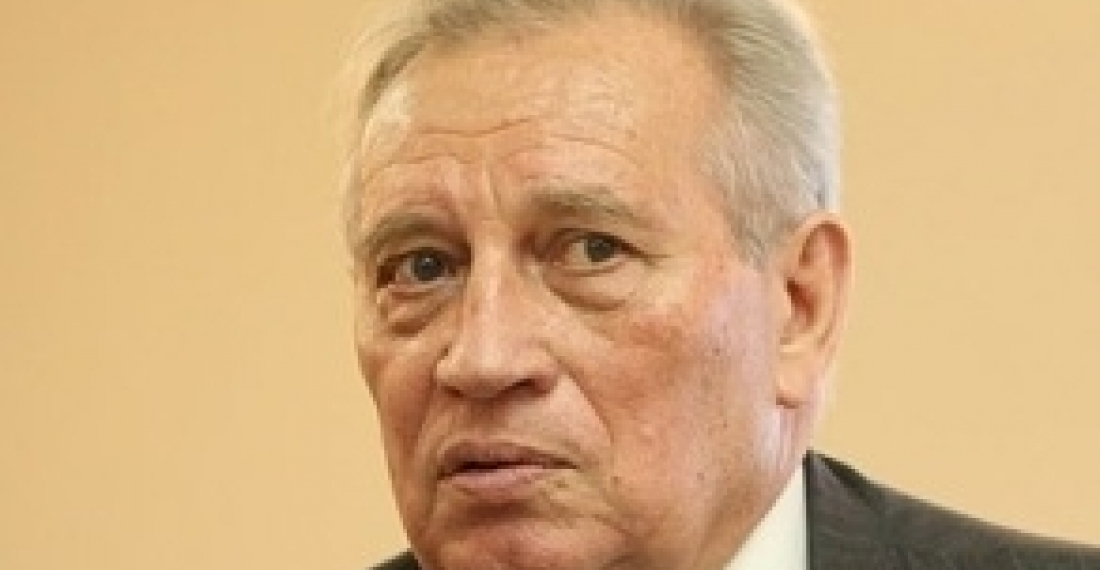
In an exclusive interview with commonspace.eu, veteran Russian diplomat Vladimir Kazimirov discusses the early days of the OSCE Minsk Process and future options for peace in Nagorno-Karabakh.
Ambassador can you say something about your role as one of the first co-chairmen of the OSCE Minsk Group, which was engaged in helping find a peaceful solution of Nagorno-Karabakh conflict?
If you are interested in my participation in settlement of that conflict, then it is more contained in my leading the Russian mediation team in the period of May 1992 through September 1996. Right at that time it was assigned to me to participate in other peace efforts around Karabakh, in particular, to represent Russia in the CSCE Minsk Group, chaotically established in June 1992. I became the co-chairman of the OSCE Minsk Group from Russia much later - from January 1995 to September 1996.
(Few people know that there has never been a decision to set up the Minsk Group, nor did it have a mandate: it was made up and gradually acquired its mission de facto after a series of meetings in Rome, then - in Moscow and other capitals. In fact, it substituted the Minsk conference as a replacement, but on a more modest level. It was not possible to convene the conference those years because of armed hostilities).
At that time, both cooperation and competition between Russia and the CSCE existed in search of a settlement for Karabakh. Russia knew the region better and was more persistent, than our Minsk Group partners, in reaching suspension of hostilities as a priority task. We promoted the very same offers in the Minsk Group, but we lacked consistency in actions. After all, the cease-fire between Azerbaijan, on the one side, and Armenia and Nagorno-Karabakh on the other, was reached 17 years ago with Russia's mediation (on 12 May 1994).
I would consider a positive outcome of Russian mediation the establishment of first direct contacts between Baku and Stepanakert, a few short-term cease-fires between them, identification of negotiations format between all the three parties in the conflict, a number of personal meetings between the leaders of the countries, and the first project of peace agreement between the three parties. A lot of this, though not immediately, was accepted by the OSCE Minsk Group.
In June 1993, Russia insisted in Rome on inferiority of OSCE Minsk Group documents to implementation of UN Security Council Resolution 822, and then - to its other Resolutions. Unfortunately, the requirements of all four UN Security Council Resolutions were not brought to life because of attempts of a well-known side to resolve the conflict with force, which only expanded occupation of its territories. This is why the cease-fire was certainly achieved considering those Resolutions, but still on a different basis: declaration of Council of CIS Heads of States of April 15 1994, which demanded immediate "halt of fire, all the armed hostilities and then - reliable ensuring of this situation". This very last requirement - reliable ensuring - has not been secure up to now.
My role as a co-chair of OSCE Minsk group was much more limited, as that was more a kind of "routine" stage of talks between the three parties around the ceasefire agreement project on the basis agreed between Russia and the OSCE. The talks were under way till April 1997 and were ceased to shift to other methods of work with these parties. I am not convinced that all the succeeding parameters and formats of the negotiation process were more promising that direct talks of the three parties related to the content of the agreement, which we had initially.
You were actively involved into the process of suspension of hostilities between Armenians and Azerbaijanis after the ceasefire of 1994. How is it possible to strengthen the cease-fire regime until a peaceful solution is found?
A full, comprehensive (and term-less!) halt of fire did not come immediately: there were 8 temporary cease-fires, some of them were broken, some were not prolonged. One cease-fire was maintained for 50 days. That was a hard, bitter, but valuable experience. Prior to the cease-fire, posting of troops was agreed upon, but then Baku refused to move the troops back, either symmetrically or asymmetrically. So the cease-fire left the front-lines very close to each other, and with that - without peacekeepers or independent observers, which produced incidents. To localize and settle them, in February 1995 on our initiative the three parties concluded a special agreement regarding strengthening the cease-fire regime, but still the same party is not willing to stick to it and keeps silencing it, as if it never existed. The agreement envisaged direct contacts between the sides and specific measures to control the incidents and prevent hostile propaganda. It is necessary to secure implementation of the officially signed agreement by all the parties, bringing the heavy arms and snipers back from the front-lines. Increase of tension and search of peaceful solutions are absolutely incompatible.
The international community is increasingly concerned over OSCE Minsk Group's inability to reach progress in talks between Armenia and Azerbaijan over Nagorno-Karabakh conflict, while the number of incidents on the contact line keeps growing up. How do you see the peace process at its current stage?
I think that the format of current talks has long ago been deformed by alienation of Nagorno- Karabakh from them. Stalling of progress and slow advancement of the negotiations is not the mediators' fault, but a consequence of maximalistic, unrealistic positions of the parties. The talks should be restructured; each round should be conducted in two directions: first, measures to strengthen the cease-fire and second - coordination of principles, and then of the agreement text. Both are being discussed at the moment, but the talks are not structured, and this is not fixed. And if there is no progress with the first line, this time the second should be cancelled as well. You cannot expect a progress in the second direction unless success has been secured in the first. It would be too virtual, deceptive and not void of dangers. It is time to let parties understand that the first direction is a higher priority for the international community and that does not allow for any delays. Prevention of resumption of armed hostilities is the "zero cycle" to build peace in this region.
Since November 2008 Russia undertook a leading role among the three co-chairs, under the leadership of President Medvedev, who devoted a lot of time to support the talks between the presidents of Armenia and Azerbaijan. Does Russia feel comfortable about the OSCE Minsk Group format, or does it prefer the three-party format?
As I do not have the right to talk on behalf of Russia, I am expressing my personal view. Back in 1992, when there were many mediators, we posed the question like this: all those, who sincerely strive to resolve this hard conflict and do not try to reach other goals, should support the mediator who managed to achieve more than the others. Such support instead of jealous attitude to success of the others would be favorable in terms of search of settlement. We used to voice this in the Minsk Group as well, but were all of our partners willing to hear us? The talks have long ago been assigned not to the Minsk Group, but to its co-chairs. At present they work in a more coordinated way, appreciating Russia's aspiration to demine the dangerous mine in the South Caucasus and, in particular, they are appreciative of its capacity, they support Russia's efforts. There is a permanent exchange of information between them and consultations around steps that are being taken.
Are there any urgent measures that need to be taken by the parties of the conflict, the international community, in order to bring the tension down and increase the chances for success of the peace process?
The most logical for the international community in the current situation would be suggesting to the parties to conclude an agreement on non-use of force under international guarantees while resolving the conflict. This would give a dual, mutually beneficial effect in the key questions. Baku would stop threatening with a revanche, instead it would have to seek solutions over the negotiations table. Armenians would lose an excuse for keeping the taken Azeri territories and would be forced to speed up leaving them.
Years of military threats make this suggestion uncomfortable for Baku, but this is nobody else's fault. This has to be offered permanently, nearly every day, and not once a year. A certain palliative is possible as well: to agree on termination of this agreement after the official announcement of results of legally binding will around the status of Nagorno Karabakh with all the possible options. Other measures of reducing the tension, including those following from the incidents, should be regularly discussed during the talks conducted around the primary, even the super-primary direction, as suggested by me.
The interview was conducted in Russian and is available in the original version on
the Russian section of this website
(c) commonspace.eu



