


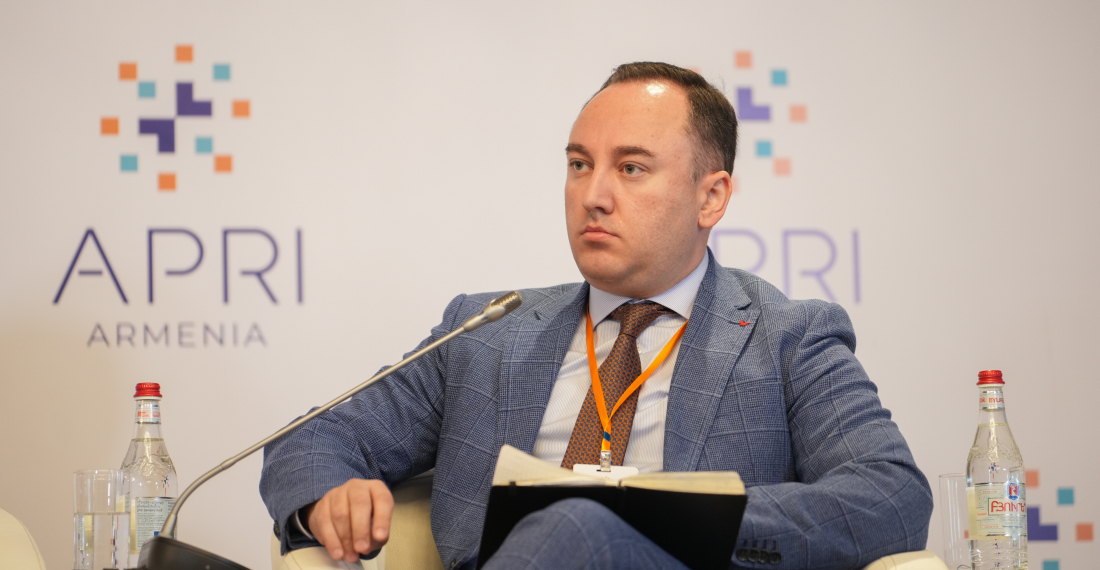
Johnny Melikyan is a Yerevan-based political analyst and foreign policy specialist. As a head of department at the Public Relations and Information Center (The Office of the Prime Minister of Armenia) and senior fellow at the Orbeli Center, he has spent more than 15 years studying Georgia and regional dynamics, and today focuses on how diplomacy, connectivity, and economic cooperation can shape stability in the South Caucasus.
Speaking to commonspace.eu this week, Melikyan reflected on what he calls a “half-diplomatic” profession, discussed regional developments, including Armenia-Georgia relations, and argued why small states increasingly rely on multi-vector foreign policy strategies to manage external pressures.
“For small states, foreign policy is about smart power: being flexible, innovative, and balancing the interests of bigger powers with your own."
Read the full interview below:
Welcome, Mr. Melikyan. To start off the interview could you describe your background to someone encountering your work for the first time? Please outline the roles you fulfil at the Orbeli Center (Public Relations and Information Center, The Office of the Prime Minister of Armenia) for our audience.
Background and professional trajectory
While studying at university, I learned Turkish, German, and English, and early in my studies I recognized that Georgia’s domestic and foreign policy were largely under-researched in Armenia. That led me to focus my work on Georgia, our northern neighbour. We share a long history of thousands of years and are good neighbours. During my studies, I started writing academic articles and reports on this country, and my diploma work was on Georgia. Then I continued to work in this direction.
I began my career in the NGO sector at the Electoral Systems Center, where we ran several websites and carried out activities during pre- and post-election periods, as well as training programs. I later helped re-establish an Analytical Center on Regional Studies within our university, focusing on the Caucasus and the broader Middle East.
I later began working at the Public Relations and Information Center that, at the time, operated under the administration of the President, as Armenia was a presidential republic until 2018. It is the same institution where I work today, although it was then known as the Center for Public Relations and Information under the President’s Office. I covered Georgia as an analyst, working on media monitoring, analytical reports, interviews, and public and expert outreach. I also continued my academic research as a PhD Student on Georgia and focused on developing expertise on Armenia–Georgia relations.
Broadening focus
At one point, I moved to the Center for Regional Studies – a think tank affiliated with the Public Administration Academy of Armenia, while also spending several years working in parallel at the Noravank Scientific-Research Foundation, which had been established by the Armenian government. The Center for Regional Studies under the Academy continued to operate until around 2020. In 2019, following the Velvet Revolution, I was invited to the Public Relations and Information Center to focus on Georgia. By then, the Center was operating under the Prime Minister’s Office, and I rejoined the team. So, after about 15 or 16 years, there are now several experts covering Georgia, and I consider myself one of them.
But times are changing and over the past five years, however, I have broadened my focus beyond Georgia and South Caucasus (including the Karabakh conflict and the broader regional context involving Iran, Turkey, and Russia) to the wider Eurasia (Central Asia, China and India), dealing with Armenian Foreign Affairs geography.
A “half-diplomatic” profession
I progressed from working part-time as a Georgia specialist to becoming a senior expert and head of the international relations research department. In the last five years, my focus has shifted increasingly towards Armenian foreign policy. Since 2009, with some short breaks, I have also taught at the university from which I graduated, covering Georgian politics, regional politics, and regional developments for journalism, international relations, and political science students, with different analytical angles drawn from political science and international relations on how to cover developments in our region.
If I were to offer advice to those entering this field, I would say that it is difficult in any country to build a career in international relations. You either work in international organizations, state institutions, including MFA, or you try to combine several paths, as I have done: teaching, studying, writing academic articles, participating to the conferences and forums, acting as a public expert, analysing, giving interviews, broadening your horizons, staying active, and being prepared for change. This ultimately becomes a way of life.
Some people work in banks from 9am to 6pm and then switch off. In our case, you might be at the university, giving interviews, attending conferences abroad, meeting diplomats or experts in Armenia, or speaking with counterparts when you travel. This is active, continuous work. I call it “half-diplomatic” because diplomats and the MFA have their official channels, while experts also play a role through public and expert diplomacy. You share your expertise, concerns, and analysis with external partners and diplomats, helping them to explain Armenia’s foreign policy and regional developments – from where we are now and where we are going.
You communicate with many people and make use of opportunities. Last year, I travelled extensively to European countries, as well as to Central Asia and China, to attend conferences. Everywhere, you encounter interesting discussions, analysis, culture, and cuisine. When I begin my classes, I ask students whether they are satisfied with the specialisation they have chosen. The answer is often split roughly 50–50. Many are not prepared for how broad international relations actually is, and often assume it is limited to international organizations or state institutions.
Advising the state: research, analysis, and public engagement
Coming back to the second part of your question, my department’s work, the same as whole Center’s function is to support the government with monitoring, analysis, public communication, information work, and related activities. The Orbeli Center serves as the label we use in cooperation with external actors. When giving interviews, we often use the affiliation of the Center. Under the Orbeli umbrella, we organize conferences, seminars, and online discussions, and work actively with think tanks, universities, and the private sector.
We are in a specific period and are trying to establish long-term peace and stability in our region. There are different initiatives, such as Crossroads of Peace and TRIPP (Trump Route for International Peace and Prosperity). One of our main activities over the past one or two years has been to discuss these initiatives with our partners, present Armenia’s official position, our analysis how they may be pursued in a regional context, or how our neighbours perceive them, and to engage with partners when concerns or challenges arise.
How important are modern Armenia–Georgia relations for stability in the South Caucasus, and what currently hinders closer cooperation?
Historical ties, good neighbourhood, strategic cooperation, and stabilizing role in the South Caucasus
These are two Christian, traditionally conservative countries with a shared history stretching back hundreds, even thousands, of years. Compared to many other regions, Armenia and Georgia have experienced relatively few conflicts with each other over the centuries. While there were difficulties in the twentieth century, these were largely shaped by the wider regional dynamics of the time. So, we share a common understanding of what good neighbourhood means: living alongside each other with mutual respect, and recognizing that each other’s security and stability are extensions of our own. Since 1991, when both countries regained independence, this principle has been reflected in every bilateral interstate document we have signed. For Armenia, a strong Georgia means a more stable and preferable regional environment, and the same logic applies in reverse. Georgia, too, benefits from a stable, developed, and prosperous Armenia, which is a prerequisite for its own long-term development.
That is why, since around 2010, I have been among the experts advocating for the development of deeper, more structured relations between our two countries. Two years ago, under the current government, our leaders signed a Declaration on establishment of the Strategic Cooperation, which for me marked a powerful and important milestone in Armenia–Georgia relations. This was a positive development also for the South Caucasus as a whole.
Towards a regional format: Armenia–Georgia–Azerbaijan
At the same time, Georgia has developed similar relations with neighbouring Turkey and Azerbaijan. Balanced relations, alongside the emerging dialogue between Yerevan and Baku, can form a foundation for the future stabilization of the region and deeper cooperation. Some colleagues in Baku and Tbilisi are already advocating for the development of a regional trio format involving Georgia, Armenia, and Azerbaijan. This could begin at the expert level and, over time, evolve into an official framework.
Such a format could help establish shared rules of behaviour within the region, as well as common approaches to engaging with external actors. We can draw lessons from other regional groupings, from the Visegrad Four to the Central Asian Five. Across different regions, including the former Yugoslavia and other post-conflict settings, we see that unresolved territorial conflicts and contested borders tend to generate long-term instability. By contrast, when countries recognize that national prosperity and stability are not sufficient on their own, and that a broader regional framework is necessary, this can lead to greater stability, increased investment, and sustainable development. For these reasons, I believe this idea should be actively promoted.
Connectivity as a peace dividend
With new initiatives such as TRIPP (Trump road) and the de-blocking of the region, neutral frameworks and new investment can encourage greater international involvement in developing infrastructure projects. This is not limited to roads and railways, but also includes fiber-optic cables, energy infrastructure, and other connectivity projects. The region can become part of broader transport corridors and regional initiatives. Through the Caspian Sea, we share a neighbourhood with Central Asia, and there is a growing understanding in some policy circles that the South Caucasus Three and the Central Asian Five can be viewed as part of a single, larger sub-region. This is an interesting approach, and one that we could also adopt by setting aside some historical negative legacy and focusing on developing cooperation in specific sectors where progress is possible.
Over time, some problems may ease or become easier to resolve as economic cooperation deepens and mutual interests expand. Today, we have to accept the existing political map of the region and move forward by building predictability and pursuing result-oriented policies that can support the stabilization, security and development of the South Caucasus.
You have also previously said that durable peace in the South Caucasus will rest on reciprocity and enforceable guarantees, concrete local benefits, and predictable external support, and that the EU is uniquely positioned to deliver the finance and institutions that can turn momentum into lasting stability. What should be the top priority in EU–Armenia relations in the coming year?
EU agendas, CEPA (Comprehensive and Enhanced Partnership Agreement), Global Gateway, infrastructure and connectivity diplomacy
The EU has its own distinct agenda with each of the three South Caucasus countries. The lowest level of engagement is with Azerbaijan, where cooperation remains largely sectoral and there is limited willingness to deepen relations. Georgia is now a candidate country, while Armenia is seeking to deepen ties with the EU through a new strategic agenda. We are continuing our European integration process, and there is also a political commitment that Armenia will seek EU membership if an opportunity arises. At the same time, we are realists: even the Western Balkans face long accession timelines, and there is a long list of countries seeking membership. In this context, our minimum objective is the full implementation of CEPA, alongside deeper sectoral integration. We now have a visa dialogue and expanding sectoral cooperation, and we are working to advance this new agenda.
On the regional dimension, as the United States becomes increasingly involved in infrastructure projects, such as the TRIPP route, which will allow Azerbaijan to use sovereign Armenian territory to enter its enclave Nakhchivan, which could be linked more broadly Turkey and Central Asia, there is also a need to ensure an Armenian perspective. Armenia requires comparable connectivity developments in Azerbaijan. This would involve preparing infrastructure on Azerbaijani territory, particularly in Nakhchivan. For Armenia, a railway connection linking the main territory of the country to its southern regions would be especially beneficial. During the Soviet period, railways were built according to geography rather than delineated, which explains why today Armenia lacks a direct north–south rail connection.
There was once an idea to build a railway connection between Armenia and Iran, but the geography makes this extremely difficult. The mountainous terrain would require extensive bridges and tunnels, making such a project prohibitively expensive. Today, with efforts to de-block the region under initiatives such as TRIPP, and with the involvement of a US–Armenian company in managing new infrastructure corridors from Azerbaijan to Nakhchivan, connectivity is again on the agenda. At the same time, Armenia needs reciprocal access, including the ability to pass through Nakhchivan to reach southern Armenia or to use the Nakhchivan rail network to connect with Iran.
This is where the EU can play a constructive role. Through its Global Gateway initiative, which mobilizes a massive budget for infrastructure, the EU has the potential to contribute to stabilising the region through involvement in Nakhchivan. One could envisage the United States being engaged in Armenian territory and the EU in Azerbaijani territory, creating two complementary segments of a larger transport corridor. Such an arrangement would enable both countries to use each other’s infrastructure for trade and transit, fostering economic interdependence and contributing to long-term regional stability.
Economic cooperation and peace-building
There are already elements of parallel economic development. Armenia imports certain goods via Azerbaijani territory, using the Azerbaijani railway network indirectly through Georgia, as borders and checkpoints remain closed. If a second phase develops, Armenia could also export goods to Azerbaijan, again via Georgia. This would demonstrate concrete interest in trade and economic cooperation. If Azerbaijan is ready, and if new opportunities emerge in banking and financial transfers, this would be essential for business, as trade depends on the ability to send and receive payments. Infrastructure projects of this kind can help consolidate stability in the region and support the development of peace.
Civil society and track-two diplomacy
Beyond trade, expert-level and civil society cooperation are also important. The EU, through various platforms and financial instruments, supports peace-building initiatives. We already engage with Azerbaijani colleagues across different platforms, with EU support playing a role for many years. Maintaining and broadening these contacts remains essential, particularly in the period ahead.
Initiatives by LINKS Europe have also contributed positively to these developments. Over the past three to four years, we have launched various programs for civil society and organized regional forums. An upcoming forum in Yerevan will bring together participants from Azerbaijan and Georgia, alongside external partners. While these bilateral tracks and civil society connections are essential, they are not sufficient on their own. EU-promoted processes are also needed, as a more diversified and multilateral approach is ultimately more beneficial for our countries and civil societies.
European integration and strategic patience
Setting aside the different agendas that Brussels pursues with each country, both Armenia and Georgia are seeking to deepen their relations with the EU. While there are currently complications in EU–Georgia relations, I am optimistic that these issues will be resolved in the near future and that Georgia will return to its European integration trajectory. Armenia will continue along the same path. We aim to implement CEPA to the fullest extent and to align our legislation with EU standards and the Copenhagen criteria. Once reforms are implemented and obligations fulfilled, it will be for the EU to decide on the timing and scope of any future enlargement. In the case of Armenia and Georgia, I believe both capitals will do everything possible to advance European integration.
For this reason, the EU still has a significant role to play in the region. A more active and sustained South Caucasus-focused agenda is needed, potentially with even greater engagement than in previous years. The extent of progress will become clearer over time.
Projects like TRIPP and Crossroads of Peace aim to improve regional cooperation. By 2030, what kind of region do you realistically expect the South Caucasus to be, and what role can these initiatives play in shaping that outcome?
External shocks, Iran, Ukraine, great power competition, domestic stability
We should consider several scenarios. In one, the regional environment becomes calmer, including improvements in Iran–US relations, developments around the war in Ukraine, and other external factors. If negative external pressures on the region decrease, the South Caucasus will have greater opportunities to advance regional cooperation.
At present, there are two strategic tracks: Armenia–Georgia and Georgia–Azerbaijan. If this evolves into a triangular framework, with more developed interstate relations between Azerbaijan and Armenia, including the institutionalization of peace through a peace agreement, this would entail diplomatic engagement and the establishment of diplomatic relations between our countries. Such progress would allow the region to move forward towards a certain level of regional integration.
Domestic factors also matter. Armenia will hold parliamentary elections, and as a parliamentary republic, these elections are significant. Domestic political stability is a prerequisite for the country’s broader stability and development. In another scenario, however, regional shocks, including developments involving Iran or other external crises, could undermine regional cooperation and stability. Global competition among major actors such as the United States, the European Union, Russia, and China also poses challenges. Each of the three South Caucasus countries faces this pressure and seeks to manage it in order to limit the spillover of global competition and conflict into the region.
Small states in a transactional world
This is why diplomacy must become more active and employ not only traditional tools, but also more creative approaches. After 2018 and the Velvet Revolution, official Yerevan primarily engaged with the external world, particularly the West, through the language of democracy and human rights. In the current international environment, however, characterized by more pragmatic and transactional foreign policies among major powers, Armenia, like other small states, must adapt to this reality.
Our objective should be to remain relevant and attractive partners for external actors, while avoiding entanglement in global conflicts that would bring instability to the region rather than cooperation. This forms part of our strategic agenda for the coming years. Much will depend on political developments within major powers and whether global foreign policy approaches remain predominantly transactional or shift again towards more value-based frameworks.
Challenges also exist on the European side. The EU is increasingly thinking in terms of strategic autonomy, recognizing the need to do more in the areas of security, defence, and the economy, and to reduce dependence on the United States. These challenges also create new opportunities for countries around the world. Those that succeed will be those that move beyond purely traditional approaches and adopt more active, innovative, and creative strategies.
Armenia is adapting to regional and global geopolitical realities. We must continue engaging with our neighbours and pursuing the peace process and its institutionalization. This includes maintaining active relations with the United States and the European Union, continuing cooperation within the Eurasian Economic Union with Russia, and engaging partners in Central Asia, China, and India. This multi-layered approach to foreign policy is a reality we cannot avoid.
We do not have the luxury of engaging with countries solely on the basis of values. Where our interests are involved, we must be present in relevant formats and organizations. This may include participation in US-led peace initiatives, Eurasian integration frameworks, or engagement with platforms such as the Shanghai Cooperation Organization. Such multi-layered engagement reflects the foreign policy approach of small states. It is notable that even middle powers are increasingly reflecting on how to avoid being coerced by larger actors.
For small states, foreign policy is ultimately about smart power: being pragmatic and innovative, balancing the interests of larger powers with one’s own national interests, and leveraging areas of commonality where possible. This also represents a form of hedging, aimed at managing external risks and limiting negative external involvement.
By 2030, the South Caucasus is unlikely to be fully integrated or entirely free of tensions. However, it can become more connected, more predictable, and more resilient if regional connectivity initiatives such as TRIPP and Crossroads of Peace are implemented pragmatically, alongside sustained diplomatic engagement and multi-vector foreign policy strategies.
Follow Johnny Melikyan on LinkedIn



