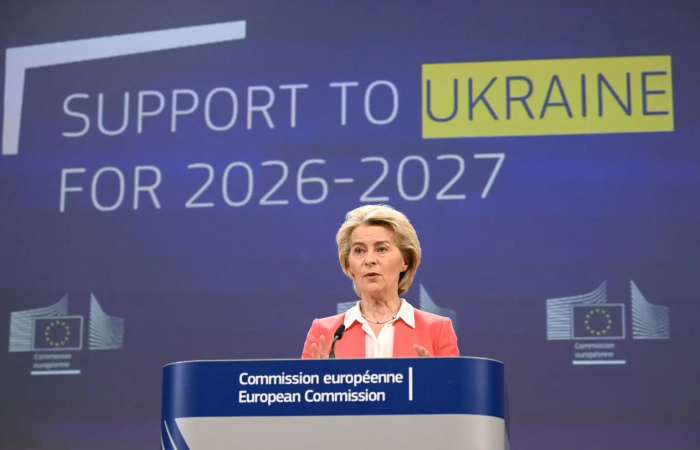
The European Union faces a series of high-stakes tests in its eastern neighbourhood that, just a few years ago, would have been treated as projects of the coming decade. Ukraine is pressing for accession terms tied to an eventual peace settlement, which raises questions of how far the bloc's enlargement architecture, designed for stable peacetime applicants, can be adapted to a country at war. A €90 billion EU loan package for Ukraine, of which €60 billion is earmarked for defence procurement, has reopened the unresolved argument over how far European money should fund European industry, given that capacity in critical areas remains well short of demand. And in the South Caucasus, Armenia heads to the polls on 7 June under heavy Russian pressure, including economic restrictions and warnings of a "Ukrainian scenario", testing whether small post-Soviet states can credibly diversify away from Moscow at all.
To discuss these issues, commonspace.eu welcomes Amanda Paul. Senior Policy Analyst and Deputy Head of the Europe in the World Programme at the Brussels-based European Policy Centre, she leads the EPC's work on Ukraine's European future and Global Türkiye. In this conversation, she sets out what a credible fast-track to Ukrainian EU membership would involve, examines the trade-offs in the "Buy European" defence debate, and discusses Russia's pre-election pressure on Armenia ahead of its parliamentary elections this coming Sunday.
“Intimidation is Russia’s calling card, if we can put it that way. It is not new, and it certainly will not be new to Prime Minister Pashinyan or any other Armenian official. This is what the Russians do. We cannot say that Russia’s intimidating narrative and messaging is empty, because it is not. We know that Russia still has leverage over Armenia in certain areas, and we have already seen them try to blackmail Armenia ahead of the elections. I am talking about restrictions on Armenian exports among other things.
This is damaging to the Armenian economy, as the Kremlins warnings about the economic consequences of getting closer to the EU. We have been hearing that for a long time, along with threats about ending discounted oil and gas supplies. Armenia still remains quite reliant on Russia for energy, but this is something that the government is trying to take in hand to the extent that it can, because Armenia’s geography does not do it any favours. There are no pipelines nearby, apart from the ones in Azerbaijan that could help them out in that respect.”
Read the full interview below:
Welcome, Ms. Paul. As someone who has built a career on regional expertise spanning Türkiye, the Black Sea, the South Caucasus, Ukraine and Moldova, when you started out, what did you think the job was, and how has that changed for you over time?
First of all, thank you for the invitation. I started my career believing that I would spend my whole career working on Türkiye, because Türkiye is often a career choice in itself. It is a major geopolitical actor with very dynamic and interesting domestic, foreign and security policy dynamics. So that is what I thought I would do, and I did that for the first few years of my professional career.
When the EU launched its EU’s European Neighbourhood Policy – I think in 2004 — I was given the European Neighbourhood Policy dossier. That is when I first started to work on the eastern flank countries and the South Caucasus. And that is what brought me to Ukraine first and foremost, which led me to developing a very strong expertise, particularly on the country, but also on the broader region, in addition to Russia, which I had also studied in the past.
On that Ukraine focus, Kyiv has recently rejected Merz’s “associate membership” to the EU suggestion as voiceless and unfair. So what would a fast, fair road to membership actually look like?
I am not sure that anybody has a real definition of what that would look like, which is why we have heard many different ideas floating around. I agree with President Zelensky’s rejection of Chancellor Merz’s associate membership idea, because it does not sound like a strong commitment to full membership, and particularly an expedited membership as promised many times by the EU as a geopolitical imperative for European security..
In fact, the issue of Ukraine’s membership is also foreseen as part of an eventual peace deal and this had already been elaborated in European proposals for a final peace agreement to the end of the war. Yet what that would look like in reality has not yet been thrashed out properly. The date of 1 January 2027 as a potential date for Ukraine’s membership has been proposed by several high ranking EU officials, but this is still very much an, open question.
One of the main pathways towards Ukraine’s EU accession being quicker than the usual process is through what they call gradual integration or phased integration. That would mean, for example, rapid integration into the EU single market, along with other key areas. Normally, processes that would take years and years, but could be done much quicker if there is the political will to do so. This is something that is viewed positively by Kyiv, so hopefully this will be taken forward.
This does not mean to say that there will not be a merit-based approach, because there still needs to be one, Ukraine needs to meet the criteria and benchmarks and align and carry out and implement crucial reforms, but it needs to be done quicker. What we have seen over the last few decades is a very slow approach, where every candidate country has had to spend an extremely long period of time meeting very rigid, but important, criteria for the opening and closing of chapters. This has been exacerbated by some member states blocking the process for bilateral reasons. Thus, there has been no new country joining since Croatia in 2013. Montenegro would seem to be the most likely next member.
Furthermore the enlargement methodology has changed. So now there are clusters that are opened rather than chapters, but there is still a very rigid approach to ensure that candidates don’t cut corners and this is as it should be. However, given the geopolitical imperative of enlargement, not least for security reasons, there is no need to create unnecessary hurdles to progress or new obstacles at bilateral level between individual member states and the candidate. Overall, there is likely to be some long transitional periods for Ukraine in certain areas, but this is nothing that cannot be sorted out if there is political will from the EU27 to actually move ahead with Ukraine, and also Moldova and the others.
Other experts I have spoken to said that before any accession talks, Ukraine will still have to contend with things like rule of law reforms and corruption. How do you think that will play into an eventual peace deal as well, if it becomes part of an eventual peace deal?
Ukraine, despite the full-scale invasion, has been able to carry out very consistent reforms across the areas that you just mentioned. We also need to bear in mind that earlier on, back when Ukraine was negotiating the Association Agreement and the Deep and Comprehensive Free Trade Agreement with the EU, many of these criteria regarding the rule of law and the fundamentals already existed, so they were not starting from scratch. But of course, it is not just about passing legislation. That is the easy part in many ways. And of course Ukraine is doing this during a full scale invasion which is also a challenge, but they are meeting that challenge.
It is about implementing this legislation, and across the country this also requires building up the capacity of municipalities and regional authorities in Ukraine to be able to do this effectively. I do not doubt that Ukraine will do this. And We have already seen the good news yesterday that the EU has finally agreed to open the fundamentals cluster with Ukraine, after months and months of it being blocked by Hungary. I think this will happen, next month, which will be an important step forward in terms of the accession process.
The next question is also on that €90 billion loan package for Ukraine. With the military component of it, we saw a split. France pushed to spend the defence money on European industry to build independence from Washington, while Germany and the Netherlands warned that would choke off systems Ukraine can't source at home in sufficient volume, like the Patriot system. The compromise was something like: European first, and turn to the US only where there's no alternative. Do you think this strikes an appropriate balance, and do you think that we will see the “Buy European” agenda in defence developing beyond this level?
I think it is a reasonable compromise: European suppliers first, but still allowing purchases from the US where no adequate European alternatives exist. The €90 billion will contributed to strengthening Ukraine’s defence capacity and procurement.
If we look at the bigger picture, Europe still remains in a challenging position. The Europeans have done many things to strengthen their own security and defence, and the industrial base and capacity across Europe has certainly been reinforced and increased in many countries. Still, the war has exposed many gaps in European production capacity, and long-term strategic autonomy requires building European defence industries in a much more robust, coordinated and sustainable fashion, including the integration of the Ukraine’s innovative and expanding defence sector. That is not going to happen tomorrow. So it means that Europe will still need to buy and rely on the US for certain military hardware and systems
For example, advanced air and missile defence, the famous Patriot missile system that we hear about all the time remains crucial for Ukraine, as well as for many other European countries. Thus this is something that they still need to procure from the Americans. What is key is shoring up European security, which includes Ukraine and if that means still buying from the US, then so be it.
Thus this is the only option for the moment, but we will definitely see a path forward that involves a reduction of reliance on the US. I think this is a good thing, but of course, it is tied to Europeans finding the necessary relevant finance to be able to continue to build up their own defence industry, which is another challenge. In addition, Ukraine will continue to play and increasingly central role in European defence, having the most power powerful military on the continent.
The EU has already come up with some large-scale financing mechanisms. This is already something that would have been unthinkable a short time ago and prior to the full-scale invasion, and is in part thanks to President Trump forcing Europe to be more responsible for their own security. Despite everything, we have some things to thank President Trump for: one of which is kicking many Europeans into actually doing something for their own security and defence while helping Ukraine at the same time.
My final question is going to be on the Armenian parliamentary election this week. Armenia’s population faces a momentous decision. Ahead of the 7 June elections, Russia has economically punished and threatened Armenia, even warning that it could face a “Ukrainian scenario” if it moves closer to Europe. Do you consider this a credible threat or mostly intimidation ahead of the vote?
Intimidation is Russia’s calling card, if we can put it that way. It is not new, and it certainly will not be new to Prime Minister Pashinyan or any other Armenian official. This is what the Russians do. We cannot say that Russia’s intimidating narrative and messaging is empty, because it is not. We know that Russia still has leverage over Armenia in certain areas, and we have already seen them try to blackmail Armenia ahead of the elections. I am talking about restrictions on Armenian exports among other things.
This is damaging to the Armenian economy, as the Kremlins warnings about the economic consequences of getting closer to the EU. We have been hearing that for a long time, along with threats about ending discounted oil and gas supplies. Armenia still remains quite reliant on Russia for energy, but this is something that the government is trying to take in hand to the extent that it can, because Armenia’s geography does not do it any favours. There are no pipelines nearby, apart from the ones in Azerbaijan that could help them out in that respect.
But again, looking to the election scenario, I am going to presume that Mr. Pashinyan will get re-elected. This is what it looks like, despite the large-scale Russian disinformation and all the other extraordinary lengths they go to in order to prevent that. Somewhere down the path, there will be an opportunity for Armenia to be linked up to the Azerbaijani gas system, which should help them diversify their energy supplies away from the bullying neighbour, Russia.
I think it is likely that Pashinyan and his government, are prepared for that scenario where there would be some sort cut off or intervention. However, Armenians won’t take such steps lying down. We have seen it in the past when Armenians have taken to the streets and protested. This is how the situation evolved in 2018 with the Velvet Revolution.
Armenians want a different type of life. They do not want to be controlled by external actors, particularly not the Russians. They want a more diversified foreign policy. They want free and fair elections and rule of law a better economic situation, more integration with the EU, and better ties with the US as well. And they area moving towards that. A key step includes is by normalising and finalising the peace agreement with Azerbaijan. This will open the door to the full opening of the border with Türkiye, which will be like a door to Europe, along with numerous connectivity projects that are currently being discussed,.
It is not going to be easy, and I am not naive enough to think that there is going to be a perfect panacea out there, because Armenia will continue to be challenged by Russia, as well as face many internal challenges which exist, and we all know they exist. But I think this is the only pathway for Armenia going forwards.
This interview was prepared with additional research support from Anjani Kumar, Junior Research Assistant at LINKS Europe.