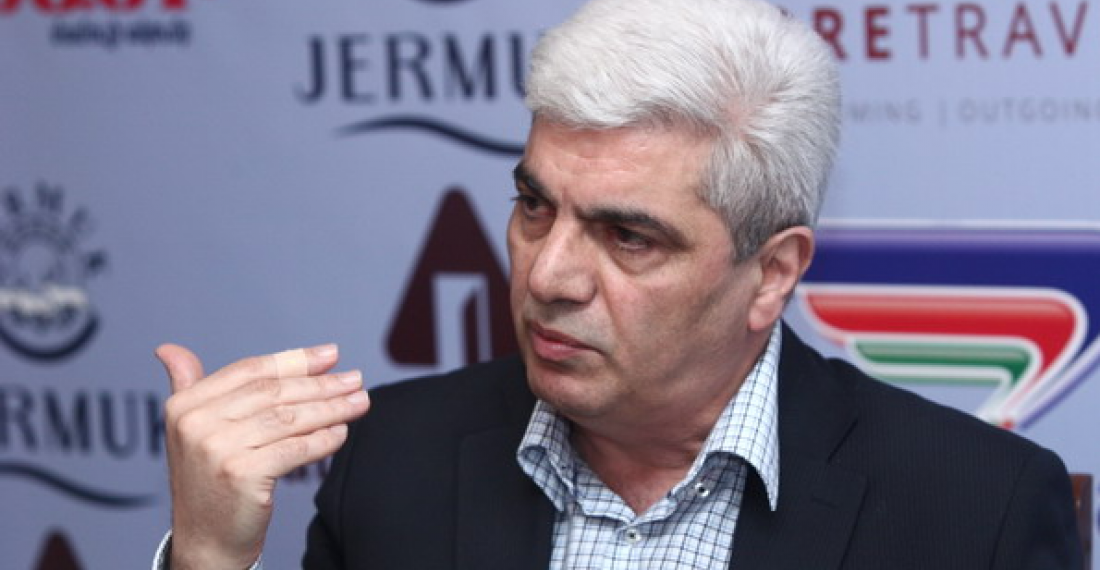
Dr Stepan Grigoryan, the Chairman of the Board of the Analytical Centre on Globalization and Regional Cooperation, is a respected analyst and opinion-shaper in Yerevan who has over many years been a moderate voice in what has often been a toxic inter-Armenian debate on the prospects for peace between Armenia and Azerbaijan and in the wider region. He spoke to commonspace.eu in Tbilisi on 22 October 2022 about the current state of the Armenia-Azerbaijan peace process, recent events surrounding it, and prospects for the future.
CS: How do you assess today’s relations between Armenia and Azerbaijan, especially after the incident of 13-14 September? And how did this, in your opinion, affect relations between the two countries?
SG: Firstly, Azerbaijan’s relations with Armenia are hostile, unfortunately. Even after the war of 2020 - which was a serious and difficult war - the situation could have calmed down and developments could have continued in a calmer fashion. But unfortunately Azerbaijan is following maximalist politics. Azerbaijan believes that they are now stronger, they think that Russia and Turkey are on their side, so they think they can take away as much as possible from Armenia. And unfortunately because of this politics we see aggressive actions against Armenia.
I wouldn’t call what happened on 13-14 September an incident, I would call it direct aggression against the territory of Armenia. I regret that it happened, and I really want to stress that it was very bad that such a development occurred. Because, after the end of the 2020 war, a chance for dialogue opened up, especially as Azerbaijan effectively got all seven territories surrounding Nagorno-Karabakh. So Azerbaijan could be satisfied with this and a chance for dialogue opened up. But I see that Azerbaijan, of course, wants to get everything it possibly could get, and because of this 13-14 September was classic aggression and incursion into the territory of Armenia.
CS: How do you think Armenia can resist this maximalist politics from Azerbaijan in the future in order to create a lasting peace?
SG: What is very important to understand is that the current Armenian government really wants peace. The reasons why they want peace are different, including the fact that Nikol Pashinyan does not have any connection to the 90s. In general, he never engaged with the Karabakh question. And therefore, as far as I see it, he is an advocate of trying to solve the Karabakh problem as quickly as possible, within the framework of the statement of November 9, 2020, mediated by Russia.
But when these big military actions against Armenia occurred on 13-14 September - when the Azerbaijanis move 6km deep into Armenian territory, when 7,000 out of Jermuk’s 10,000 residents flee - Pashinyan had no choice but to turn to the international community for help. This was a very important moment which I would like to note because my meetings with the Prime Minister of Armenia and with experts show that he really wants peace, and wants to sign a peace treaty. But this tough stance from Azerbaijan forces him to appeal to the West and the international community for help (UN Security Council and the OSCE) and the EU and OSCE have now sent their missions to the Armenia-Azerbaijan border. I hope that this mission will help to bring peace.
CS: You noted that Armenia appealed to Russia for help after the 13-14 September clashes. But we are currently seeing a decline in Russia’s influence on the global stage. What dangers and opportunities do you think this decline poses to Armenia?
SG: Of course, Russia has thrown huge numbers of soldiers into Ukraine. Russia didn’t think that Ukraine would be able to defend itself. Russia and Putin thought that Ukraine would surrender within a week, maximum. But as it turns out Ukraine has a pretty good army, and this war has therefore been dragged out for several months. This has taken away enormous power from Russia, and Russia is weakening. This is very clear to see. And, therefore Russia is finding it very difficult to control the situation in the South Caucasus. The appetites of Azerbaijan and Turkey are all very big, and so all players have their own interests. So Russia, yes, is partially withdrawing from the region, but hardly voluntarily. But they don't have enough resources. And what is very important here is that Russia, in this situation, chose to cooperate with Azerbaijan and Turkey against Armenia.
I am confident that this policy is misguided, this is the first thing. The second is that Azerbaijan continues to attack us simply because Russia is weakened. Therefore it is obvious that the weakening of Russia is destabilising the region. And the greatest danger is that if Russia loses in Ukraine - and I believe that Russia will lose - then Russia itself will begin to destabilise. The country would begin to collapse and this is a danger for all of us. The destabilisation of Russia would mean that they would withdraw their peacekeepers from Karabakh, and from their military bases in Armenia. So there is already a new kind of dynamic, and this is always undoubtedly a danger. I am not saying that it is very good that Russia has military bases in Armenia, we don’t win anything from this. But the very fact that these tectonic changes are happening results in tensions in the region.
CS: And do you think there will be some opportunities for Armenia because of the weakening of Russia in the South Caucasus?
SG: Well, on the one hand, dangers arise. Azerbaijan will start acting more independently, with Turkey against us. But there are opportunities. Why? Because France, the USA, and the EU are assessing the current development of events that are happening in Ukraine, and in the South Caucasus. France and the EU realised that the South Caucasus could begin to destabilise, and so they came here because they have a common interest in keeping the South Caucasus stable. Or at least relatively stable, so that there isn’t a big, new war. That’s why they actively came here. They have lots of other problems, but the Americans understand that another big front could open up somewhere, like in Ukraine. Therefore, the Americans are now active in the South Caucasus, the EU are also very active in wanting to help Armenia and Azerbaijan, and President Macron too. But these aren’t just coincidences, they didn’t come here just for Armenia’s sake. They understood that a large destabilisation could start here because Russia is weakening. So that’s why they came here, to try and find a solution.
CS: Concerning the domestic situation in Armenia, we see that there are strongly divergent views between the government of Nikol Pashinyan, and the Armenian population. How do you think one can reconcile these opposing views within Armenia?
SG: I wouldn’t say that about Nikol Pashinyan, at the moment he has a high approval rating. I would say this: it is true to say that there is great polarisation in our society, but a polarisation between whom? It is a polarisation between Nikol Pashinyan, and the so-called “pro-Russian opposition” in parliament. That is where the polarisation is strong. But this “pro-Russian opposition” in parliament had about 20-25% approval, now this support has undoubtedly decreased. So this faction strongly criticises Pashinyan, but there is no-one else. There is of course extra-parliamentary opposition and criticism, but there is no hate there.
What does this pro-Russian faction say? They say, “why are you bringing the West into the region? Why are you working with Europe, with the USA? Don’t collaborate with them, only with Russia.” But Russia at the moment is demanding concessions from us, together with Azerbaijan. They say “yes, you should give away everything.” So this opposition is not acting like an Armenian opposition, but like a 5th column. They say “if Russia says you should reject independence, then you should reject independence”. So this is not a typical opposition like in European countries which say “you have bad policies, but I have better ones.” No. They say that Pashinyan should do what Putin tells him to do. European countries have never encountered anything like this, and so they don’t understand what is going on. People say “why are you not listening to the opposition?” Well, it is not an opposition. It is an 5th column. And this is a problem we have. So on the one hand we are a democracy, they have the right to criticise and to say what they want to. But on the other hand they are controlled from the outside.
But what do we have that is good? We have a strong civil society, active NGOs and active experts, and they act like pillars of independence in Armenia. And this civil society also criticises Nikol Pashinyan, but they are trying to help him. Yes, I myself am sometimes not happy with what Nikol Pashinyan is doing, but I try to help him with my advice, with my publications, with my speeches. So in Armenia one should not only look at the political field - which is polarised - but civil society too. We shouldn’t think that we have an ideal government, they have made many mistakes, but they really want peace.
CS: At the very least, I think we can say that in order for there to be peace between Armenia and Azerbaijan, both countries need to make concessions. Which concessions do you think Azerbaijan should make? And which concessions do you think Armenia should make?
SG: I will only talk about the situation today, because a month ago I would have said something else as the situation is always changing. I think that Azerbaijan should renounce maximalism. For example, Armenia says they will build a road, open it, and let Azerbaijanis travel between mainland Azerbaijan and Nakhchivan. But Azerbaijan should reject the idea of a corridor. We [Armenia] should control this road, and Azerbaijan should control Azerbaijani roads. Azerbaijan should note that we are offering them a route - a non ex-territorial route - between mainland Azerbaijan and Nakhchivan. Azerbaijan should agree to this and Armenia should agree to providing this road, and this would be our concession. I can’t say it would really benefit us, but in principle we should agree to give Azerbaijan a road, but with our customs controls, security, and passport controls when they cross. So I think that we should give them a road, but the Azerbaijanis should not demand ex-territorial control over it. I think this should be the main compromise.
Armenia should also agree to the delimitation and demarcation of the border. Why does Armenia only half agree to this, and half not? Because Azerbaijan entered our territory in certain locations, and we say that they should withdraw their troops from Armenian territory. Then we would be ready to delimit and demarcate the border, which is right. How can you delimit and demarcate a border when foreign troops are on your territory? But I think that Armenia should agree to delimitation and demarcation of the border in line with international norms. So I would say that these concessions are not really concessions, but simply approaching the problem rationally.
CS: Do you think that the attack on Armenia on 13-14 September was a strategic mistake by Azerbaijan? And do you think that it could be the start of Azerbaijan abandoning maximalist policies?
SG: I would simply say this to Azerbaijan: “Just think. Is it worth continuing like this?” I can give one possibility of what awaits them if they continue to strike Armenia. Sanctions will start. Take my word for it, I am an international expert. I know that they don’t believe this in Azerbaijan. But there will be. Because I meet with lots of diplomats, with internationally recognised experts, I sense all tendencies of the delegations that visit Armenia, the formal ones and the informal ones. The world has established that Putin has sided with Aliyev, and this is hurting Aliyev’s rating badly. Everyone has understood that Putin is supporting Aliyev. This means that sanctions on Putin would spread to sanctions on Aliyev.
So I would suggest the following to Azerbaijan, so that there isn't any escalation. Stop with this aggression against Armenia, you have already got a lot. If Azerbaijan continues with this aggressive policy, I predict that sanctions would start somewhere in December. The EU wouldn’t be the first to impose sanctions; first it would be the France and USA, and then later the EU.
And there is one last thing I would say. Of course, some kind of civil society involvement - so for example when Armenian experts meet Azerbaijani experts - all these things are necessary. It’s very hard to talk when, unfortunately, there are cases of war crimes against Armenian prisoners of war. Such things are undoubtedly bad and not right. But even so, civil society, track 2, or track 1.5 initiatives must continue to meet and move forward, and talk to each other face-to-face, because peace needs to be built in the region no matter what. Of course, non-regional players all have their own interests and so on, but in the end, no matter what, you have to try and build a relationship. So I want to say that I would very much welcome any track 2 initiatives.