GEU Podcast: Giving EU citizens a voice on foreign policy – with Dr Dennis Sammut

“I think what is important is that the issue of international affairs is understood not to be an elitist sphere but something that impacts the lives of everyone in one way or another; and as a result, discussions on foreign policy need to be extended to include the wider citizenry. This is a challenge going forward and an increasingly important one.”

[The podcast is also available on all of the usual channels, including Apple Podcasts, Spotify and Google Podcasts]

In series two of Global Europe Unpacked, commonspace.eu is collaborating with the City of The Hague to bring you several conversations looking at the future of Europe in the world. This series runs alongside the EU’s largest citizen consultation to date, the Conference on the Future of Europe. Our objective is to spark your interest in some of the important issues under discussion and encourage you to get involved.

Since September 2021, the action-oriented thinktank LINKS Europe and The Hague Municipality, with the support of The Hague Humanity Hub, have hosted a series of 10 citizen-dialogue events on various issues of international concern. Titled, ‘The Hague Conversations on the Future of Europe in the World’, the events ran in framework of the EU’s Conference on the Future of Europe, and were a chance for European citizens to share their thoughts and ideas on the what the EU is doing and what it needs to do better.

The final report summarising the prevailing trends and ideas to come out the series of citizen dialogues can be found here, and the reports from each of the thematic events are available here

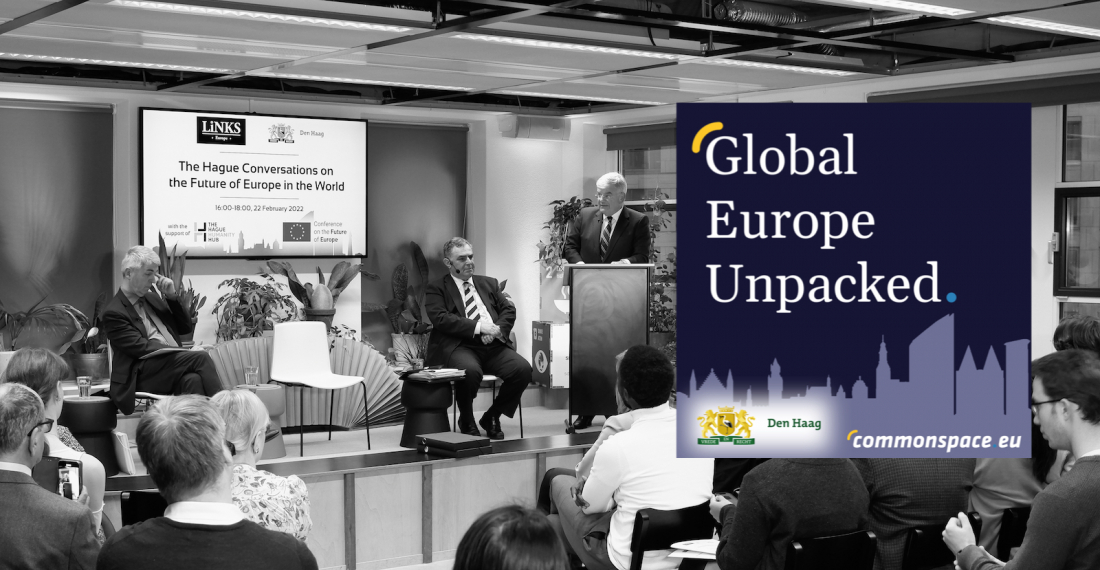
To unwrap the main findings of the events series, in this episode, Will Murray is joined by Dr Dennis Sammut, the Director of LINKS Europe and Managing Editor of commonspace.eu. There are also excerpts from speeches by the European Commission’s Ivo Belet and the Mayor of The Hague, Jan van Zanen, from the closing event of The Hague Conversations in the Future of Europe in the World, which took place at The Hague Humanity Hub on 22 February 2022. You can watch the full video from the closing event here.

Amongst other things, this episode covers:

  • The prevailing thoughts and ideas to emerge from The Hague Conversations on the Future of Europe in the World
  • The need for the EU to listen and communicate better with citizens, and to better involve citizens in international affairs
  • Why discussion on EU softpower has not been made superfluous by the invasion of Ukraine
  • How the concept of a global Europe is perceived by European citizens
  • The primary importance of the EU’s neighbourhood in realising its global ambitions
  • Why it is important to bridge the gap between the local and the international
  • The role of the City of The Hague and other municipalities as bridges between the EU and local citizens

The Conference on the Future of Europe’s online platform can be accessed here.
 

Photos: Ivo Belet, Dennis Sammut, and Mayor Jan van Zanen at the closing event of The Hague Conversations on the Future of Europe in the World at The Hague Humanity Hub on 22 February 2022; Holland Park Media

Related articles

Editor's choice
News
Borrell tells the European Parliament that the situation in Afghanistan was critical, but the EU will remain engaged

Borrell tells the European Parliament that the situation in Afghanistan was critical, but the EU will remain engaged

Borrell underlined that the European Union will make every effort to support the peace process and to remain a committed partner to the Afghan people. "Of course, we will have to take into account the evolving situation, but disengagement is not an option.  We are clear on that: there is no alternative to a negotiated political settlement, through inclusive peace talks.
Editor's choice
News
Pope's visit to Türkiye and Lebanon has a strong ecumenical character, and places interreligious dialogue at its centre

Pope's visit to Türkiye and Lebanon has a strong ecumenical character, and places interreligious dialogue at its centre

Pope Leo XIV has begun the first overseas trip of his pontificate, a six-day visit to Türkiye and Lebanon, which started yesterday (27 November) and ends on Tuesday (2 December). According to Vatican Radio, the visit "carries a strong ecumenical character and places interreligious dialogue at its centre. It will also be a moment of closeness to Christian communities and local populations across the region".   During nearly a week in the region, Pope Leo XIV will meet civil and religious authorities, visit mosques and ancient churches, pray at Beirut’s port in memory of the victims of the 2020 explosion, and hold private meetings with Presidents Recep Tayyip Erdoğan and Joseph Aoun.   A highlight of the visit will be a visit to Nicaea, where the Pope will mark the anniversary of the Council of Nicaea. Christians of many traditions recognise the Council of Nicaea as a foundation of shared faith. One of the most anticipated moments will be the Pope’s encounter with Lebanese youth in Bkerké, at the Maronite Patriarchate, a meeting expected to carry strong messages of hope in the Jubilee Year. A central event will be the ecumenical celebration in İznik, where the Pope and Ecumenical Patriarch Bartholomew will walk together toward the ruins of the Basilica of St Neophytos. The prayer, held before icons of Christ and the Council, will conclude with the lighting of a candle—a symbolic gesture of unity. The journey will also highlight interreligious engagement.   Memorable moments are expected throughout the trip: a wreath at Atatürk’s mausoleum, prayer inside the Blue Mosque, Mass at Istanbul’s Volkswagen Arena, the planting of a cedar at the presidential palace in Beirut, and prayer at the tomb of St Charbel in Lebanon. The Vatican said that "Pope Leo XIV’s pilgrimage to Türkiye and Lebanon aims to offer a voice of peace, unity, and hope at the heart of the Middle East."

Popular

Editor's choice
News
Pope's visit to Türkiye and Lebanon has a strong ecumenical character, and places interreligious dialogue at its centre

Pope's visit to Türkiye and Lebanon has a strong ecumenical character, and places interreligious dialogue at its centre

Pope Leo XIV has begun the first overseas trip of his pontificate, a six-day visit to Türkiye and Lebanon, which started yesterday (27 November) and ends on Tuesday (2 December). According to Vatican Radio, the visit "carries a strong ecumenical character and places interreligious dialogue at its centre. It will also be a moment of closeness to Christian communities and local populations across the region".   During nearly a week in the region, Pope Leo XIV will meet civil and religious authorities, visit mosques and ancient churches, pray at Beirut’s port in memory of the victims of the 2020 explosion, and hold private meetings with Presidents Recep Tayyip Erdoğan and Joseph Aoun.   A highlight of the visit will be a visit to Nicaea, where the Pope will mark the anniversary of the Council of Nicaea. Christians of many traditions recognise the Council of Nicaea as a foundation of shared faith. One of the most anticipated moments will be the Pope’s encounter with Lebanese youth in Bkerké, at the Maronite Patriarchate, a meeting expected to carry strong messages of hope in the Jubilee Year. A central event will be the ecumenical celebration in İznik, where the Pope and Ecumenical Patriarch Bartholomew will walk together toward the ruins of the Basilica of St Neophytos. The prayer, held before icons of Christ and the Council, will conclude with the lighting of a candle—a symbolic gesture of unity. The journey will also highlight interreligious engagement.   Memorable moments are expected throughout the trip: a wreath at Atatürk’s mausoleum, prayer inside the Blue Mosque, Mass at Istanbul’s Volkswagen Arena, the planting of a cedar at the presidential palace in Beirut, and prayer at the tomb of St Charbel in Lebanon. The Vatican said that "Pope Leo XIV’s pilgrimage to Türkiye and Lebanon aims to offer a voice of peace, unity, and hope at the heart of the Middle East."