As Georgia prepares to enter in a new Association relationship with the EU, euroscepticism makes an appearance in an unlikely form ahead of poll.
Joseph Alexander Smıth reports from Tbilisi for commonspace.eu.
Weeks away from signing an historic association agreement with the EU, on the eve of local elections, Georgian voters may well mimic the EU's recent eurosceptic turn at the polls.
Nana shifts uncomfortably in the sweltering heat. "Why do we need Europe?" she asks. "Morality is more important than money. We have nothing to learn from Europe." Behind her, a large banner reads "homosexuality is a sin and a pathology". An amplified speech delivered from the steps of the old parliament building on Tbilisi's central Rustaveli Avenue decries the "perversion" and "propagandism" of gay-friendly European states.
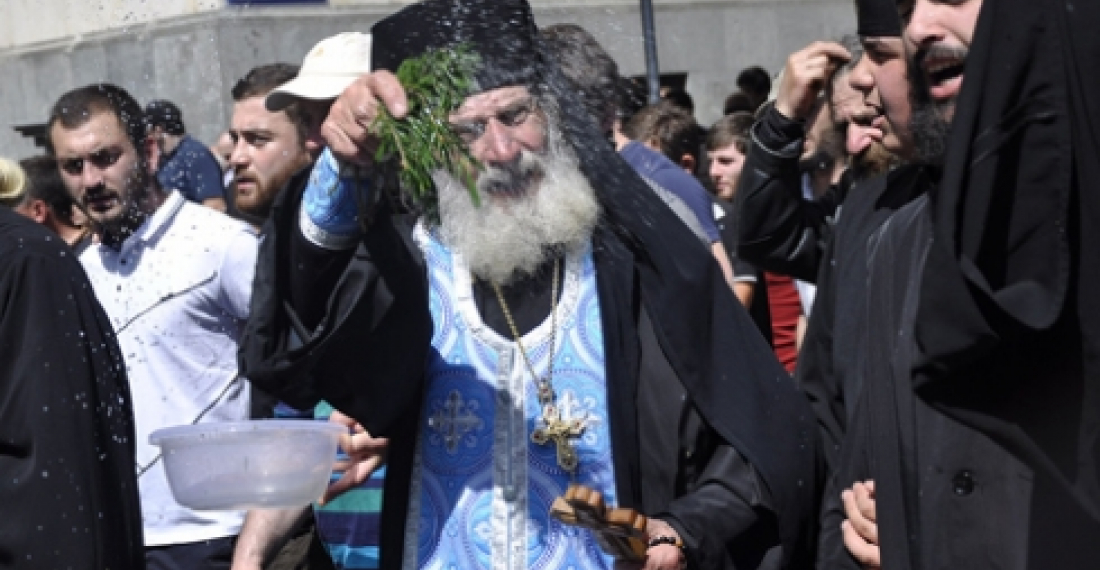
It's May 17 in central Tbilisi, a day many observe as the International Day against Homophobia and Transphobia (or "IDAHO"), but which the Georgian Orthodox Church has re-branded as a Day of Family Strength and Respect for Parents in response to what it calls the "propaganda of homosexuality". Last year's IDAHO rally was violently dispersed after thousands of Orthodox counter-demonstrators, led by clergy, broke through police cordons and attacked the buses in which anti-homophobia activists were being evacuated.
This year, there was no IDAHO rally, but thousands of Orthodox faithful heeded the Church's call to take to the streets on May 17 to defend "traditional family values" against the recent adoption of an anti-discrimination law by Georgia's fervently pro-European government. The law is a pre-condition for a highly-desired visa liberalization deal with the EU, and among other things, outlaws discrimination based on sexual and gender identity.
Georgia's Church leadership was furious at the adoption of this bill, which it claims "legalizes sin", with clergy storming out of a meeting with parliamentarians once it was clear the legislation would be accepted by parliament. One cleric told beleaguered deputies he would stop praying for them. One MP said she felt she could never go to church again.
The confrontation between the government and church conservatives, just weeks before local authority and mayoral elections, has brought into focus a simmering scepticism about Georgia's European orientation. The Georgian government is due to sign an historic Association Agreement with the EU at the end of June, and will also join the EU's Deep and Comprehensive Free Trade Area.
Opinion polls consistently show a conservative attitude to gay rights among Georgian society. According to an NDI-commissioned poll in July last year, 79% of respondents disapproved of the May 17 anti-homophobia demonstration, while only 49% disapproved of the violence carried out by orthodox counter-protesters. 52% said that protecting the rights of sexual minorities was not important for Georgia. There is a widespread perception in Georgia's conservative society that the EU is excessively supportive of sexual minorities and is actively promoting 'non-traditional' sexual relationships.
In addition to this, events in Ukraine have had a paradoxical effect on the Georgian political climate. On the one hand, Russia's annexation of Crimea brought back traumatic memories of Georgia's territorial conflicts in Abkhazia and South Ossetia, galvanizing public support for closer relations with the EU in order to counter the threat of Russia.
For others, however, the perceived inaction of the EU in response to the Crimea crisis has led some to believe that Georgia might be better off avoiding confrontation and dropping its EU and NATO integration plans in favor of developing more friendly relations with their powerful neighbor.
"The US was perceived as a much more unequivocal ally for Georgia", says Nino Dolidze, Professor of Public Administration at the Georgian Institute of Public Affairs (GIPA). "By contrast, the EU seems a much more reluctant partner".
Europe's failure to act decisively in Ukraine during the Crimea crisis has led many Georgians to believe that the EU isn't serious about their security concerns. This impression has only been reinforced by German Chancellor Angela Merkel's recent comments that a long-coveted NATO membership action plan for Georgia will likely not be on the agenda at the organization's upcoming summit in Wales.
Many Georgians are also anxious about closer economic integration with the EU. The Georgia's EU trade turnover was 2.87 billion USD in 2013, representing 27% of the country's total, with Georgian exports accounting for 608 million USD. However, according to Dolidze many Georgians perceive Russia as a more viable export market, and have concerns about the potential costs of meeting EU trading standards.
Some politicians have sought to capitalize on this surge of anti-gay and anti-EU sentiment ahead of the elections. Nino Burjanadze, a former-comrade-turned-bitter-opponent of ex-President Mikheil Saakashvili, has allied her Democratic Movement party to the conservative Christian Democrats to contest the local elections.
Burjanadze, who came third in last year's presidential election, is widely perceived to be in favor of restoring better relations with Russia, advocating a more 'open' foreign policy. Reacting to the adoption of the anti-discrimination law, Burjanadze suggested it would encourage children to accept a "non-traditional orientation", and added that "if the choice is as follows - to accept incest or stay where we are - I want to stay in my country."
Her party's candidate for mayor of Tbilisi, Dimitri Lortkipanidze caused an outcry in 2009 when, as a candidate for the role of Public Defender, he called for the re-criminalization of homosexuality in Georgia. The latest political ratings put him in third place. The party's majoritarian candidate for central Tbilisi's Mtatsminda district, Guram Palavandishvili, also leads the conservative Union of Families of Georgia, which led protests against the anti-discrimination law on May 17th.
Dolidze believes that Burjanadze represents a "real threat, because she knows how to play the right political games." Saakashvili's UNM-led government, which was ousted in 2012, was widely perceived as trying to undermine the position of the Church, says Dolidze. With the adoption of the anti-discrimination law and electronic ID cards - which some conservative clergy believe to carry the seal of the devil - many are now "pointing fingers at the ruling party" and looking for an alternative. According to Dolidze, Burjanadze's party could take up to 20% of the vote in the capital, representing a serious blow for the ruling party and the opposition alike.
Back on Rustaveli Avenue, the crowd's rejection of the anti-discrimination law is resolute. "This is not my opinion, is everyone's opinion" says Nana. "People are not going to let this happen." The local elections for many will be a confidence vote in Georgia's lurch towards Europe. It remains to be seen just how much deep-seated anxieties about European integration will shape the poll results.
Joseph Alexander Smith is a freelance journalist based in Tbilisi. He writes regularly for the national newspaper Georgia Today. He contrıbuted this report for commonspace.eu.
Photo: Conservative Orthodox priests have emerged as the unlikely leaders of Gerogia's eurosceptic movement. (pıctutre courtesy of civil.ge).