


In the first in a series of reports for commonspace.eu Tbilisi based freelance journalist Joseph Alexander Smith examines the political landscape ahead of local elections in Georgia due on 15 June..
Georgians will go to the polls on June 15 to elect local officials after reforms to the country's system of local government were adopted in February this year. Georgia's new Law on Local Self-Government allows for the direct election of mayors in 12 cities across Georgia and for the election of all heads of municipalities in the country. Previously only the mayor of Tbilisi was chosen by citizens.
The ruling Georgian Dream coalition is widely expected to consolidate gains made at the polls over the last year and a half. The coalition, then headed by billionaire businessman Bidzina Ivanishvili, defeated President Mikheil Saakashvili's United National Movement (UNM) in parliamentary elections in October 2012, bringing an end to the UNM's 9-year hold on power.
Last year Saakashvili himself, having completed the maximum two presidential terms allowed by the constitution, was replaced as head of state by Georgian Dream candidate Giorgi Margvelashvili. The election also saw in constitutional changes which transferred many key presidential powers to the prime minister.
Until now, the UNM have maintained control over the office of Tbilisi Mayor, although Mayor Gigi Ugulava, who was elected in 2010, was suspended from office by Tbilisi's City Court after facing charges of misspending public funds. The mayor's suspension raised concerns, both domestically and among Georgia's EU and US partners, of a 'witch hunt' against UNM officials. Georgia's Constitutional Court has since ruled in favor of allowing Ugulava's to appeal against his suspension. To allay any further concerns, Prime Minister Irakli Gharibashvili has also announced a moratorium on prosecutions of public officials in the run-up to the elections.
The US-based National Democratic Institute (NDI) sent a mission to assess the pre-election environment at the end of April, concluding that while the political climate in the country is characterized by "pluralism and activism", "polarization continues to be a problem".
According to NDI's statement, delivered on May 2, "voters felt confidence in the results of the 2012 parliamentary and 2013 presidential elections, which led to peaceful transfers of power... As the June 15, 2014, local elections approach, the electoral administration appears equipped to support a credible process, and the legal framework, while still open to improvement, provides a solid foundation."
The NDI mission also pointed out some areas of concern, saying that "efforts to delegitimize and criminalize political adversaries are still commonplace. The line between state and party remains blurred. Allegations of politically-motivated harassment tarnish an otherwise vibrant political landscape."
Civil society groups in Georgia have also voiced concern over a provision in the new local self-government law that allows local councils to vote out the elected mayor or head of the municipality (gamgebeli in Georgian). A joint statement by three leading NGOs warned that the provision "weakens the importance of the institution of directly elected mayors and gamgebelis" and makes them dependent on local councils for political support.
The new legislation also faced opposition from the Church last December, when the leader of the Georgian Orthodox Church, Patriarch Ilia II labelled the law a "threat" that could bring about the "disintegration" of the Georgian state. A politician from the Christian-Democratic Movement also suggested that the new legal framework could lead to "regional separatism". In response to these criticisms, a group of 23 NGOs urged the government not "suspend the reform process" or "back away" from a key pre-election promise to deliver "citizen-oriented self-government".
A total of 87 mayoral candidates have been registered by Georgia's Central Election Commission, representing 20 political parties and 4 electoral blocs. The Georgian Dream coalition, which is leading in opinion polls, unites six parties, including the Republican Party and Defence Minister Irakli Alasania's Free Democrats. The UNM, still headed by Saakashvili, is the largest opposition party, holding 65 out of 150 seats in parliament. A coalition headed by Nino Burjanadze, a former ally of Saakashvili and key figure in the 2003 Rose Revolution, is in third place.
The most closely-watched mayoral contest will be in Tbilisi, where Georgian Dream's candidate, former Infrastructure Minister Davit Narmania, will face the UNM's Nika Melia, head of the city's Mtatsminda District. Despite having the backing of the ruling party, Narmania's campaign has met with a fairly cool response from the electorate, with some asking whether a native of West Georgia's Samegrelo region is the best candidate for Mayor of the capital city.
In a pre-election poll commissioned by the NDI in April, Narmania was endorsed as first choice by 39% of respondents in the capital, followed by Nika Melia with 10%. 20% remained undecided and 13% said they wouldn't vote for any candidate. If Narmania fails to reach the threshold of 50% of the vote, a run-off election will be required to select a mayor for Tbilisi.
In other cities which will elect a mayor, Georgian dream is sitting on a fairly comfortable lead in the polls, with 42% of respondents saying it is the party they most closely identify with. Still, a win across the board is not guaranteed, with as much as 35% of those polled in the Black Sea port of Batumi unsure who they'll vote for.
Joseph Alexander Smith is a freelance journalist based in Tbilisi. He writes regularly for the national newspaper Georgia Today. He contributed this report for commonspace.eu
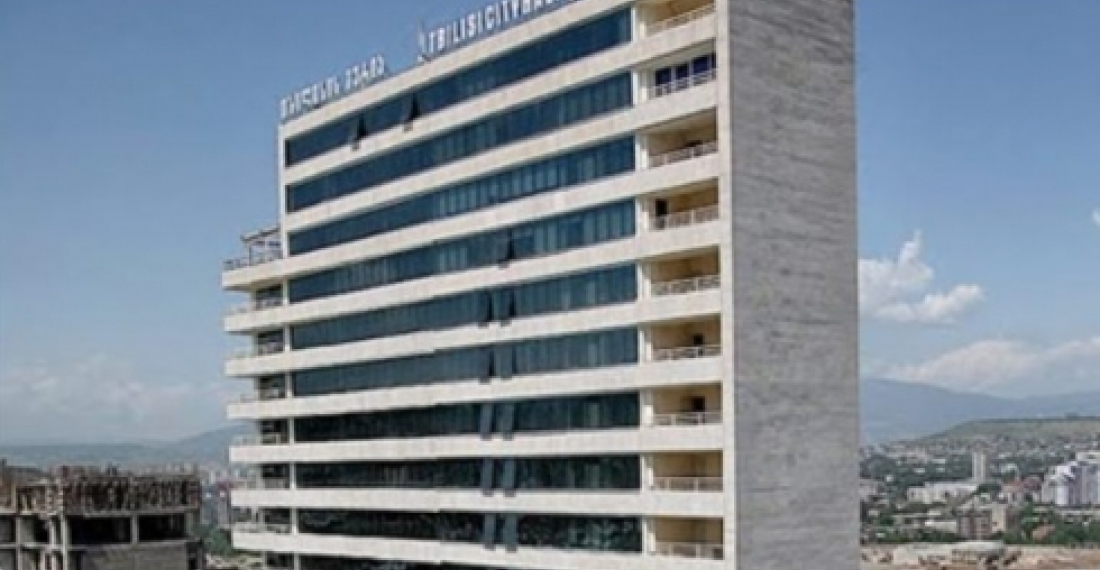
photo: Tbilisi City Hall



