The main stage of negotiations on the strategic partnership agreement between the EU and Azerbaijan will be completed in summer 2016, said Herbert Salber, the EU special representative for South Caucasus, in an exclusive interview with Trend in Baku March 17.
He said the new strategic partnership agreement between EU and Azerbaijan is bound to cover all the potential areas of cooperation.
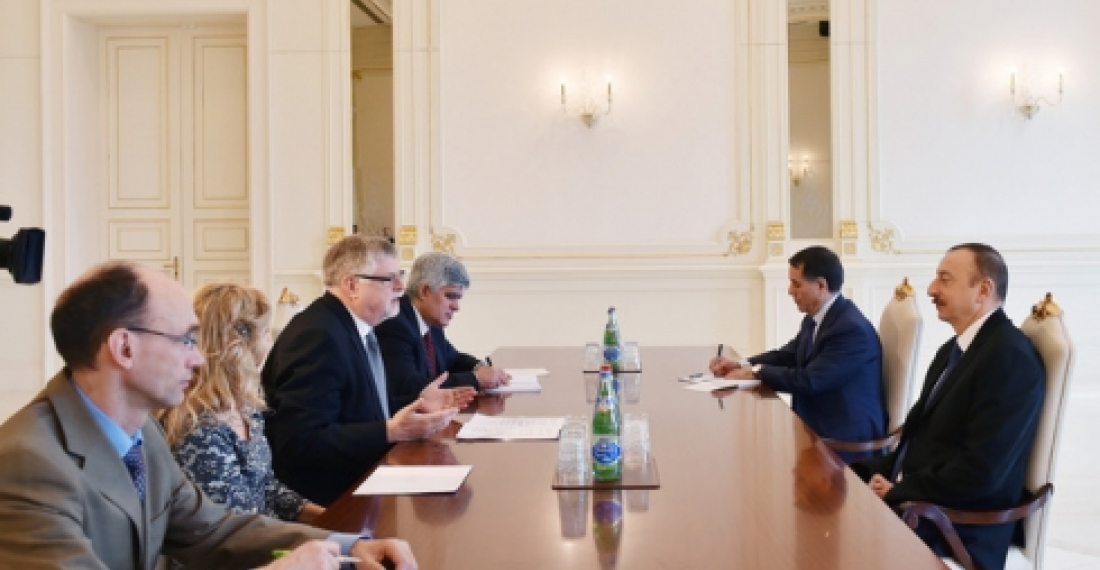
"I had meetings with Azerbaijani President Ilham Aliyev, Foreign Minister Elmar Mammadyarov," he said. "I covered a big spectrum of interest for me."
"During the meetings, we discussed the Nagorno-Karabakh conflict settlement, few issues that followed up to the visit of Federica Mogherini, vice-president of the European Commission, high representative of the EU for foreign affairs and security policy," he said.
He also said the relations between the EU and Azerbaijan have good prospects, adding that Mogherini's recent visit to Azerbaijan confirmed the willingness of both sides to develop the bilateral cooperation.
President of the Republic of Azerbaijan Ilham Aliyev stressed that the visit of Vice-President of the European Commission, High Representative of the European Union for Foreign Affairs and Security Policy Federica Mogherini to Azerbaijan was successful and fruitful. Hailing the cooperation between Azerbaijan and the European Union, President Ilham Aliyev said there were good prospects for future partnership.
During the meetimg with the Foreign Minister Elmar Mammadyarov the sides exchanged views on the current status of the relations and prospects of development between Azerbaijan and EU, expressed mutual interest for the development of cooperation.
Speeking about the negotiations process over the settlement of the Armenia-Azerbaijan conflict the Minister emphasized the importance of establishing contacts and dialogue between the Azerbaijani and Armenian communities of Nagorno-Karabakh region of Azerbaijan.
Salber on his part said the settlement must be achieved first and foremost by the both parties involved.
"International community can make proposals for settlement of the conflict," he said. "But the choice should be made by the actors involved."
"The negotiations on the conflict settlement have been lasting for more than 20 years," said Salber. "All the potential proposals have been on the table. This is the matter of making choice."
Salber positively assessed his visit to Azerbaijan.
source: commonspace.eu with president.az, trend.az and other agencies