Erkin Gadirli: I fully support widening and deepening of relations between Azerbaijan and EU

Prominent opposition politician and thinker in Azerbaijan, Erkin Gadirli, who is a board member of the Alternative REAL Movement, welcomed ongoing negotiations between the European Union and Azerbaijan aimed at concluding a new framework agreement to regulate relations between them. Gadirli said that contacts between the EU and Azerbaijan should be deepened and widened. 

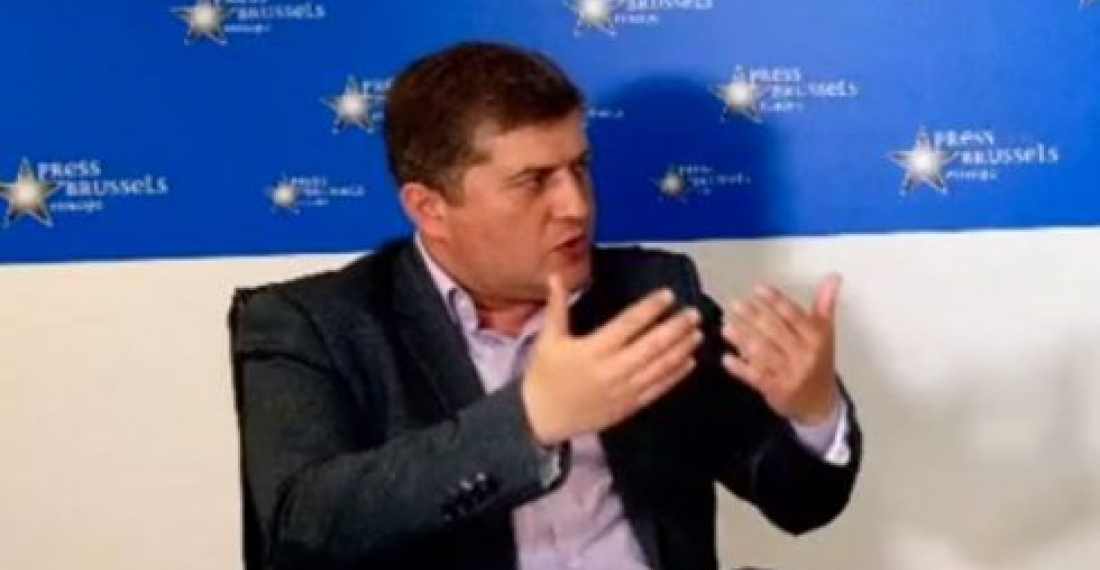
Gadirli was speaking on Monday (15 May) at the Brussels Press Club, at the heart of the European capital, as guest of the organisation LINKS (Dialogue, Analysis and Research), as part of its series "Voices and Conversations". 

In the conversation with the LINKS Director, Dr Dennis Sammut, Erkin Gadirli said that European insititutions must pay more attention to what civil society and opposition forces have to say on many issues of EU-Azerbaijan relations, and a way needs to be found that would be suitable for all sides, to include them in the dialogue. This, Gadirli said, was exactly what happened in the 1990s when the first EU-Azerbaijan agreement was being discussed, and it was then considered a useful and necessary process.

Speaking on the Karabakh conflict Gadirli said that Azerbaijan is entitled under article 51 of the UN Charter to use force to liberate its occupied territories, but war was the least desirable option, and whilst Azerbaijani society was united on a common position on the Karabakh issue, Azerbaijan society was overall peaceful and tolerant and saw the benefit of dialogue to achieve a solution.

Speaking about the domestic political situation in Azerbaijan Gadirli said that the REAL Movement will use all legal means to push forward its ideas and get its message out to the Azerbaijani public. This includes through participation in elections.

source: "Conversation with Erkin Gadirli" is part of the series Voices and Conversations, a LINKS DAR initiaive in association with commonspace.eu. Views voiced do not necessarily reflect the opinion of LINKS (DAR), commonspace.eu, or their members, partners and supporters.

Photo: Erkin Gadirli at the Brussels Press Club on Monday 15 May 2017 (c) commonspace.eu
Related articles

Editor's choice
News
Russian attacks on Kyiv and other Ukrainian cities highlights need of strengthening European resolve

Russian attacks on Kyiv and other Ukrainian cities highlights need of strengthening European resolve

Ukrainian President Volodymyr Zelensky condemned the attack, writing on X that it proved that US and European sanctions against Russia should not be weakened. Russia launched more than 700 drones and missiles at Ukraine in multiple waves overnight from Wednesday to Thursday, killing at least 18 people in what local officials said was the deadliest attack in months. Ukraine's air force said on Thursday morning that Russia had launched 659 drones and 44 cruise and ballistic missiles in the prior 24 hours. It said that 636 drones and 31 missiles had been shot down - but there had been direct hits in 26 locations. (click picture to read more)

Popular

Editor's choice
Interview
Thursday Interview: Murad Muradov

Thursday Interview: Murad Muradov

Today, commonspace.eu starts a new regular weekly series. THURSDAY INTERVIEW, conducted by Lauri Nikulainen, will host  persons who are thinkers, opinion shapers, and implementors in their countries and spheres. We start the series with an interview with Murad Muradov, a leading person in Azerbaijan's think tank community. He is also the first co-chair of the Action Committee for a new Armenian-Azerbaijani Dialogue. Last September he made history by being the first Azerbaijani civil society activist to visit Armenia after the 44 day war, and the start of the peace process. Speaking about this visit Murad Muradov said: "My experience was largely positive. My negative expectations luckily didn’t play out. The discussions were respectful, the panel format bringing together experts from Armenia, Azerbaijan, and Turkey was particularly valuable during the NATO Rose-Roth Seminar in Yerevan, and media coverage, while varied in tone, remained largely constructive. Some media outlets though attempted to represent me as more of a government mouthpiece than an independent expert, which was totally misleading.  Overall, I see these initiatives as important steps in rebuilding trust and normalising professional engagement. The fact that soon a larger Azerbaijani civil society visits to Armenia followed, reinforces the sense that this process is moving in the right direction." (click the image to read the interview in full)