PUTIN SAYS THE UNITED STATES ATTEMPTS TO DOMINATE THE WORLD
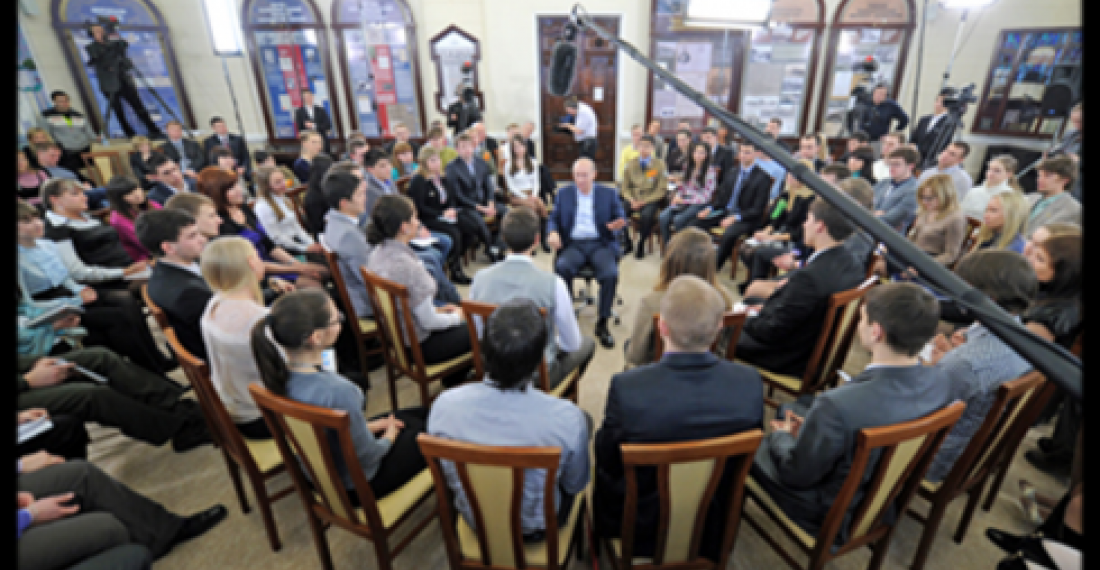
Vladimir Putin is electioneering. Yesterday he was in Tomsk where he met University students in an informal atmosphere. “I really like talking to audiences like this one,” the Russian prime minister told the students. “I always enjoy it, but it’s especially nice on St Tatyana’s day, the day of Russian students.”

Putin's speech was wide-ranging, and for most of the time focused on domestic issues where Putin spoke in calm and somewhat philosophical way to his student audience, including about the importance of money and how money was not everything in life. He said some people believe that they have achieved success in life because they enjoy life and have a sense of personal fulfilment.

At the end of the three and a half hours meeting one student asked him about elections in Kazakhstan and the US reaction. Putin accused the United States of attempts to dominate the world and challenging internal political procedures in other countries as a tool for achieving that goal. “The reason is the U.S. foreign policy doctrine. They want to control everything… sometimes I have the impression that the United States does not need allies, that it needs vassals,” the prime minister said. “They are not prepared to cooperate on equal terms either with Europe or us. Cooperation on equal terms means determining threats together and working out a system of response to them together. They reject that flatly,” he said, referring to the missile defence system the U.S. is building in Europe. According to Putin, one of the American ways to influence other countries is to “doubt everything and say that you do not meet certain standards” but “they work out these standards themselves”.

source: commonspace.eu with Itar-Tass and the Press Service of the government of Russia

photo: Prime Minister of Russia Vladimir Putin talking with students at Tomsk University on 25 January 2012 (photo courtesy of the Press Service of the government of Russia)

Related articles

Editor's choice
News
The British prime minister says Europe must "stand on its own two feet" when it comes to defence

The British prime minister says Europe must "stand on its own two feet" when it comes to defence

The UK will deploy a carrier strike group, led by the aircraft carrier HMS Prince of Wales to the Arctic and the High North as part of efforts to bolster security against Russian threats. British prime minister, Sir Keir Starmer announced the deployment in a speech on Saturday (14 February) at the Munich Security Conference. Europe must be ready to fight to protect its people, values, and way of life,  Sir Keir told the Conference. Starmer also called for deeper links and cooperation, including economic ties, between the UK and EU. The PM stressed the continent must "stand on its own two feet" when it comes to defence commitments. "We must build our hard power, because that is the currency of the age," he told the conference. (Click image to read the full story).

Popular

Editor's choice
Interview
Thursday Interview: Murad Muradov

Thursday Interview: Murad Muradov

Today, commonspace.eu starts a new regular weekly series. THURSDAY INTERVIEW, conducted by Lauri Nikulainen, will host  persons who are thinkers, opinion shapers, and implementors in their countries and spheres. We start the series with an interview with Murad Muradov, a leading person in Azerbaijan's think tank community. He is also the first co-chair of the Action Committee for a new Armenian-Azerbaijani Dialogue. Last September he made history by being the first Azerbaijani civil society activist to visit Armenia after the 44 day war, and the start of the peace process. Speaking about this visit Murad Muradov said: "My experience was largely positive. My negative expectations luckily didn’t play out. The discussions were respectful, the panel format bringing together experts from Armenia, Azerbaijan, and Turkey was particularly valuable during the NATO Rose-Roth Seminar in Yerevan, and media coverage, while varied in tone, remained largely constructive. Some media outlets though attempted to represent me as more of a government mouthpiece than an independent expert, which was totally misleading.  Overall, I see these initiatives as important steps in rebuilding trust and normalising professional engagement. The fact that soon a larger Azerbaijani civil society visits to Armenia followed, reinforces the sense that this process is moving in the right direction." (click the image to read the interview in full)