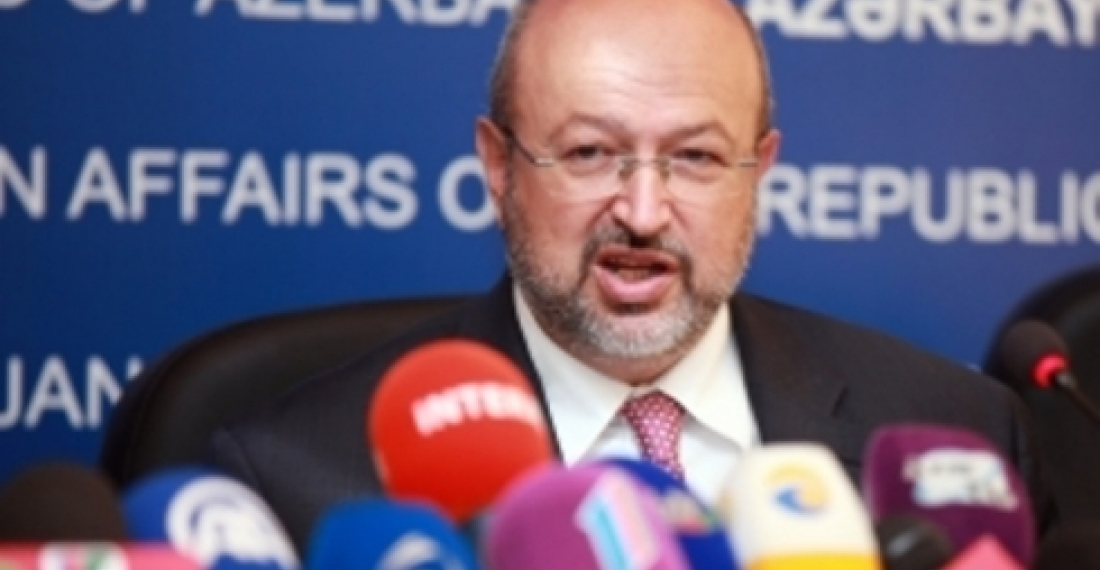
OSCE Secretary General in Baku

The OSCE Secretary General, Lamberto Zannier, on an official visit to Azerbaijan today, emphasized the need for political will in negotiating a peaceful solution to the Nagorno-Karabakh conflict. He stressed that OSCE will continue working with the country in implementing its OSCE commitments.

“Azerbaijan, which this year celebrates 20 years in the OSCE, plays an important role in the work of our Organization, in politico-military, economic and environmental and human rights-related areas,” Zannier said in a press briefing, following his meeting with the Foreign Minister Elmar Mammadyarov.

Zannier stressed that the Nagorno-Karabakh conflict presents an enormous threat to the region’s security and stalls economic development in the South Caucasus. He voiced his support for the efforts of the OSCE Minsk Group Co-Chairs and the OSCE Chairperson’s Personal Representative in finding a negotiated solution to the conflict and strengthening the ceasefire regime.

“The conflict will not be resolved by the use of force,” Zannier said. “Negotiations are the only way forward; and political goodwill and the commitment of all those involved is an essential prerequisite for finding a lasting peaceful solution.”

The Secretary General said he was “seriously concerned” by the recent incidents on the border between Armenia and Azerbaijan and on the Line of Contact, which “marred the efforts to bring long-awaited peace and stability to the people living in these areas”.

All parties should refrain from the use or threat of force, abstain from retaliatory measures, remove snipers from the line of contact and implement the agreed confidence-building measures, including the mechanism for investigating incidents on the front lines, Zannier underlined.

He also said that the OSCE stood ready to assist in the implementation of the agreement reached by the Presidents of Armenia and Azerbaijan to develop people-to-people contacts and dialogue between the countries’ intelligentsia and academic and public circles.

source: commonspace.eu withOSCE Press Service.
Related articles

Editor's choice
News
Aden under curfew, as problem in Yemen's south deepens

Aden under curfew, as problem in Yemen's south deepens

The port city of Aden, in Yemen's south, has been put under curfew, as the rift in the country between  the Saudi led coalition which  backs Yemen's presidential governing council, and the southern forces led by the Southern Transitional Council (STC), deepens. Abdul Rahman al-Mahrami, a member of the Yemeni Presidential Governing Council and commander of the al-Amalik brigades, has ordered a curfew in the temporary capital, Aden, "to maintain security". "A curfew has been imposed throughout Aden Governorate from 9:00 p.m. to 6:00 a.m., in accordance with the instructions of Commander Abdul Rahman al-Mahrami, a member of the Presidential Management Council," the statement said. It states that only security and military personnel, as well as medical and technical teams with approved permits, will be allowed to move in the area during these hours. Yemen's presidential council, which is backed by Saudi Arabia and which already is in a struggle with the Houthi Movement in the north of the country who also occupy the capital Sanaa, two days ago issued an order for the arrest of the head of the Southern Transitional Council (STC),, Aidarous al Zubaidi. The STC have wide support among people in the South, and advocate that South Yemen restores its independence. The coalition warned of further escalation in Aden, long regarded as an STC stronghold, as the Presidential Leadership Council (PLC) chief accused STC leader Aidarous Al Zubaidi of “high treason” and announced the revocation of his membership in the governing body. The moves mark a sharp escalation in tensions within the anti-Houthi camp, despite National Shield Forces, rivals of the STC and former allies, having recently retaken control of Hadhramaut and Mahra from southern fighters. The STC’s takeover of the two regions last month angered Saudi Arabia and contributed to igniting the current internal conflict. (click the picture to read more)

Popular

Editor's choice
News
Aden under curfew, as problem in Yemen's south deepens

Aden under curfew, as problem in Yemen's south deepens

The port city of Aden, in Yemen's south, has been put under curfew, as the rift in the country between  the Saudi led coalition which  backs Yemen's presidential governing council, and the southern forces led by the Southern Transitional Council (STC), deepens. Abdul Rahman al-Mahrami, a member of the Yemeni Presidential Governing Council and commander of the al-Amalik brigades, has ordered a curfew in the temporary capital, Aden, "to maintain security". "A curfew has been imposed throughout Aden Governorate from 9:00 p.m. to 6:00 a.m., in accordance with the instructions of Commander Abdul Rahman al-Mahrami, a member of the Presidential Management Council," the statement said. It states that only security and military personnel, as well as medical and technical teams with approved permits, will be allowed to move in the area during these hours. Yemen's presidential council, which is backed by Saudi Arabia and which already is in a struggle with the Houthi Movement in the north of the country who also occupy the capital Sanaa, two days ago issued an order for the arrest of the head of the Southern Transitional Council (STC),, Aidarous al Zubaidi. The STC have wide support among people in the South, and advocate that South Yemen restores its independence. The coalition warned of further escalation in Aden, long regarded as an STC stronghold, as the Presidential Leadership Council (PLC) chief accused STC leader Aidarous Al Zubaidi of “high treason” and announced the revocation of his membership in the governing body. The moves mark a sharp escalation in tensions within the anti-Houthi camp, despite National Shield Forces, rivals of the STC and former allies, having recently retaken control of Hadhramaut and Mahra from southern fighters. The STC’s takeover of the two regions last month angered Saudi Arabia and contributed to igniting the current internal conflict. (click the picture to read more)