


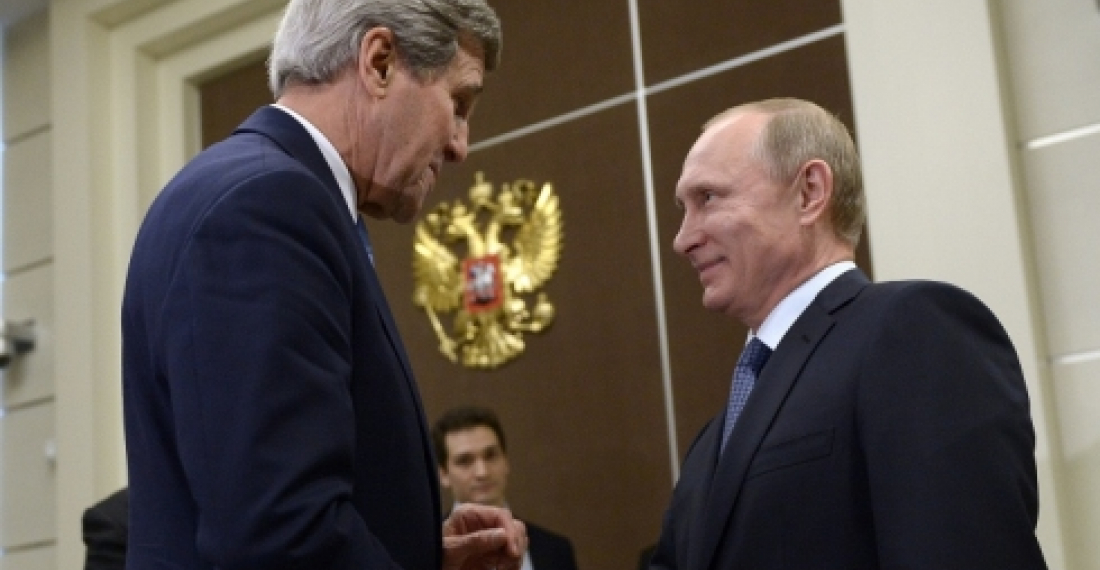
Not quite detente yet, but it's a start.

Commentary, prepared by the editorial team of commonspace.eu

Russian officials delighted with Kerry-Putin meeting, amid nostalgia for cold-war style diplomacy that recognised Russia's superpower status

There is one bit of cold-war nostalgia that senior Russian officials and diplomats constantly hanker for. It is the time when the US and the USSR were the two undisputed superpowers in the world and their two leaders could sit together and decide any issue in the world whilst still holding the nuclear button to each other's head. "Ah, those were the days, when Russians and Americans could talk to each other as equals", some could be heard saying. According to some Russian propoganidsts what has happened since 1991 has been one big misunderstanding. Soon the world will come to its senses, and Russian power will be recognised once more.

This mindset partly explains Russian excitement and glee at yesterday's visit to Sochi of US Secretary of State John Kerry, and his meeting with President Putin - the first since the Ukraine crisis erupted.

Officially, the Kremlin was not euphoric, but it could hardly hide its pleasure either. The Russian News Agency Itar-Tass reported that Russian Presidential aide Yuri Ushakov stated that the Kremlin does not qualify talks of Russian President Vladimir Putin and US Secretary of State John Kerry as a breakthrough, but as first signs of understanding that the two great powers should get their relations back on track. "Our president proceeded in the conversation from our fundamental interest in seeing bilateral relations get back to normal," Ushakov said. "As it was emphasized, it meets the interests of Russia, and we hope the interests of the US, and is extremely important from the point of view of ensuring international stability and security," he added. "Proceeding from this, we consider the talks very useful, necessary and positive," he added.

Ushakov said the talks had been long, open, quite friendly and businesslike. He said Kerry had relayed regards from the U.S. president to Putin. He quoted Kerry as saying President Obama was very interested in Putin's receiving the state secretary. There was no written message, he added. Ushakov also said a meeting of the two countries' leaders was not discussed at talks, although possibilities for that did exist.

Earlier the Russian Foreign Ministry had spelled out the Russian position even more clearly,saying that Russia is ready for constructive interaction with the United States, but on an equal basis.

There is ofcourse much to be said for respect and equality in relations between any two states. That Russia should demand this from the United States is not surprising, nor unreasonable. But there is a sub text to the Russian rhetoric, namely that the United States and Russia should return to a time when they could decide the fate of nations, without these other nations having much say in the matter. A country that has just occupied and annexed part of its neighbours' territory, as Russia did in Crimea last year, may very well seek such a way of doing international relations. The United States must not succumb to these temptations. That is not to say that US diplomacy should not be talking to the Russian side on all issues, at the highest levels. Dialogue is an important part of a process to resolve international crisis. European leaders have also continued talking to the Russians after the start of the Ukraine crisis, and that is not only understandable but also desireable. But there should be no deals on the fate of smaller countries behind their backs.

There are many issues, including on the European continent, which require the goodwill of both Russia and the United States if they are to be resolved. Ukraine is one example, others are Nagorno-Karabakh and other conflicts in the post Soviet space. There is a framework in which these issues need to be discussed and action for their resolution taken - it is the Organisation for Security and Co-operation in Europe (OSCE). One hopes that in their re-energised dialogue Russia and the United States will find time to discuss how they can make the OSCE a meaningful framework once more, and how they can bring in back respect for the principles and norms that underpin that organisation.

This commentary was prepared by the editorial team of commonspace.eu.

photo: President Putin greeting US Secretary of State John Kerry in Sochi on Tuesday, 12 May 2015. (picture courtesy of Itar-Tass).

 

Related articles

Editor's choice
News
Council of Europe launches new International Claims Commission for Ukraine

Council of Europe launches new International Claims Commission for Ukraine

Thirty-four countries and the European Union have signed a new convention establishing an International Claims Commission for Ukraine at a diplomatic conference co-hosted by the 46-nation Council of Europe and the Netherlands in the Hague. The diplomatic conference was attended by leaders and high-level representatives from over 50 states, including the President of Ukraine, Volodymyr Zelenskyy, the President of the Republic of Moldova, Maia Sandu, and the Prime Minister of the Netherlands, Dick Schoof.  “Today marks a major step forward in ensuring accountability for Ukraine. The International Claims Commission represents justice and hope for tens of thousands of victims—our determination that those who have suffered will not be forgotten. I call for quick ratifications so we can get the commission rapidly up and running for the people of Ukraine,” said Council of Europe Secretary General Alain Berset. Ukrainian President Volodymyr Zelenskyy said: “We expect that every mechanism for compensation from the Register of Damage and Claims Commission to the actual payments – will start working and receive strong and sufficient international support, so that people can truly feel that any kind of damage caused by the war can be compensated. This war, and Russia’s responsibility for it, MUST become a clear example – so that others learn not to choose aggression.” “Accountability is about creating the conditions for peace that endures. And therefore, accountability is a condition of security – today and for the future. But accountability is not only about Ukraine. And it is not only about one aggressor and one victim. Accountability is about Europe. About every country in Europe. It is about whether Europe, as a whole, is willing to defend its peace,” said Maia Sandu, President of the Republic of Moldova, which currently holds the Presidency of the Council of Europe’s Committee of Ministers. The Prime Minister of the Netherlands, Dick Schoof, said: “Every day Russia is deliberately bombarding homes, destroying businesses and damaging infrastructure in Ukraine. Russia must compensate Ukraine for the damage caused. That is why we have launched the International Claims Commission for Ukraine and we are honoured to host it.” The International Claims Commission will be the second part of a comprehensive compensation mechanism related to Russia’s war of aggression, building on the existing Register of Damage for Ukraine. The claims commission will be established within the framework of the Council of Europe and will also be open to other countries. The Register of Damage for Ukraine, created in 2023, collects and records compensation claims submitted by individuals, organisations and public bodies in Ukraine. Forty-four states and the European Union have so far joined the Register, which has already received 86,000 claims. The International Claims Commission will review, assess and decide upon claims submitted to the Register of Damage for Ukraine and determine the amount of compensation, if any, which is due in each case. The convention establishing the commission will enter into force once it has been ratified by 25 signatories, as long as sufficient funds have been secured to support its initial work.

Popular

Editor's choice
News
Council of Europe launches new International Claims Commission for Ukraine

Council of Europe launches new International Claims Commission for Ukraine

Thirty-four countries and the European Union have signed a new convention establishing an International Claims Commission for Ukraine at a diplomatic conference co-hosted by the 46-nation Council of Europe and the Netherlands in the Hague. The diplomatic conference was attended by leaders and high-level representatives from over 50 states, including the President of Ukraine, Volodymyr Zelenskyy, the President of the Republic of Moldova, Maia Sandu, and the Prime Minister of the Netherlands, Dick Schoof.  “Today marks a major step forward in ensuring accountability for Ukraine. The International Claims Commission represents justice and hope for tens of thousands of victims—our determination that those who have suffered will not be forgotten. I call for quick ratifications so we can get the commission rapidly up and running for the people of Ukraine,” said Council of Europe Secretary General Alain Berset. Ukrainian President Volodymyr Zelenskyy said: “We expect that every mechanism for compensation from the Register of Damage and Claims Commission to the actual payments – will start working and receive strong and sufficient international support, so that people can truly feel that any kind of damage caused by the war can be compensated. This war, and Russia’s responsibility for it, MUST become a clear example – so that others learn not to choose aggression.” “Accountability is about creating the conditions for peace that endures. And therefore, accountability is a condition of security – today and for the future. But accountability is not only about Ukraine. And it is not only about one aggressor and one victim. Accountability is about Europe. About every country in Europe. It is about whether Europe, as a whole, is willing to defend its peace,” said Maia Sandu, President of the Republic of Moldova, which currently holds the Presidency of the Council of Europe’s Committee of Ministers. The Prime Minister of the Netherlands, Dick Schoof, said: “Every day Russia is deliberately bombarding homes, destroying businesses and damaging infrastructure in Ukraine. Russia must compensate Ukraine for the damage caused. That is why we have launched the International Claims Commission for Ukraine and we are honoured to host it.” The International Claims Commission will be the second part of a comprehensive compensation mechanism related to Russia’s war of aggression, building on the existing Register of Damage for Ukraine. The claims commission will be established within the framework of the Council of Europe and will also be open to other countries. The Register of Damage for Ukraine, created in 2023, collects and records compensation claims submitted by individuals, organisations and public bodies in Ukraine. Forty-four states and the European Union have so far joined the Register, which has already received 86,000 claims. The International Claims Commission will review, assess and decide upon claims submitted to the Register of Damage for Ukraine and determine the amount of compensation, if any, which is due in each case. The convention establishing the commission will enter into force once it has been ratified by 25 signatories, as long as sufficient funds have been secured to support its initial work.

