


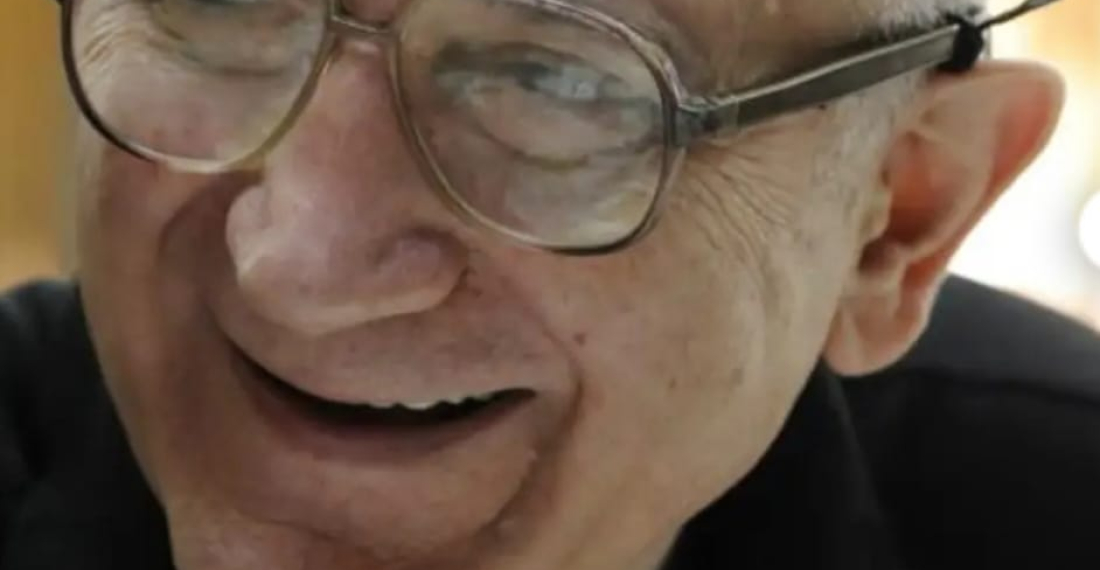
Obituary: Eldar Shengelaia – a most reluctant politician

Obituary: Eldar Shengelaia – a most reluctant politician

This obituary was written on 5 August 2025 by Dr Dennis Sammut, Director of LINKS Europe and Managing Editor of commonspace.eu


I was saddened to hear the news of the death of Georgian public figure, Eldar Shengelaia, at the venerable age of 92.

Shenngelaia connected the Georgian past with the present, and his death marks the end of an era. Shengelaia is known most for his career in cinema as a film director, and for the last thirty years of the Soviet Union his films mesmerized audiences across the USSR. From his debut film “The White Caravan” (1963), which described the difficult life of shepherds, to later more light hearted films like “An extraordinary exhibition” (1968) to “The ringers” 1973, Eldar Shengelaia walked the difficult tightrope of balancing the demands of the Soviet system, which tightly controlled all artistic expression, with his Georgian free spirit.

In 1995 Eldar Shengelaia made an unexpected appearance on the Georgian political scene. This was a defining year for Georgia. Shevardnadze had got rid of the warlords after they tried to kill him; a new constitution was adopted, and in November, the first free elections were held. The Citizens Union of Georgia (CUG) was created, with Shevardnadze as the nominal head, but with Zurab Zhvania as the effective leader. CUG won a landslide victory, and Zhvania was elected Chairman of the new parliament. There was a joke in Georgia at the time that CUG was like a watermelon, green on the outside because it was led by many people from the Greens, red on the inside, because it included many former communists and ex nomenklatura persons, with black spots on the inside, because it also included many corrupt people.

Zhvania certainly wanted CUG to be a “broad church”. Eldar Shengalaia understood the significance on the moment and became an MP, and soon Deputy Chairman of the new parliament.

Zhvania soon understood that a “broad church” brought it own problems, including discipline. At the time I used to spend a lot of time in Georgia. He asked me if  I could speak to the CUG MPs about party discipline, and about the “whip” system in the British parliament. The meeting was held in the main parliament room – there were more than 120 CUG MPs and no other room could accommodate all of them. It was chaired by Mikheil  Saakashvili, because he was the head of the CUG Parliamentary faction.  I gave my lecture on party discipline, including the grisly details of the whip system in the British parliament. I could see many MPs were not happy.

After the meeting, Eldar Shengelaia approached me. He had been to some of our meetings so we knew each other. “Its incredible”, he told me. “I could never believe such a system could exist in a democratic country like Britain”. It was one of the hard truths that Eldar Shengelaia had to deal with during his short time in politics. He was a most reluctant politician. However, in 1995, given the circumstances of the time, he did the right thing by getting involved in politics. But his heart was always in cinema, and that is how he will be best remembered.

This obituary was written on 5 August 2025 by Dr Dennis Sammut, Director of LINKS Europe and Managing Editor of commonspace.eu

Related articles

Editor's choice
News
Borrell tells the European Parliament that the situation in Afghanistan was critical, but the EU will remain engaged

Borrell tells the European Parliament that the situation in Afghanistan was critical, but the EU will remain engaged

Borrell underlined that the European Union will make every effort to support the peace process and to remain a committed partner to the Afghan people. "Of course, we will have to take into account the evolving situation, but disengagement is not an option.  We are clear on that: there is no alternative to a negotiated political settlement, through inclusive peace talks.
Editor's choice
News
Mystery surrounds the crash of a Turkish airline in Georgia which resulted in the death of 20 Turkish Airforce personnel

Mystery surrounds the crash of a Turkish airline in Georgia which resulted in the death of 20 Turkish Airforce personnel

​ Twenty Turkish Airforce personnel died when a military plane crushed on the Georgian side of the Azerbaijan - Georgia border on Tuesday (11 November). The C130 took off from Ganja and was heading to Merzifon, transporting service members that had participated in Azerbaijan's Victory Day celebrations. Half an hour after takeoff, the aircraft lost altitude and broke apart in mid-air over a mountainous area on the Georgian border. Lockheed C130 Hercules have been in service with Turkey since the 1960s and are considered among the most reliable in their class. However, some of these aircraft are 50–60 years old. In October, the Turkish Ministry of Defense announced plans to replace them with new C130J Super Hercules models, with deliveries expected to begin in the coming years. All aircraft fragments have already been collected for technical examination. The cause of the crash has not yet been officially determined. A Turkish expert and retired military officer Coşkun Başbuğ noted on CNN Türk, a technical malfunction "should be ruled out" as the cause of the crash. "Various possibilities should be considered, but the first thing to consider is that the C-130 is a time-tested military transport aircraft, the last known incident involving which occurred in 1982." "A technical malfunction should be ruled out as the cause of the crash. The same applies to weather conditions, as the relevant authorities would have reported bad weather. The remaining theories include a mid-air collision, sabotage, or an attack," he emphasized. Former Turkish Armed Forces Logistics Commander and retired Army General Erdoğan Karakuş stated in an interview with Turkish television that although the C-130 aircraft are old, they have undergone a complete modernization in Turkey, and their technical condition is thoroughly inspected before each flight. The Turkish Air Force is expected to operate the C-130 aircraft until 2040. ​

Popular

Editor's choice
News
Mystery surrounds the crash of a Turkish airline in Georgia which resulted in the death of 20 Turkish Airforce personnel

Mystery surrounds the crash of a Turkish airline in Georgia which resulted in the death of 20 Turkish Airforce personnel

​ Twenty Turkish Airforce personnel died when a military plane crushed on the Georgian side of the Azerbaijan - Georgia border on Tuesday (11 November). The C130 took off from Ganja and was heading to Merzifon, transporting service members that had participated in Azerbaijan's Victory Day celebrations. Half an hour after takeoff, the aircraft lost altitude and broke apart in mid-air over a mountainous area on the Georgian border. Lockheed C130 Hercules have been in service with Turkey since the 1960s and are considered among the most reliable in their class. However, some of these aircraft are 50–60 years old. In October, the Turkish Ministry of Defense announced plans to replace them with new C130J Super Hercules models, with deliveries expected to begin in the coming years. All aircraft fragments have already been collected for technical examination. The cause of the crash has not yet been officially determined. A Turkish expert and retired military officer Coşkun Başbuğ noted on CNN Türk, a technical malfunction "should be ruled out" as the cause of the crash. "Various possibilities should be considered, but the first thing to consider is that the C-130 is a time-tested military transport aircraft, the last known incident involving which occurred in 1982." "A technical malfunction should be ruled out as the cause of the crash. The same applies to weather conditions, as the relevant authorities would have reported bad weather. The remaining theories include a mid-air collision, sabotage, or an attack," he emphasized. Former Turkish Armed Forces Logistics Commander and retired Army General Erdoğan Karakuş stated in an interview with Turkish television that although the C-130 aircraft are old, they have undergone a complete modernization in Turkey, and their technical condition is thoroughly inspected before each flight. The Turkish Air Force is expected to operate the C-130 aircraft until 2040. ​
