Russia must honour the 2008 cease fire agreement with Georgia before it is embraced back as a partner in Europe's security argues Dennis Sammut in this week's Monday Commentary.
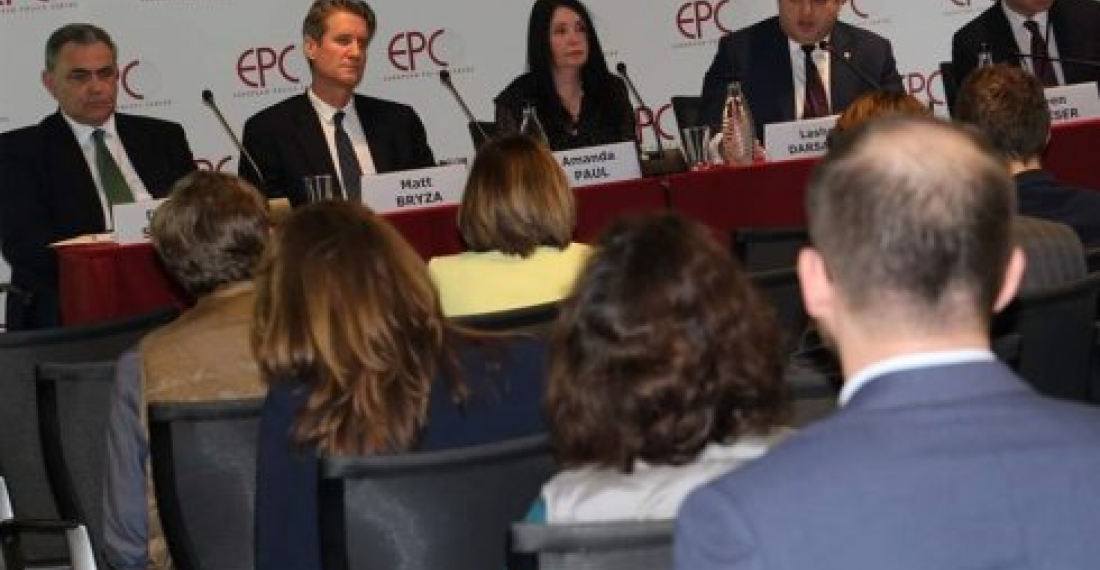
Last week I spoke at a policy dialogue organised by the European Policy Centre in Brussels on the theme "Managed insecurity in the EU's neighbourhood: Costs of the unresolved conflict in Georgia". I was honoured to join a distinguished panel which included Georgia's Deputy Foreign Minister, Lasha Darsalia, Estonia's former Foreign Minister and current rapporteur on Georgia at the European parliament, Sven Mikser MEP, and former US Deputy Assistant Secretary of State for Europe and Eurasia, Matthew Bryza, in a lively and informative discussion ably chaired by the EPC's Amanda Paul.
The meeting was timely.
In the Chancelleries of Europe a discussion is going on about how to address the issue of future relations with Russia. The French seem to be the ones pushing the hardest for a more positive engagement and for tangible co-operation, but the idea also has its supporters in Berlin, Rome and beyond. Europe's relations with Russia have many tiers. There is the bilateral tier, where each country has its own nuanced relationship; there is the EU tier, where decisions are co-ordinated, and where we have seen an unprecedented level of EU unity, especially in response to the Russian annexation of Crimea; and then there is the pan European level in the context of the OSCE and various mechanisms that emanate from it. Keeping everybody on the same page has been difficult but has happened. Now that the French are leading the thrust for a new approach the internal discussion - within the EU, but also within NATO - on how to proceed is likely to intensify.
I have always favoured dialogue with Russia, and I think trying to isolate a country like Russia for a long time is a risky - and possibly futile - endeavour. I have also often spoke and wrote over the last decade in support of the idea of a new "Helsinki process" - a CSCE.2, in other words a new holistic discussion on Europe's future security in all its dimensions. The Russians are keen on this but for obvious reasons others have been more lukewarm. An attempt by the Greeks to launch a Corfu Process in 2009 fizzled out, overshadowed by other priorities.
The biggest value of CSCE.1 (the Conference for Security and Co-operation in Europe) was its inclusiveness, which added some complications but which ensured the buy in of all states from the largest to the smallest. The patient work of diplomats stretched over more than a decade, but in the end it gave us the cherished 1975 Helsinki Final Act. It is violation of this act in Crimea and elsewhere that has put Russia most at odds with Europe.
Russia has also violated the Helsinki Final Act in its dealings with Georgia. Its recognition of Abkhazia and South Ossetia as independent states violates the principle of territorial integrity. It remains the only signatory of the Helsinki Final Act to have done so. But there is more.
In 2008 Russia and Georgia fought a short war. What happened before and during that war is well documented in the Tagliavini report. But what has happened since is shrouded in ambiguity. The end of hostilities in August 2008 was brokered by the French, in the person of Nicolas Sarkozy, then president of France and by chance, holding at the time the six monthly rotating presidency of the EU. Sarkozy conducted shuttle diplomacy between Moscow and Tbilisi and in a short time, to his credit, brokered a cease fire agreement. That agreement required all sides to return to their positions before hostilities started - status quo ante. The Russians never did. What the Russians have been doing since has been quite different. They have given a different meaning to what they understand to be Abkhazia and South Ossetia. They do not accept the geographical space in which these two entities existed in 2008 before fighting started, but insist that their borders are according to maps the Soviet General Staff had prepared in 1986 of the then Abkhaz Autonomous Republic and South Ossetian Autonomous Oblast. During the August War they pushed to extend control up to these artificial lines, taking over whole Georgian communities, such as in Akhalgori, and creating a new wave of displaced persons. But they did not even stop there. Ever since they have been engaged in a process of so called borderisation of South Ossetia, which means a constant encroachment on Georgian territory as they try to establish the imaginary 1986 line. This has happened in front of the eyes of the EU Monitoring Mission that has duly recorded the incidents, but which has no mandate to do more.
It is not clear to what extent the French - the brokers of the 2008 cease fire agreement - have been pushing the Russians to honour it, but if they haven't now is the time to do it.
The status of Abkhazia and South Ossetia, Crimea, and other disputed territories in Europe, will eventually have to be resolved in a future European Security framework - the CSCE.2 if it happens. But before that process can start the Russians need to restore their credibility as actors that honour the documents that they sign. When President Macron goes to Moscow next May to celebrate with Mr Putin the 75th anniversary of Europe - as he should - he can take with him the 2008 Russia-Georgia ceasefire agreement which is safely kept at the Quai d'Orsay. He should firmly tell his Russian host that the process of normalising relations cannot start if that document at least is not honoured. Otherwise Europe's process of normalisation with Russia will be happening at cost of Georgia and that cannot be right.
source: Dennis Sammut is the Director of LINKS and a regular commentator on Caucasus issues and European security matters. His Monday Commentary is published weekly on commonspace.eu
photo: Speakers at a policy dialogue organised by the European Policy Centre in Brussels on the theme "Managed insecurity in the EU's neighbourhood: Costs of the unresolved conflict in Georgia" on 5 March 2020 included Georgia's Deputy Foreign Minister, Lasha Darsalia, Estonia's former Foreign Minister and current rapporteur on Georgia at the European parliament, Sven Mikser MEP, former US Deputy Assistant Secretary of State for Europe and Eurasia, Matthew Bryza, and LINKS Directior, Dennis Sammut. It was chaired by the EPC's Amanda Paul.
The views expressed in opinion pieces and commentaries do not necessarily reflect the position of commonspace.eu or its partners