Vladimir Putin was sworn in for another six-year term as the President of Russia on Tuesday, 7 May.
With Putin having been the undisputed leader of Russia for decades, continuity, one would have thought, was assured. Yet Putin himself, on Monday (13 May) speaking at a meeting of the Security Council spoke of “a new political cycle” in Russia. Some of the first decisions of the re-elected president give us a sense of what is to come.
First, there was the surprise dismissal of Sergei Shoigu as Minister of Defence, and his transfer to be the Secretary of the Security Council. There had been speculation for some time that Shoigu’s time at the Ministry of Defence was up. But what was surprising was the appointment of Andrei Belousov, former Deputy Prime Minister – an efficient technocrat with an economic background to replace him. That the Russian Ministry of Defence has needed a shake-up for some time has been abundantly clear, but Andrei Belousov’s mission seems to be more ambitious than that: He is tasked with transforming the Russian Defence Ministry into a modern institution that can embrace new ideas and techniques, and that has enough flexibility to conduct the sort of hybrid warfare that is likely to be the order of the day going forward. So despite all of Putin’s bravados about the Russian nuclear arsenal, it seems he is putting his faith in a more innovative, agile, and versatile force.
Then on Monday, 13 May, Putin held his first meeting of the Security Council since his inauguration. The Kremlin website only referred to one item out of apparently several that were discussed, namely relations with the post-Soviet Republics, a subject much close to the heart of the president. Putin reiterated that this was a priority in foreign policy. Putin said, “we should pay even more attention to this area in the new political cycle in Russia and discuss the way we will organise this work from all points of view, including organisational”. So it appears that there is new thinking in this sphere, details of which is not yet known.
Then, at the operational level, in the war in Ukraine, in the last days, we saw the strange sight of Russian troops walking across the border into Ukraine, apparently unopposed and without being obstacled by any defence lines. This was not a massive military advance, simply the Russians identifying a weakness in Ukrainian defences and exploiting it. Opportunism remains a hallmark of the Putin administration.
These first days of Putin’s fifth presidency may give us a sense of what is to come. And all this has massive implications for Central Asia. If for Putin relations with the post-Soviet republics are going to be even more prominent than before then we can expect new “initiatives” soon. We can assume that Central Asia will be the primary target of the Kremlin going forward, since the situation in the South Caucasus and Moldova is more complicated for Russia, and its room of manoeuvre is limited by considerable Western interest and involvement. The modest attempts of the Central Asian Republics, or at least some of them, to embark on reform and on opening up to the West, have irritated the Kremlin. Its propagandists lash out against the leadership of the Central Asian republics regularly through its mouthpieces.
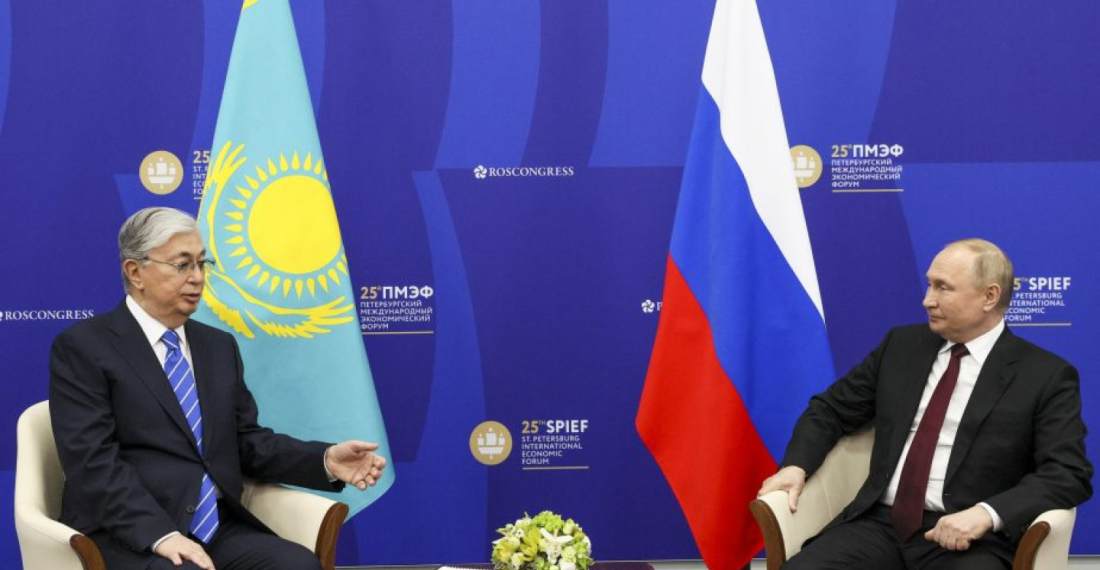
For many reasons, some of which are outlined in articles we refer to in the voices section below, Kazakhstan is likely to be the country in the focus of the Russian leader going forward. Under President Kassym-Jomart Tokayev Kazakhstan has been trying to emerge from the Russian shadow and carve a role for itself on the global stage. But geography, demography and political culture constrain any action the Kazakh president may want to take. Developing relations with the West is therefore risky, and Astana is threading very carefully. Kazakhstan may get away with maintaining good relations with China, and with developing its relations with the Turkic World, especially Azerbaijan and Turkey, but even that may now not be so certain.
In the end, what Putin will do will also depend on how the situation in Ukraine will develop. The future of Central Asia may be decided in the steppes and forests of Ukraine. Which is why what happens next in Ukraine matters enormously for the future of Europe and Eurasia.