


Cypriot leaders continue to disappoint. UN cancels conference due to failure of Greek and Turkish Cypriot leaders to make sufficient progress in the negotiations

UN Secretary-General Ban Ki-moon has stated that not sufficient progress has been made during talks between Greek and Turkish Cypriot leaders to justify calling an international conference aimed at consoilidating a peace deal as had been hoped.

Ban's spokesman made the announcement Saturday afternoon following the secretary-general's meeting Friday with Alexander Downer, the UN special adviser on Cyprus, and telephone calls earlier Saturday with Greek Cypriot leader Dimitris Christofias and Turkish Cypriot President Derviş Eroğlu.

Cyprus was split in 1974 when Turkey intervened after a coup by supporters of union with Greece. Turkish Cypriots declared an independent state in the north in 1983, but only Turkey recognises it and keeps 35,000 troops there.

Ban has been pressing the two leaders to reach a settlement, and Downer said last month he had planned to call an international conference by early May, bringing together Britain, Greece and Turkey with the aim of putting the finishing touches on an accord.

But Downer said the two sides have not yet converged closely enough on key issues. He said talks are stalled on how executive power would be shared under an envisioned federation and on how to deal with private property lost during the intervention.

Ban's spokesman said that on the basis of the meeting with Downer on Friday, "the secretary-general shared his assessment that there is not the sufficient progress on core issues that would provide a basis for calling an international conference at this time."

Greek Cyprus joined the EU in 2004, but only the south enjoys membership benefits. Turkey, a candidate for EU membership, doesn't recognize Greek Cyprus as a sovereign country and has threatened to freeze its relations with the bloc if the island takes over the presidency before a reunification accord is reached. Long-running negotiations to reunify divided Cyprus will likely halt in July, when Greek Cyprus takes over the European Union's six-month rotating presidency. Alexander Downer, the UN Special Adviser on Cyprus, earlier said Turkish Cypriots believe negotiations during that period would be "meaningless" since Christofias would be preoccupied with EU matters.

Numerous rounds of UN mediated peace talks over four decades have led nowhere. The latest round, which began amid high hopes in 2008, has achieved limited progress, and both sides have begun blaming each other for the impasse.

Diplomats have expressed disappointment that yet another opportunity to resolve the Cyprus problem has been lost due to the intansigence of leaders who do not seem to have the moral authority within their societies to take forward a peace deal around which their is broad consensus, hiding instead behind problems of detail. The matter is of serious concern also to the European Union that has struggled to deal with the difficulty of having a divided country as one of its members.

source: commonspace.eu with agencies

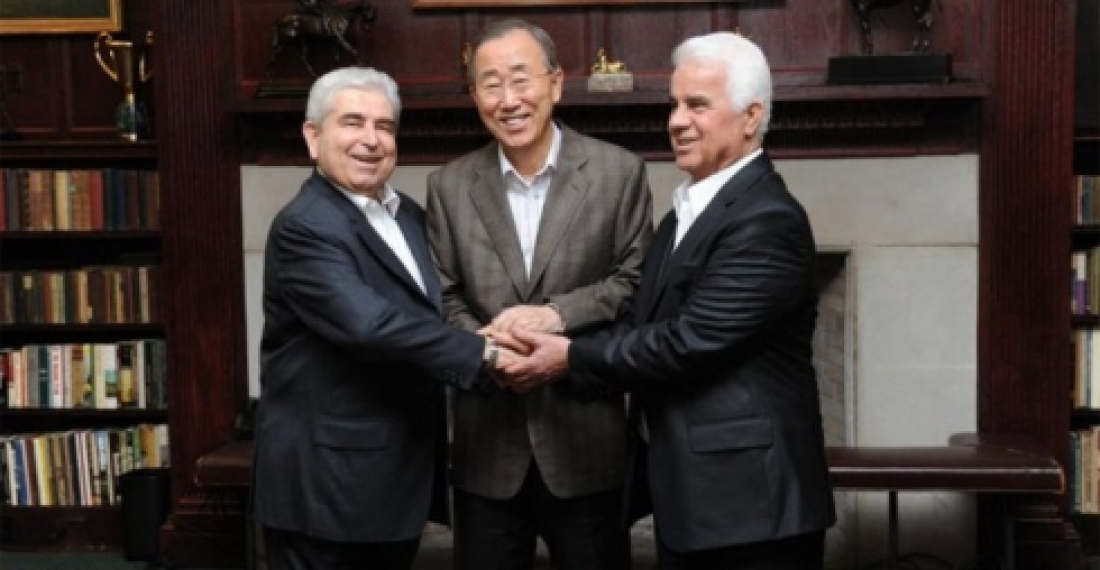
photo: UN Secretary General Ban Ki-Moon with Greek Cypriot leader Christofias and Turkish Cypriot leader Eroglu at talks in New York earlier this year (archive picture courtesy of the UN)


Related articles

Editor's choice
News
Borrell tells the European Parliament that the situation in Afghanistan was critical, but the EU will remain engaged

Borrell tells the European Parliament that the situation in Afghanistan was critical, but the EU will remain engaged

Borrell underlined that the European Union will make every effort to support the peace process and to remain a committed partner to the Afghan people. "Of course, we will have to take into account the evolving situation, but disengagement is not an option.  We are clear on that: there is no alternative to a negotiated political settlement, through inclusive peace talks.
Editor's choice
News
NATO Chief says war is on Europe's doorstep, and warns against complacency

NATO Chief says war is on Europe's doorstep, and warns against complacency

Russia could attack a Nato country within the next five years, the Secretary General of NATO, Mark Rutte, said in a stark new warning. "Nato's own defences can hold for now," Rutte warned in Berlin, but conflict was "next door" to Europe and he feared "too many are quietly complacent, and too many don't feel the urgency, too many believe that time is on our side. "Russia is already escalating its covert campaign against our societies," Rutte said in a speech in Germany. "We must be prepared for the scale of war our grandparents or great-grandparents endured." Earlier this month, Russia's President Vladimir Putin said his country was not planning to go to war with Europe, but it was ready "right now" if Europe wanted to - or started a war. But similar reassurances were given by Moscow in 2022, just before 200,000 Russian troops crossed the border and invaded Ukraine. Putin has accused European countries of hindering US efforts to bring peace in Ukraine - a reference to the role Ukraine's European allies have recently played in trying to change a US peace plan to end the war, whose initial draft was seen as favouring Russia. But Putin was not sincere, Nato's secretary-general said in the German capital, Berlin. Supporting Ukraine, he added, was a guarantee for European security. "Just imagine if Putin got his way; Ukraine under the boot of Russian occupation, his forces pressing against a longer border with Nato, and the significantly increased risk of an armed attack against us." Russia's economy has been on a war footing for more than three years now - its factories churn out ever more supplies of drones, missiles and artillery shells. According to a recent report by the Kiel Institute for the World Economy, Russia has been producing each month around 150 tanks, 550 infantry fighting vehicles, 120 Lancet drones and more than 50 artillery pieces. The UK, and most of its Western allies, are simply not anywhere near this point. Analysts say it would take years for Western Europe's factories to come close to matching Russia's mass-production of weapons. "Allied defence spending and production must rise rapidly, our armed forces must have what they need to keep us safe," the Nato chief said.

Popular

Editor's choice
News
NATO Chief says war is on Europe's doorstep, and warns against complacency

NATO Chief says war is on Europe's doorstep, and warns against complacency

Russia could attack a Nato country within the next five years, the Secretary General of NATO, Mark Rutte, said in a stark new warning. "Nato's own defences can hold for now," Rutte warned in Berlin, but conflict was "next door" to Europe and he feared "too many are quietly complacent, and too many don't feel the urgency, too many believe that time is on our side. "Russia is already escalating its covert campaign against our societies," Rutte said in a speech in Germany. "We must be prepared for the scale of war our grandparents or great-grandparents endured." Earlier this month, Russia's President Vladimir Putin said his country was not planning to go to war with Europe, but it was ready "right now" if Europe wanted to - or started a war. But similar reassurances were given by Moscow in 2022, just before 200,000 Russian troops crossed the border and invaded Ukraine. Putin has accused European countries of hindering US efforts to bring peace in Ukraine - a reference to the role Ukraine's European allies have recently played in trying to change a US peace plan to end the war, whose initial draft was seen as favouring Russia. But Putin was not sincere, Nato's secretary-general said in the German capital, Berlin. Supporting Ukraine, he added, was a guarantee for European security. "Just imagine if Putin got his way; Ukraine under the boot of Russian occupation, his forces pressing against a longer border with Nato, and the significantly increased risk of an armed attack against us." Russia's economy has been on a war footing for more than three years now - its factories churn out ever more supplies of drones, missiles and artillery shells. According to a recent report by the Kiel Institute for the World Economy, Russia has been producing each month around 150 tanks, 550 infantry fighting vehicles, 120 Lancet drones and more than 50 artillery pieces. The UK, and most of its Western allies, are simply not anywhere near this point. Analysts say it would take years for Western Europe's factories to come close to matching Russia's mass-production of weapons. "Allied defence spending and production must rise rapidly, our armed forces must have what they need to keep us safe," the Nato chief said.

