This is a commentary prepared by the political editor of commonspace.eu
The short, 5 day war fought between Russia and Georgia in August 2008 can with hindsight be seen as the turning point in Russia's relations with the west, a reversal of the collaborative relationship that had existed since the end of the cold war, and a return to an atmosphere of distrust and adversarial posturing that characterised that period. It is true that it took another crisis, in Ukraine in 2013/14, for matters to come to a head, but the crisis in Georgia was a wake-up call, and in many ways pre-defined what happened in Ukraine later.
The situation in Georgia post 1991 independence was in many ways conducive for the sort of Russian meddling that we have seen subsequently played out elsewhere. In the euphoria of regaining their independence the Georgians lacked sensitivity to the situation of the national minorities within them. In the confusion that ensued with the collapse of the Soviet Union Abkhazians and Ossetians fought short, messy conflicts, and with a little bit of help from the deep state that emerged in Moscow at the time, they seceded. Official Moscow then intervened to broker a cease fire and deploy "peace-keeping forces" whose role was always ambiguous. The international community, by and large, acquiesced.
For those watching the process carefully it was evident that from 1992-2008 Russia was in no great hurry to resolve the conflicts in Georgia. In South Ossetia in particular, during the Shevardnadze presidency there were several moments when, with an active Russian encouragement. a solution was possible and doable. If that had happened successfully it could have created a solid momentum for a solution to the Abkhaz problem too. Up to this point however most were ready to give the Kremlin the benefit of the doubt - blaming rogue generals, problems at home, and even Yeltsin's alcoholism problem for the inertia. When Mikheil Saakashvili replaced Shevardnadze as leader of Georgia in 2003 the dynamic on the ground changed from day one. Saakashvili challenged the Russian position in many ways, resulting in a build-up in tensions that gradually increased until it reached its climax on 7 August 2008.
All sides - Georgians, Russians, Ossetians, and even the international community, share some responsibility for allowing the crisis to come to a breaking point on that day. The report of the Tagliavini Commission that investigated the war on behalf of the European Union spells this out in some detail.
What happened during the war and after however is another matter. Once the gloves were off, Russian intentions became clear. Russia's role was no longer that of peace-keeper, nor even as peace-enforcer - a role which it claimed for itself although there was certainly no UN Security Council mandate to support it. Russia's objective was to dismember the Georgian state, and create two protectorates on the territory of Georgia based on the internal boundaries of the USSR and regardless both of international law, and of the existing situation on the ground. During the short-war therefore Russian troops were not only engaged in securing the status quo, they were engaged in gaining territory, as in the case of Akhalgori and Kodori.
These crucial, but "limited" military objectives were not properly understood at the time. As the war was going on there was speculation, even within Western diplomatic quarters, that the Russians might want to occupy Tbilisi and push for regime change. It was only weeks later, when the Russians moved to recognise the independence of Abkhazia and South Ossetia that it became clear that Russian intentions were even more nefarious. Russia wanted to redraw the map of the Caucasus.
In Georgia, in 2008 and after, Russia showed that it was no longer ready to play by the established rules, such as the sanctity of international borders, nor even to abide with agreements on which the ink had hardly dried, such as the agreement ensuing from the Sarkozy mission at the height of the August conflict, signed by Dimitri Medvedev, which obliged Russia to return to the status quo ante. A precedent for using force to re-draw international boundaries in Europe had been set. It was shortly to be repeated in Crimea and elsewhere.
Russia's gamble in Georgia however has a price. Distrust of Russia's intentions, particularly among its neighbours has increased dramatically - even within those countries that are Russia's closest allies. Georgia was a wake-up call for the west. When Ukraine came, the response was swifter and more acute. Russia however pays the biggest price for its actions in the Caucasus itself where a new generation is coming up perceiving Russia as the biggest threat to its future. Even in South Ossetia and Abkhazia, beyond the small elites that front Moscow's remit, there are now considerable misgivings as to where things will end up. Moscow will continue to play a price for its actions for a long time to come.
For the Georgians the anniversary of the August War is both a sombre moment of remembrance and a time to draw lessons from the past. Hundreds of people died in those five days in 2008; hundreds of families were displaced, adding yet another wave to the painful problem of refugees and displaced people in the region. It is understandable that the Georgians claim the moral high ground, and expect international support for their position. International law is on their side. They should also however use the occasion to reflect on their own past mistakes of which there were many: in their dealings with Abkhaz and Ossetians and other national minorities in their midst; in the failures of their subsequent governments to articulate proper policies, and the occasional adventurism resulting in costly consequences; and in their failure sometimes to keep a cool head and instead shoot themselves in the foot.
In South Ossetia too, this is a time to remember and reflect. In a small tightly knit community as in South Ossetia the scars of the August war will take a long time to heal. As in Georgia, Ossetian leaders have made their fair share of mistakes. Much needs to be done to repair Georgian-Ossetian relations, but although much blood has been spilt, there is a basis for this to happen. This work must start.
After 1991 Russia had a choice in how it could deal with those countries around it that emerged after the dissolution of the USSR. The devious heavy-handed approach which saw Russian planes bombing Georgian towns and villages in 2008, the attempt to redraw the map of the Caucasus subsequently, and events in Ukraine more recently, have exposed Russian bad intentions. Russia is paying a price for this in the form of strained relations with the west. It is also paying a much heavier price in the way that it is perceived by its immediate neighbours.
source: This commentary was prepared by the political editor of commonspace.eu
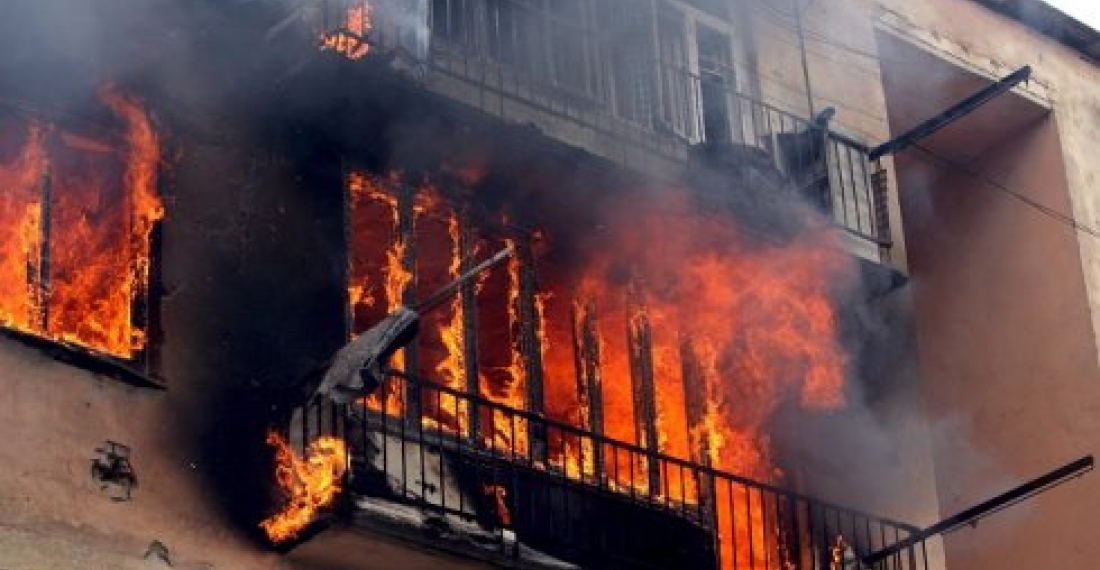
photo: Houses burning in the Georgian town of Gori after Russian planes bomb the town in August 2008. (picture courtesy of EPA)