


Commentary: A team fit for purpose

This is a commentary prepared by the editorial team of Caucasus Concise, a weekly newsletter published in association with commonspace.eu

After a convincing victory in last October's parliamentary elections, the Georgian Dream party over the last days set about assigning posts in the new Parliament and Government. For the first time the party will govern alone, and not in coalition with other parties as was the case in 2012-16. Also a huge parliamentary majority means the party can not only rely on a stable government for the coming four years, but is also able to push through any constitutional changes that it feels are necessary.

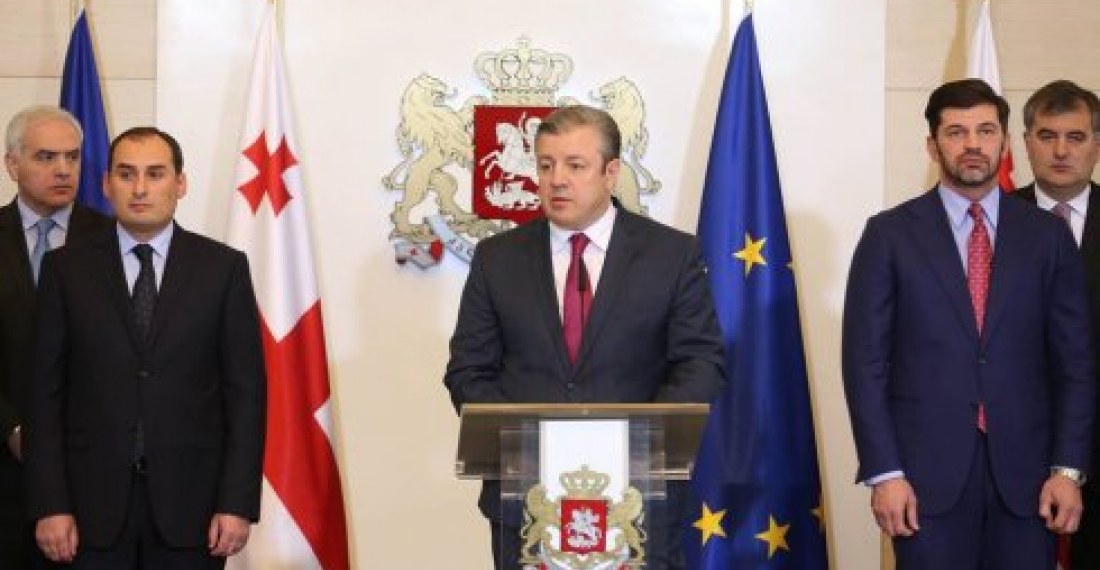
The team presented by prime minister Giorgi Kvirikashvili retains many of those who were in Cabinet prior to the elections, but there are some significant changes. Kvirikashvili is determined to make the economy the cornerstone of his administration. He has moved Dimitri Kumsishvili to head the Ministry of Finance, whilst retaining the post of first deputy prime Minister. Kumsishvili will have to deal quickly with the challenge of stabilising the national currency, the lari, which has been under pressure since the election. The appointment of Giorgi Gakharaia as the new Minister of Economic Development has been widely welcomed by Georgia's business community, who see Gakharaia as competent and trustworthy. Zurab Alavidze is the new Minister for regional development and infrastructure - a key sector for Georgia's next stage of development.

Kvirikashvili has also strengthened his foreign affairs team. Whilst the foreign minister Mikheil Janelidze retained his post, Victor Dolidze has been appointed as Minister for European and Euro-Atlantic integration, replacing David Bakradze who will be Georgia's new Ambassador to the United States. Dolidze, who was until the elections a member of the Free Democrats served as Chairman of the European Affairs Committee in the previous parliament. He is highly regarded in European circles and his appointment has been warmly welcomed in the European parliament and other EU circles in Brussels.

Kvirikashvili has decided to maintain the same people in the defence, internal affairs and security sectors. The heads of these Ministries and entities were widely praised for their professionalism during the tense days of the election campaign.
Kakha Kaladze retains his post as deputy Prime Minister and Minister for Energy. Kaladze - known up to 2012 for his career as a footballer, has grown in the job, and in the election campaign, as head of the Georgian Dream election team he emerged as an able political operator. He was praised for his television appearances, and his ability to forge together an impressive election machine. Other ministers such as Justice Minister Tea Tsulukiani and Minister for refugees and displaced persons, Sozar Subari who were an important part of the outgoing Ministerial team retain their posts.

Parallel to the Ministerial appointments, which are subject to parliamentary approval, Georgian Dream MPs have also agreed on appointments for the officers of the new parliament. The election of Irakli Kobakhidze as the new Chairman of Parliament is significant. Kobakhidze replaces David Usupashvili who fought the elections with the Republican party which performed very badly in the poll and did not secure seats in the parliament. It is widely recognised that Usupashvili is a hard act to follow as Chairman of Parliament. However, whilst lacking parliamentary experience, Kobakhidze is a political heavyweight in the Georgian Dream party. This is important as the new parliament will have a dual task of both providing the government with political support and enacting government legislation in an efficient and timely manner, whilst at the same providing parliamentary oversight, necessary to ensure the necessary check and balances. Parliament will be the first place where the government will be held to account for the promises it has made prior to the elections.

Here too Georgian Dream has opted for a mix of veterans from the previous parliament and a wave of new and highly qualified MPs from amongst who Georgia's future leaders are likely to emerge. The new First Deputy Chairman of Parliament Tamar Chugoshvili, the Chair of the Foreign Affairs Committee Sopo Katsarava, the chair of the Committee for Human Rights and Civil Integration - Sopo Kiladze, and the chair of the Committee for European Integration, Tamar Khulordava, are part of an impressive crop of women MPs who now have strategic positions within the legislature.

Long-time observers of Georgia say that this is likely the most competent and able government and legislature that Georgia has ever had in its short history as an independent country since 1991. There is also an eagerness within the new government of wanting now to get on with the job of addressing some of the key issues that face the country. And the tasks ahead are far from easy.

The pressure on Kvirikashvili and his government to deliver on key economic objectives of making significant structural improvements to the economy that would guarantee for all Georgians a better quality of life is high, and Kvirikashvili is likely to be judged on his achievement in this sector.

In foreign affairs, managing relations with its large neighbour Russia, whilst anchoring Georgia in the European and Euro-Atlantic family at a time when both Washington and Brussels are increasingly introspective will require all the diplomatic skills and ingenuity that the Georgians can muster.

Internally Georgia now faces a period of democratic consolidation. Concerns about slippage in past achievements on human rights and democratic values, and of Georgian Dream abusing its constitutional majority have been unnecessarily exaggerated by critics of the government, and their friends in the international media. There is no sign of this happening yet. But Georgia remains a young democracy, and there can be no room for complacency on these issues.

The new Georgian Dream political leadership team is fit for purpose, but the challenges ahead should not be underestimated. The party will do well to put in place transparent and democratic processes to deal with issues as they arise, to ensure that internal political harmony will provide the country's leadership with a space for open and comprehensive debate on policies, whilst maintaining the necessary discipline and cohesion that large majorities often imperil.

This is a commentary prepared by the editorial team of Caucasus Concise, a weekly newsletter published in association with commonspace.eu

photo: members of the new Georgian Cabinet of Ministers being presented on Tuesday, 22 November 2016
Related articles

Editor's choice
News
Russia adds pressure on Armenia ahead of key elections; recalls Ambassador in Yerevan for consultations

Russia adds pressure on Armenia ahead of key elections; recalls Ambassador in Yerevan for consultations

Ahead of key parliamentary elections,scheduled to be held in Armenia on Sunday, 7 June, Russia continues to attempt to put pressure on the Armenian Government led by prime minister Nikol Pashinyan. On 30 May, Russia recalled its Ambassador to Yerevan for consultations. A terse statement, published on the website of the Russian Foreign Ministry, said, "The Ambassador of the Russian Federation to the Republic of Armenia , S.P. Kopyrkin, has been summoned to Moscow for consultations in connection with the steps taken by the Armenian leadership to move closer to the European Union, which are detrimental to cooperation within the EAEU." This followed a statement issued the day before, by the leaders of the Eurasian Economic Union (EAEU) that challenges the Armenian trajectory towards approximating to the European Union. Vladimir Putin is undertood to have personally pushed the other four EAEU leaders to issue the statement, which said: "Taking into account the significant risks to the economic security of the member states of the Eurasian Economic Union (hereinafter referred to as the Union) arising in connection with the preparation of the Republic of Armenia for accession to the European Union, as well as the need to prevent the associated damage to the member states of the Union: decided that the members of the Eurasian Intergovernmental Council from the Republic of Belarus, the Republic of Kazakhstan, the Kyrgyz Republic and the Russian Federation will report at the next meeting of the Supreme Eurasian Economic Council in December 2026 on the possible consequences of the suspension of the Treaty on the Eurasian Economic Union with respect to the Republic of Armenia. We share the position on the need to hold a national referendum in the Republic of Armenia as soon as possible on joining the European Union or continuing to be part of the Eurasian Economic Union."
Editor's choice
News
The leaders of the states of the Eurasian Economic Union issued a tough statement warning fellow-member state Armenia of the consequences of its desire to join the European Union.

The leaders of the states of the Eurasian Economic Union issued a tough statement warning fellow-member state Armenia of the consequences of its desire to join the European Union.

The leaders of the states of the Eurasian Economic Union (EEAS) issued a tough statement warning fellow-member state Armenia of the consequences of its desire to join the European Union. The stark, sharply worded,  warning, comes days before crucial parliamentary elections in Armenia, scheduled for 7 June. The full statement said, “We, the Presidents of the Republic of Belarus, the Republic of Kazakhstan, the Kyrgyz Republic and the Russian Federation, Taking into account the actions of the Republic of Armenia aimed at joining the European Union, including the approval in 2025 by the National Assembly of the Republic of Armenia and the signing by the President of the Republic of Armenia of the Law of the Republic of Armenia "On the Start of the Process of Accession of the Republic of Armenia to the European Union", as well as the confirmation by the European Union of the European aspirations of the Government of the Republic of Armenia, expressed in the joint declaration following the first Armenia-European Union summit, adopted on 5 May 2026, Taking into account the significant risks to the economic security of the member states of the Eurasian Economic Union (hereinafter referred to as the Union) arising in connection with the preparation of the Republic of Armenia for accession to the European Union, as well as the need to prevent the associated damage to the member states of the Union: decided that the members of the Eurasian Intergovernmental Council from the Republic of Belarus, the Republic of Kazakhstan, the Kyrgyz Republic and the Russian Federation will report at the next meeting of the Supreme Eurasian Economic Council in December 2026 on the possible consequences of the suspension of the Treaty on the Eurasian Economic Union with respect to the Republic of Armenia. We share the position on the need to hold a national referendum in the Republic of Armenia as soon as possible on joining the European Union or continuing to be part of the Eurasian Economic Union. Astana, May 29, 2026” A meeting of the Supreme Eurasian Economic Council was held in Astana, Kazakhstan, on May 29, 2026. The meeting of the Supreme Eurasian Economic Council in a restricted format was attended by Russian President Vladimir Putin, Belarusian President Alexander Lukashenko , Kazakh President Kassym-Jomart Tokayev , Kyrgyz President Sadyr Japarov , Armenian Deputy Prime Minister Mher Grigoryan, and Chairman of the Board of the Eurasian Economic Commission Bakytzhan Sagintayev. From the Russian side, the meeting was also attended by Deputy Prime Minister and member of the Council of the Eurasian Economic Commission Alexey Overchuk and Presidential Aide Yury Ushakov . The heads of delegations from EAEU observer states, including President of Uzbekistan Shavkat Mirziyoyev , Vice President of Cuba Salvador Valdés Mesa, Minister of Industry, Mines, and Trade of Iran Mohammad Atabak, and CIS Secretary General Sergei Lebedev, joined the expanded meeting . Following the meeting of the Supreme Eurasian Economic Council, a number of documents were signed .

Popular

Editor's choice
Interview
Thursday Interview: Murad Muradov

Thursday Interview: Murad Muradov

Today, commonspace.eu starts a new regular weekly series. THURSDAY INTERVIEW, conducted by Lauri Nikulainen, will host  persons who are thinkers, opinion shapers, and implementors in their countries and spheres. We start the series with an interview with Murad Muradov, a leading person in Azerbaijan's think tank community. He is also the first co-chair of the Action Committee for a new Armenian-Azerbaijani Dialogue. Last September he made history by being the first Azerbaijani civil society activist to visit Armenia after the 44 day war, and the start of the peace process. Speaking about this visit Murad Muradov said: "My experience was largely positive. My negative expectations luckily didn’t play out. The discussions were respectful, the panel format bringing together experts from Armenia, Azerbaijan, and Turkey was particularly valuable during the NATO Rose-Roth Seminar in Yerevan, and media coverage, while varied in tone, remained largely constructive. Some media outlets though attempted to represent me as more of a government mouthpiece than an independent expert, which was totally misleading.  Overall, I see these initiatives as important steps in rebuilding trust and normalising professional engagement. The fact that soon a larger Azerbaijani civil society visits to Armenia followed, reinforces the sense that this process is moving in the right direction." (click the image to read the interview in full)

