This is a commentary prepared by the political editor of commonspace.eu
After days of political turmoil, Abkhazia is now set for a re-run of presidential elections. This follows a tense week which saw protesters forcing their way into the building of the presidential administration in Sukhumi, a standoff in parliament and a ruling by the Courts. In the end however it appears that it was Russia which took the final decision.
Ever since it decided to recognise Abkhazia and South Ossetia as independent countries in 2008, the Kremlin has tried to present the pretence of two successful societies pursuing a process of state building under a benign Russian protection.
This week once more sees this narrative exposed for the propaganda story that it is, and once more questions being asked about the Russian role in these territories which the world continues to recognise as being part of Georgia
The so called presidential elections in Abkhazia in 2019 were very hardly contested, and ended with what appeared to be a very close result which gave victory to the incumbent Raul Khajimba.
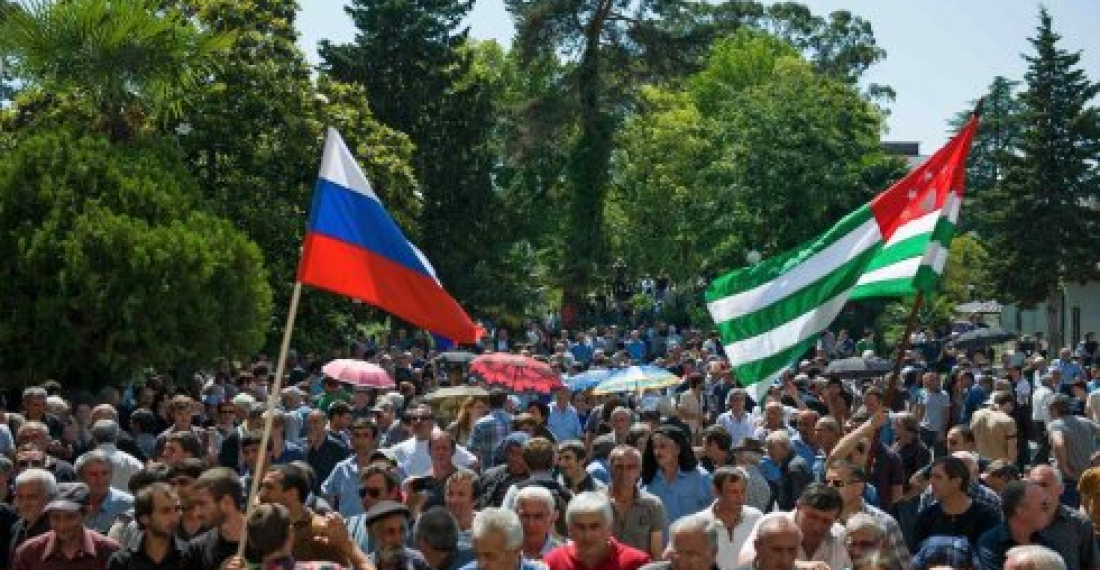
The opposition never accepted the result, and took the case to the courts. On January 9, as the case was being heard in front of the court of appeal, protesters demanding the resignation of President Raul Khajimba forced their way into the building of the presidential administration in Sukhumi, effectively taking it over. They even raided the arsenal in the building and took weapons
Khajimba called an urgent meeting of the Security Council to declare that the introduction of a state of emergency was not ruled out. Abkhazia's parliament met in early session on the same day to vote for a message to the president urging him to step down. In response, Khajimba invited the opposition to negotiate.
But on Friday (10 January) the Court agreed that the election result should be cancelled and fresh elections held in the period not earlier than two months and not later than three months. Khajimba at first appeared not to be accepting this judgement, but later acquiesed.
Moscow has been watching these developments in its protectorate with concern. It sent the Deputy Secretary of Russia's Security Council Rashid Nurgaliyev, to Sukhumi to try to stabilise the situation. His presence seems to have focused minds. The press service of the Abkhaz president earlier said that Raul Khajimba and Rashid Nurgaliyev had discussed ways of normalizing the socio-political situation in the country". On Friday and Saturday, Nurgaliyev held several meetings with the country's officials and opposition members. Earlier, leader of the Abkhaz opposition Aslan Bjania informed that he had met with the Russian official to discuss the situation in the country, adding that the talks were held in a constructive and positive manner.
"All parties involved in the current political crisis in Abkhazia have a high level of trust towards the members of the Russian delegation to the country headed by Deputy Secretary of the Russian Security Council Rashid Nurgaliyev", Abkhazia's Security Council Secretary Mukhamed Kilba informed TASS on Saturday. "In Abkhazia, Rashid Nurgaliyev is well received; there is a lot of trust towards him. He came with a delegation that involves representatives from various Russian institutions, they are seen as arbitrators and experienced colleagues," Kilba said.
Despite pumping large ammounts of money into Abkhazia Russia has been unable to stabilise the territory. Competing clans, some with a history of conflict dating back centuries, continue to provide the fabric of the political framework. Organised crime has now entrenched itself in the territory and has infiltrated the political process. The Kremlin has to continously knock heads together to keep the situation under control. This is what appears to have happened now too. New elections will now be held, probably sometime in April, and in the meantime Khajimba will remain president.
There is an asspect of this saga that is also worrying for other reasons, and this is the attempt by the current Abkhaz leadership to blame ongoing events on foreign sources. The Secretary of the Abkhazian Security Service Mukhamed Kilba told TASS on Friday (10 January) that "Abkhazia's special services are verifying reports about possible participation of citizens of other countries in the protests in Sukhum. It is not ruled out that there are Ukrainian nationals among them,"
"We have such information. It is being verified," he said, adding that Ukrainian nationals are among such foreigners. "Corresponding services are verifying these reports." He said that Georgian nationals could also be involved in the protests.
In the context of an already tense Caucasus region these claims appear highly irresponsible and motivated only by a desire to prepare the population for a possible crackdown on protesters. So far Moscow has not distanced itself from these claims.
As is often the case Moscow does not appear interested in dealing with any of the root causes of the Abkhaz problem. They have created a narrative which they now feel they must sustain. This is not good, either for the people of Abkhazia, or for peace in the wider region.
source: This commentary was prepared by the political editor of commonspace.eu.
photo: Demonstrators in front of the building of the presidential administration in Sukhumi.
The views expressed in opinion pieces and commentaries do not necessarily reflect the position of commonspace.eu or its partners