


Commentary: The political significance of Pope Francis' visit to Georgia and Azerbaijan

Commonspace.eu political editor commented on the political significance of Pope Francis' visit to Georgia and Azerbaijan

The Caucasus is a complex region at the crossroads between continents, cultures and civilisations. The visit of Pope Francis will bring forth some of the many issues.

The Pope's first stop will be Georgia, an Orthodox country with a long and distinguished history. Georgia's biggest challenge is its relations with its large neighbour Russia. Russia harbours hegemonic ambitions over Georgia, seen most vividly during the 2008 war between the two countries and Russia's subsequent creation of protectorates in Abkhazia and South Ossetia, Georgian territories that want to secede from Georgia. Relations remain tense and the two countries do not have diplomatic relations. The Pope is likely to make a reference to the tens of thousands of displaced Georgians, victims of the wars in Abkhazia and South Ossetia, as part of a more general reference to the refugee crisis in Europe.

Pope Francis arrives in Georgia one week before the country goes to the polls in competitive elections to choose a new parliament. It is a bit puzzling why Vatican diplomacy acquiesced, or probably even proposed, these dates so close to elections. The visit of Pope Francis is not controversial in a political context. But in Georgia politics and religion often interphase, and the presence of elements of hard line orthodox priests and their followers who have made insulting statements directed at the Pope raises the risk of the visit getting entangled in the political debate.
But Georgia is today a very different country then only a decade ago. It is most appropriate that a reformist Pope visits a country that has embraced reforms and is trying to implement them as part of an ongoing process towards European and Euro-Atlantic integration. The visit of the Pope is another affirmation of Georgia's western orientation, and of the readiness of the majority of the leadership of the Georgian Orthodox Church to embrace openness and dialogue.

From Georgia the Pope will go to Azerbaijan, a secular country with a largely Muslim population. It is not often that the Head of the catholic Church can visit a Shia Muslim country. Azerbaijan is a keen supporter of the dialogue between cultures and civilisations, and is sensitive to incidences of Islamophobia in Europe. According to Agenzia Fides, the news agency of the Vatican, Azerbaijani President Ilham Aliyev, speaking on the eve of the Pope's visit denounced the risk of a resurgence of fascism in the heart of the Old Continent. Speaking at the 5th International Humanitarian Forum being held in Baku, President Aliev said "some politicians and experts in the world are building a negative image of Islam by linking it with terror and at the same time forgetting to say that terrorism mainly affects Islamic countries".

Azerbaijan has just held a referendum on constitutional changes. The Pope's visit only days after the referendum has also raised some concerns.

Vatican diplomacy is very thorough and sophisticated, and one can only think that the decision to visit Georgia and Azerbaijan so close to sensitive ballots indicates that the Vatican thinks the visit to the two countries is important enough to justify the risks. The Pope visited Armenia in June. The Vatican hopes that the papal visits to the South Caucasus will highlight the importance of the region and the need for peace and dialogue.

source: This is a commentary prepared by the political editor of commonspace.eu

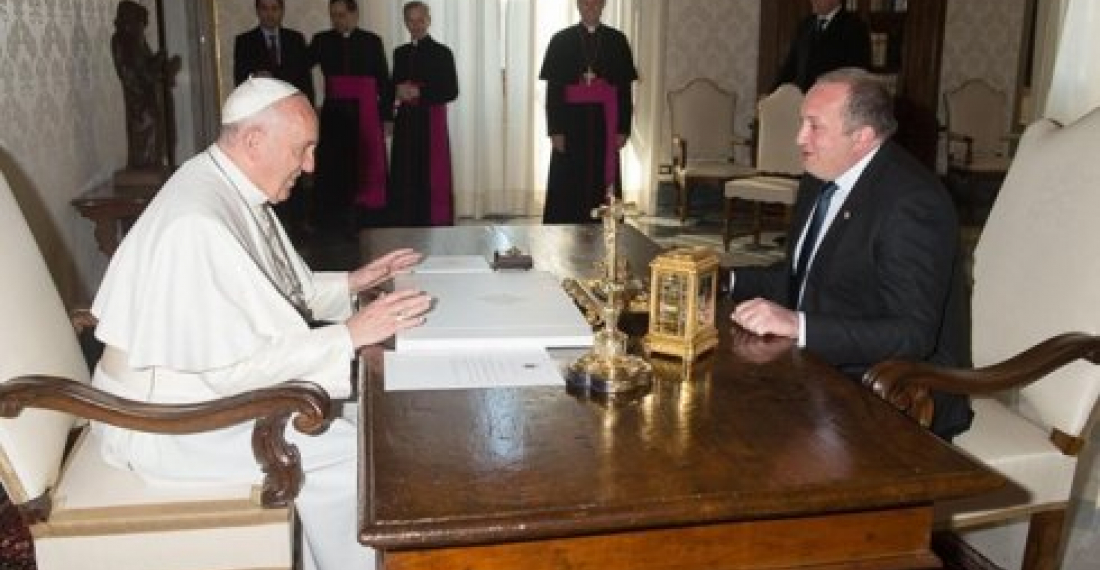
photo: Pope Francis and Georgian president Giorgi Marghvelashvili during the latter's visit to the Vatican in April 2016.

 

Related articles

Editor's choice
News
Borrell tells the European Parliament that the situation in Afghanistan was critical, but the EU will remain engaged

Borrell tells the European Parliament that the situation in Afghanistan was critical, but the EU will remain engaged

Borrell underlined that the European Union will make every effort to support the peace process and to remain a committed partner to the Afghan people. "Of course, we will have to take into account the evolving situation, but disengagement is not an option.  We are clear on that: there is no alternative to a negotiated political settlement, through inclusive peace talks.
Editor's choice
News
Germany accuses Russia of cyberattacks and disinformation campaign

Germany accuses Russia of cyberattacks and disinformation campaign

The German government holds Russia responsible for a cyberattack on German air traffic control, and for targeted disinformation campaigns before the last federal election. According to the German Foreign Office in Berlin, the incidents could be clearly attributed to the Russian military intelligence service, the GRU. In response, the Russian ambassador to Berlin was summoned to the Foreign Ministry. "We have been observing a massive increase in threatening hybrid activities by Russia for some time now," a spokesperson for the Foreign Ministry stated. These range from disinformation campaigns and espionage to cyberattacks and sabotage attempts. The aim is to divide society, sow distrust, and undermine confidence in democratic institutions. The spokesperson added that with these actions, Russia is "very concretely threatening our security, not only through its war of aggression against Ukraine, but also here in Germany."  The Foreign Ministry spokesperson explained that the cyberattack on air traffic control in August 2024 was clearly attributed to the hacker collective "APT28," known as "Fancy Bear," and to the responsibility of the Russian military intelligence service, the GRU. Furthermore, it could now be "conclusively stated" that Russia had attempted "to influence and destabilize both the last Federal election and the ongoing internal affairs of the Federal Republic of Germany." There was "absolutely irrefutable evidence" for this". The so-called "Storm 1516" campaign, which has been running since 2024, is allegedly backed by "reliable information" that the Moscow-based think tank "Center for Geopolitical Expertise" is behind it. The Center is also said to be supported by Russian military intelligence. Its primary aim is to influence democratic elections in the West. (Click the image to read more).

Popular

Editor's choice
News
Germany accuses Russia of cyberattacks and disinformation campaign

Germany accuses Russia of cyberattacks and disinformation campaign

The German government holds Russia responsible for a cyberattack on German air traffic control, and for targeted disinformation campaigns before the last federal election. According to the German Foreign Office in Berlin, the incidents could be clearly attributed to the Russian military intelligence service, the GRU. In response, the Russian ambassador to Berlin was summoned to the Foreign Ministry. "We have been observing a massive increase in threatening hybrid activities by Russia for some time now," a spokesperson for the Foreign Ministry stated. These range from disinformation campaigns and espionage to cyberattacks and sabotage attempts. The aim is to divide society, sow distrust, and undermine confidence in democratic institutions. The spokesperson added that with these actions, Russia is "very concretely threatening our security, not only through its war of aggression against Ukraine, but also here in Germany."  The Foreign Ministry spokesperson explained that the cyberattack on air traffic control in August 2024 was clearly attributed to the hacker collective "APT28," known as "Fancy Bear," and to the responsibility of the Russian military intelligence service, the GRU. Furthermore, it could now be "conclusively stated" that Russia had attempted "to influence and destabilize both the last Federal election and the ongoing internal affairs of the Federal Republic of Germany." There was "absolutely irrefutable evidence" for this". The so-called "Storm 1516" campaign, which has been running since 2024, is allegedly backed by "reliable information" that the Moscow-based think tank "Center for Geopolitical Expertise" is behind it. The Center is also said to be supported by Russian military intelligence. Its primary aim is to influence democratic elections in the West. (Click the image to read more).

