


Commentary: The old politics is still not quite dead in Georgia, but its end is near

This is a commentary prepared by the editorial team of Caucasus Concise

Georgian politics in the last twenty-five years, since the country regained its independence after the collapse of the USSR in 1991, has been anything but boring.

The natural artistic flair of the Georgians, together with a macho culture, where no good wedding party is complete without the inevitable punch-up, are only some of the ingredients that have traditionally spiced up Georgian politics. Larger than life personalities dominate, from the national to village levels. And with Georgia located at the intersection between Europe and Asia, between European democracy, and Eurasian authoritarianism, the stakes could not be higher.

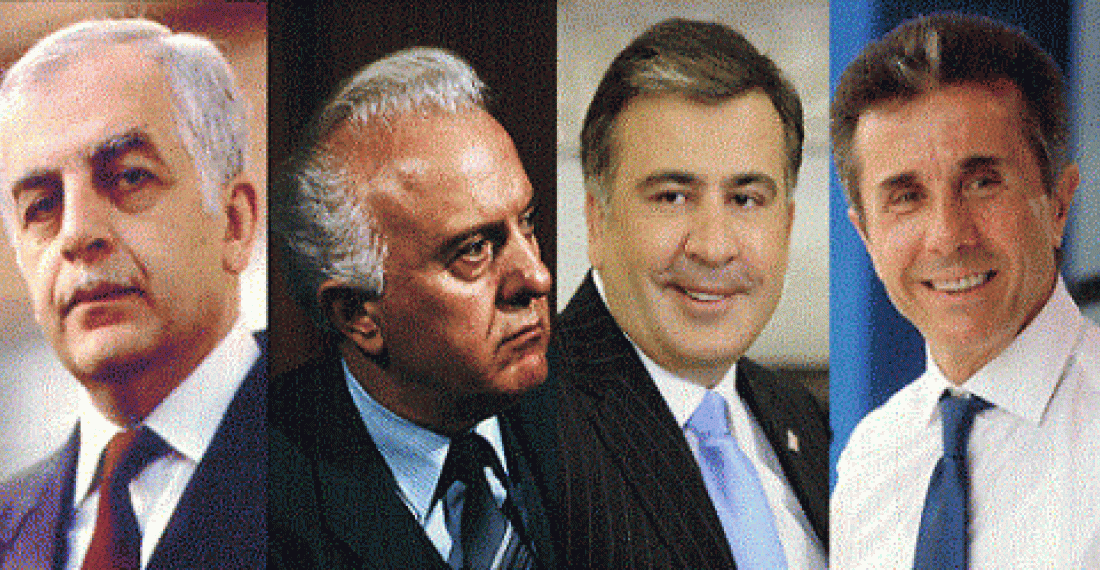
Post-Soviet politics started with nationalist ethnographer, ZviadGamsakhurdia, galvanising the nation in throwing off Moscow's yoke in the twilight years of the Soviet Union.Despite massive popular support, he ultimately led the country into the abyss barely a year later with his nationalist rhetoric, lack of government experience, and disregard for minorities.

In came Eduard Shevardnadze, former leader of Communist Georgia and SovietPolitburo Member, now re-invented as one of the key architects of the end of the Cold War, and hero in the United States and Europe, especially Germany. Shevardnaze's thankless task was to try to save Georgia from itself, and from its large neighbour to the north. He succeeded, but only just. Georgian statehood was secured, but its territorial integrity compromised, and its economy in ruins. Exhausted and isolated, in 2003 he was probably relieved when Mikheil Saakashvili, a political opportunist par excellence, burst into the Georgian parliament carrying a bunch of roses, and took power.

Saakashvili gave Georgia a good shake-up, which it badly needed. His problem was he did not quite know when to stop shaking. He was continuously restless and often reckless. Georgians are by and large patient with their leaders, having learned over the years not to expect too much. But Saakashvili's insipient authoritarianism crossed red lines which many Georgians considered threatened their sense of dignity. The problem was finding someone who could unseat his increasingly entrenched administration.

Into the scene in 2012 rodeBidhzina Ivanishvili, not quite atop a white horse, but very nearly. A village boy from western Georgia who had left for Russia and made good, becoming the richest Georgian.  Georgians had heard of him through his philanthropic work, but until 2012 few had even ever seen a picture of him.

Quite what made Ivanishvili throw his hat into the political arena is unclear, but it is likely that he was persuaded that there was no one else who could unseat Saakashvili. Indeed, his biggest contribution was to unite a fractious melange of parties and personalities into a coherent political force, a task considered all but impossible only months before. The landslide victory in 2012 of Georgian Dream, the coalition led by Ivanishvili, stunned Saakashvili, who with a little bit of nudging from the international community, bowed out graciously, flew to Ukraine where he took citizenship, and has since become Governor of Odessa.

Since then Georgian politics has been largely quiet and predictable. Ivanishvili left the helm of government a year after his election victory, but has remained engaged with politics through television talk shows. His critics accuse of him of interfering with government. His supporters say he does not interfere enough. His future role will depend on the way that Georgian Dream will evolve as a political force.

Nobody expected Saakashvili to disappear into the twilight when he left Georgia in 2013, but his efforts to continue leading his UNM from Odessa has raised some eyebrows: foreign citizens technically cannot participate in Georgian politics. But what some international observers of the Georgian political scene are concerned about is not this technicality, but rather the danger that from afar Saakashvili may not appreciate quite how much Georgian politics has changed. Whilst some of the theatrics of politics remain the same, the rules of the game are now different. Georgians, and increasingly the younger generation in particular, are clear that they want their country to move forward, and most want to see a stable Western political culture. No one wants to go back to the turbulence of the past. A repeat of 2003 Rose Revolution is not possible, simply because the conditions are completely different.

The 2016 parliamentary election campaign has showed some of the negative hallmarks of past campaigns - violent incidents, abusive rhetoric, leaked telephone conversations and too much emphasis on personalities and not enough on substance. But the extent of these negative hallmarks is much lower than in previous elections. The reaction of the electorate is also sharply different. Voters are much less impressed, or even amused, by the excesses of their politicians

Yes, one can still see signs of the old politics in Georgia's political campaigning, but they are the signs of a dying political culture that is slowly butsurely making way to something much better, and much healthier. How the process will play out on election day itself - 8 October, will either seal this trend or reverse it.

This commentary was prepared by the editorial team of Caucasus Concise

Photo collage: The four personalities that have dominated the Georgian political scene in the last quarter century - from left to right Zviad Gamsakhurdia, Eduard Shevardnadze, Mikheil Saakashvili and Bidhzina Ivanishvili
Related articles

Editor's choice
News
Council of Europe launches new International Claims Commission for Ukraine

Council of Europe launches new International Claims Commission for Ukraine

Thirty-four countries and the European Union have signed a new convention establishing an International Claims Commission for Ukraine at a diplomatic conference co-hosted by the 46-nation Council of Europe and the Netherlands in the Hague. The diplomatic conference was attended by leaders and high-level representatives from over 50 states, including the President of Ukraine, Volodymyr Zelenskyy, the President of the Republic of Moldova, Maia Sandu, and the Prime Minister of the Netherlands, Dick Schoof.  “Today marks a major step forward in ensuring accountability for Ukraine. The International Claims Commission represents justice and hope for tens of thousands of victims—our determination that those who have suffered will not be forgotten. I call for quick ratifications so we can get the commission rapidly up and running for the people of Ukraine,” said Council of Europe Secretary General Alain Berset. Ukrainian President Volodymyr Zelenskyy said: “We expect that every mechanism for compensation from the Register of Damage and Claims Commission to the actual payments – will start working and receive strong and sufficient international support, so that people can truly feel that any kind of damage caused by the war can be compensated. This war, and Russia’s responsibility for it, MUST become a clear example – so that others learn not to choose aggression.” “Accountability is about creating the conditions for peace that endures. And therefore, accountability is a condition of security – today and for the future. But accountability is not only about Ukraine. And it is not only about one aggressor and one victim. Accountability is about Europe. About every country in Europe. It is about whether Europe, as a whole, is willing to defend its peace,” said Maia Sandu, President of the Republic of Moldova, which currently holds the Presidency of the Council of Europe’s Committee of Ministers. The Prime Minister of the Netherlands, Dick Schoof, said: “Every day Russia is deliberately bombarding homes, destroying businesses and damaging infrastructure in Ukraine. Russia must compensate Ukraine for the damage caused. That is why we have launched the International Claims Commission for Ukraine and we are honoured to host it.” The International Claims Commission will be the second part of a comprehensive compensation mechanism related to Russia’s war of aggression, building on the existing Register of Damage for Ukraine. The claims commission will be established within the framework of the Council of Europe and will also be open to other countries. The Register of Damage for Ukraine, created in 2023, collects and records compensation claims submitted by individuals, organisations and public bodies in Ukraine. Forty-four states and the European Union have so far joined the Register, which has already received 86,000 claims. The International Claims Commission will review, assess and decide upon claims submitted to the Register of Damage for Ukraine and determine the amount of compensation, if any, which is due in each case. The convention establishing the commission will enter into force once it has been ratified by 25 signatories, as long as sufficient funds have been secured to support its initial work.

Popular

Editor's choice
News
Council of Europe launches new International Claims Commission for Ukraine

Council of Europe launches new International Claims Commission for Ukraine

Thirty-four countries and the European Union have signed a new convention establishing an International Claims Commission for Ukraine at a diplomatic conference co-hosted by the 46-nation Council of Europe and the Netherlands in the Hague. The diplomatic conference was attended by leaders and high-level representatives from over 50 states, including the President of Ukraine, Volodymyr Zelenskyy, the President of the Republic of Moldova, Maia Sandu, and the Prime Minister of the Netherlands, Dick Schoof.  “Today marks a major step forward in ensuring accountability for Ukraine. The International Claims Commission represents justice and hope for tens of thousands of victims—our determination that those who have suffered will not be forgotten. I call for quick ratifications so we can get the commission rapidly up and running for the people of Ukraine,” said Council of Europe Secretary General Alain Berset. Ukrainian President Volodymyr Zelenskyy said: “We expect that every mechanism for compensation from the Register of Damage and Claims Commission to the actual payments – will start working and receive strong and sufficient international support, so that people can truly feel that any kind of damage caused by the war can be compensated. This war, and Russia’s responsibility for it, MUST become a clear example – so that others learn not to choose aggression.” “Accountability is about creating the conditions for peace that endures. And therefore, accountability is a condition of security – today and for the future. But accountability is not only about Ukraine. And it is not only about one aggressor and one victim. Accountability is about Europe. About every country in Europe. It is about whether Europe, as a whole, is willing to defend its peace,” said Maia Sandu, President of the Republic of Moldova, which currently holds the Presidency of the Council of Europe’s Committee of Ministers. The Prime Minister of the Netherlands, Dick Schoof, said: “Every day Russia is deliberately bombarding homes, destroying businesses and damaging infrastructure in Ukraine. Russia must compensate Ukraine for the damage caused. That is why we have launched the International Claims Commission for Ukraine and we are honoured to host it.” The International Claims Commission will be the second part of a comprehensive compensation mechanism related to Russia’s war of aggression, building on the existing Register of Damage for Ukraine. The claims commission will be established within the framework of the Council of Europe and will also be open to other countries. The Register of Damage for Ukraine, created in 2023, collects and records compensation claims submitted by individuals, organisations and public bodies in Ukraine. Forty-four states and the European Union have so far joined the Register, which has already received 86,000 claims. The International Claims Commission will review, assess and decide upon claims submitted to the Register of Damage for Ukraine and determine the amount of compensation, if any, which is due in each case. The convention establishing the commission will enter into force once it has been ratified by 25 signatories, as long as sufficient funds have been secured to support its initial work.

