Commentary: Iran-Russia relations and their impact on the South Caucasus

Russia and Iran for the moment have shared interest in containing western and Turkish influence in the South Caucasus. In the long term however their relationship in the region is likely to become more competitive than cooperative, says Benyamin Poghosyan in this commentary

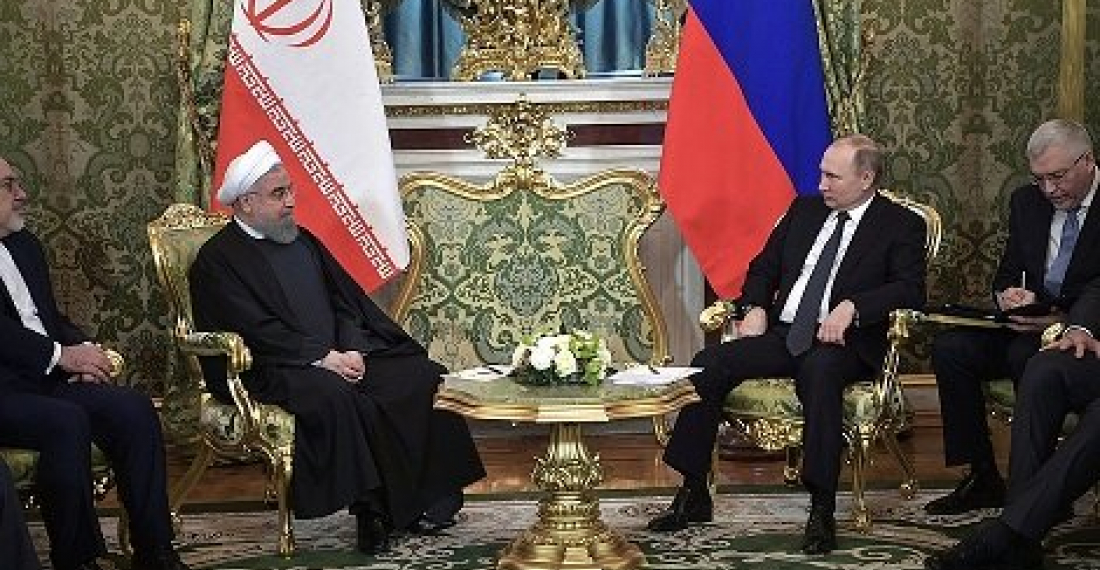
On March 28, 2017, Iranian President Hassan Rouhani met with his Russian counterpart in Mosscow. Overall, Russian - Iranian relations can be characterized as both cooperative and simultaneously competitive. Both states share a mutual distrust towards the post-Cold War Western-led international order viewing it as disadvantageous for their pursuit of vital national interests. Russia and Iran are interested in curbing Western influence in their neighborhood, for example, since they perceive it as a potential  excuse for meddling into their domestic politics, with long-term regime change plans. The two states have converging short-term interests in Syria with the clear aim to prevent the collapse of the Syrian state apparatus and to halt the spread of Sunni radical extremism in the Middle East and beyond.

Meanwhile, Iran has a long history of distrust towards Russia starting from the Tsarist period and substantiated by Soviet support for the short-lived Mahabad Republic and Azerbaijan People's Government in 1945-1946. During the Iranian nuclear crisis, Tehran was suspicious that Russia may use its relations with Iran as a bargaining chip for getting a broader understanding with the West.

The South Caucasus is one of the key regions for Russian-Iranian relations. Located between the two states, the South Caucasus was largely part of the Persian Empire till the first half of the 19th century, and still perceived by Iran as a part of its civilizational area. Meanwhile, Russia perceives the region as part of its legitimate sphere of special interests, and tries to regain its control and curb the influence of other powers.

For both Russia and Iran, the main strategic threat is the growing US/EU/NATO involvement in the region. Iran believes that the South Caucasus can be used as a launching pad for anti-Iranian activities; and for Russia, Western influence in the region is a direct obstacle to its efforts to retake the post-Soviet space. Thus, both Russia and Iran share the interest of thwarting Western influence in the South Caucasus. Another important factor shaping Iranian and Russian policy in the region is driven by geo-economic issues. The South Caucasus provides a direct link between Iran and Russia which has the potential to be part of much greater transport corridor connecting India through Iranian Gulf ports and the South Caucasus to the Russia and Northern Europe. The establishment of a North-South corridor was one of the key points discussed during a Russia-Azerbaijan-Iran trilateral meeting held in Baku in August 2016, and was discussed also during Rouhani's March 2017 visit to Russia.

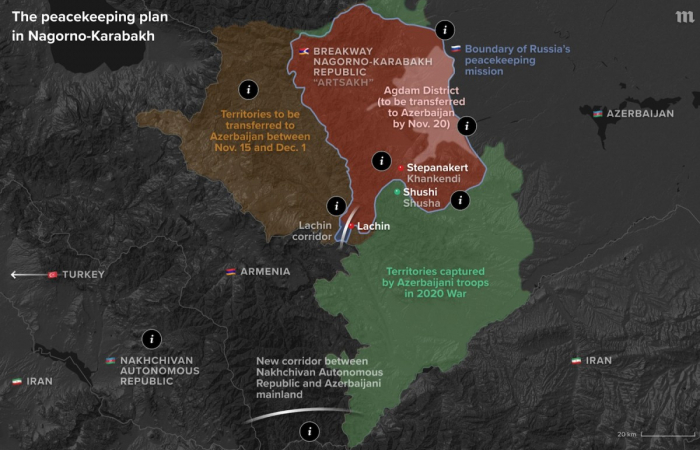
As for relations with regional states, they are driven by different factors. Taking into account the strategic alliance between Turkey and Azerbaijan, Iran views Armenia as a significant factor in its policy to thwart the growing influence of Turkey in the region. This is one of the key considerations for Iran to tacitly support the current status quo in Nagorno Karabakh conflict. Meanwhile, friendly relations with Armenia are allowing Iran to reject accusations of pursuing mainly a religion-based foreign policy. The membership of Armenia in the Eurasian Economic Union (EEU) also provides Iran with a possibility to view Armenia as a launching pad for entering the 170 million-strong EEU market. The possible signature of an agreement on free trade area between the EEU and Iran, as well as Armenia's plans to establish a free economic zone near the Iranian border later this year, makes Armenia a more important economic partner for Iran. Armenia is also an alternative transit route for Iran to link India and Europe through Georgian Black sea ports.    

Azerbaijan plays a key role in Iran's regional policy, first of all due to its strategic alliance with Turkey, as well as taking into account the existence of several-million strong Azeri speaking population in Iran. The majority of the population in Azerbaijan itself are Shia Muslims, which is a significant factor influencing Iranian policy.   The growing cooperation between Azerbaijan and Israel is another key concern for Iran which is anxious not to allow Israel to use Azerbaijan in its activity against Iran. Economically, Iran perceives Azerbaijan as a strategic route linking it with Russia.

Georgia plays a less important role in Iranian regional policy. Georgia is the only South Caucasian state not bordering Iran. Georgia's Euro-Atlantic foreign policy aspirations put some constraints on bilateral relations. After the 2015 nuclear deal, the two states made some efforts to foster cooperation in different spheres including energy. Iran-Armenia-Georgia and Iran-Armenia-Georgia-Russia cooperation in electricity transmission may create the necessary conditions for deepening Iran-Georgia bilateral relations.

Russia views the South Caucasus as part of it zone of special interests. Russia holds a tight grip over Armenia, directly or indirectly controlling most of Armenia's strategic assets. After 2012, Russia and Georgia are slowly improving bilateral relations but with the Abkhazian and South Ossetian conflicts in place, no real breakthrough seems possible. The Russian strategic goal is to prevent a further growth of Western influence in Georgia simultaneously attempting to regain economic clout. As for Azerbaijan, Russia is interested in driving Azerbaijan closer to the EEU and keeping current levels of military cooperation with multi-billion dollar contracts for the Russian defense industry. Despite the recent thaw in Russian-Turkish relations, Russia is concerned over Turkish efforts to pull Georgia closer to the Turkish-Azerbaijani strategic alliance which may result in a growing role for Turkey in the South Caucasus.

Thus, in the short and mid-term perspective, both Russia and Iran have converging interests in the South Caucasus: to prevent the growing influence of both Turkey and the West, to deepen economic cooperation, and to utilize the region's transit capacities in launching new transport corridors. In the long-term   Iranian efforts to strengthen its positions in the region. using "soft power" tools such as religious affiliation or shared history, may transform Russia-Iran relations, making them more competitive than cooperative.     

Benyamin Poghosyan is the Executive Director, Political Science Association of Armenia. He contributed this commentary to commonspace.eu

photo: President Rouhani of Iran meeting President Putin of Russia in the Kremlin on 28 March 2017 (picture courtesy of the press service of the President of Russia)
Related articles

Editor's choice
News
Council of Europe launches new International Claims Commission for Ukraine

Council of Europe launches new International Claims Commission for Ukraine

Thirty-four countries and the European Union have signed a new convention establishing an International Claims Commission for Ukraine at a diplomatic conference co-hosted by the 46-nation Council of Europe and the Netherlands in the Hague. The diplomatic conference was attended by leaders and high-level representatives from over 50 states, including the President of Ukraine, Volodymyr Zelenskyy, the President of the Republic of Moldova, Maia Sandu, and the Prime Minister of the Netherlands, Dick Schoof.  “Today marks a major step forward in ensuring accountability for Ukraine. The International Claims Commission represents justice and hope for tens of thousands of victims—our determination that those who have suffered will not be forgotten. I call for quick ratifications so we can get the commission rapidly up and running for the people of Ukraine,” said Council of Europe Secretary General Alain Berset. Ukrainian President Volodymyr Zelenskyy said: “We expect that every mechanism for compensation from the Register of Damage and Claims Commission to the actual payments – will start working and receive strong and sufficient international support, so that people can truly feel that any kind of damage caused by the war can be compensated. This war, and Russia’s responsibility for it, MUST become a clear example – so that others learn not to choose aggression.” “Accountability is about creating the conditions for peace that endures. And therefore, accountability is a condition of security – today and for the future. But accountability is not only about Ukraine. And it is not only about one aggressor and one victim. Accountability is about Europe. About every country in Europe. It is about whether Europe, as a whole, is willing to defend its peace,” said Maia Sandu, President of the Republic of Moldova, which currently holds the Presidency of the Council of Europe’s Committee of Ministers. The Prime Minister of the Netherlands, Dick Schoof, said: “Every day Russia is deliberately bombarding homes, destroying businesses and damaging infrastructure in Ukraine. Russia must compensate Ukraine for the damage caused. That is why we have launched the International Claims Commission for Ukraine and we are honoured to host it.” The International Claims Commission will be the second part of a comprehensive compensation mechanism related to Russia’s war of aggression, building on the existing Register of Damage for Ukraine. The claims commission will be established within the framework of the Council of Europe and will also be open to other countries. The Register of Damage for Ukraine, created in 2023, collects and records compensation claims submitted by individuals, organisations and public bodies in Ukraine. Forty-four states and the European Union have so far joined the Register, which has already received 86,000 claims. The International Claims Commission will review, assess and decide upon claims submitted to the Register of Damage for Ukraine and determine the amount of compensation, if any, which is due in each case. The convention establishing the commission will enter into force once it has been ratified by 25 signatories, as long as sufficient funds have been secured to support its initial work.

Popular

Editor's choice
News
Council of Europe launches new International Claims Commission for Ukraine

Council of Europe launches new International Claims Commission for Ukraine

Thirty-four countries and the European Union have signed a new convention establishing an International Claims Commission for Ukraine at a diplomatic conference co-hosted by the 46-nation Council of Europe and the Netherlands in the Hague. The diplomatic conference was attended by leaders and high-level representatives from over 50 states, including the President of Ukraine, Volodymyr Zelenskyy, the President of the Republic of Moldova, Maia Sandu, and the Prime Minister of the Netherlands, Dick Schoof.  “Today marks a major step forward in ensuring accountability for Ukraine. The International Claims Commission represents justice and hope for tens of thousands of victims—our determination that those who have suffered will not be forgotten. I call for quick ratifications so we can get the commission rapidly up and running for the people of Ukraine,” said Council of Europe Secretary General Alain Berset. Ukrainian President Volodymyr Zelenskyy said: “We expect that every mechanism for compensation from the Register of Damage and Claims Commission to the actual payments – will start working and receive strong and sufficient international support, so that people can truly feel that any kind of damage caused by the war can be compensated. This war, and Russia’s responsibility for it, MUST become a clear example – so that others learn not to choose aggression.” “Accountability is about creating the conditions for peace that endures. And therefore, accountability is a condition of security – today and for the future. But accountability is not only about Ukraine. And it is not only about one aggressor and one victim. Accountability is about Europe. About every country in Europe. It is about whether Europe, as a whole, is willing to defend its peace,” said Maia Sandu, President of the Republic of Moldova, which currently holds the Presidency of the Council of Europe’s Committee of Ministers. The Prime Minister of the Netherlands, Dick Schoof, said: “Every day Russia is deliberately bombarding homes, destroying businesses and damaging infrastructure in Ukraine. Russia must compensate Ukraine for the damage caused. That is why we have launched the International Claims Commission for Ukraine and we are honoured to host it.” The International Claims Commission will be the second part of a comprehensive compensation mechanism related to Russia’s war of aggression, building on the existing Register of Damage for Ukraine. The claims commission will be established within the framework of the Council of Europe and will also be open to other countries. The Register of Damage for Ukraine, created in 2023, collects and records compensation claims submitted by individuals, organisations and public bodies in Ukraine. Forty-four states and the European Union have so far joined the Register, which has already received 86,000 claims. The International Claims Commission will review, assess and decide upon claims submitted to the Register of Damage for Ukraine and determine the amount of compensation, if any, which is due in each case. The convention establishing the commission will enter into force once it has been ratified by 25 signatories, as long as sufficient funds have been secured to support its initial work.