


Commentary: The gap in the rhetoric between Baku and the west widens

Diplomatic echoes of the 23-hour Azerbaijani military operation in Nagorno-Karabakh on 19-20 September – which resulted in the Azerbaijani army taking control of the territory, and in the subsequent exodus of more than one hundred thousand Armenians who decided they could not live under Azerbaijani jurisdiction – continue.

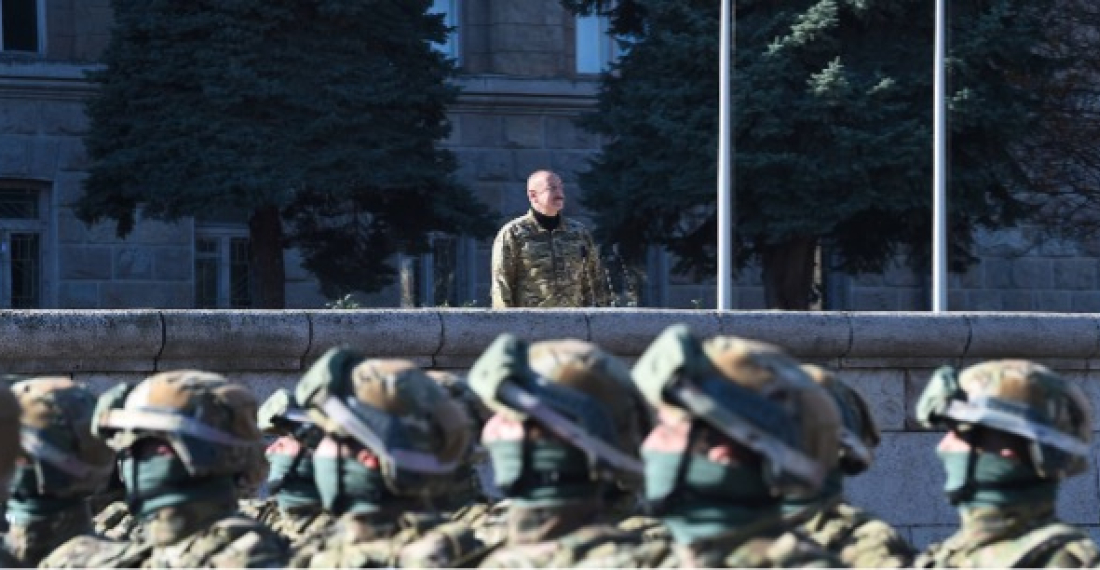
Azerbaijan this week marked its military victory with a parade in the administrative capital of the territory, which is now practically a ghost town.

The territory is internationally recognised as part of Azerbaijan but there is disquiet about the future of the Armenian population which overnight became refugees. Azerbaijan had previously refused outright the prospect of granting the territory autonomy, or of accepting an international monitoring mission. In the absence of both, the Armenians felt it was not safe for them to stay, and left. Questions about whether they can return, and under what conditions, continue.

Attempts to get a resolution approved by the UN Security Council failed, as there was no consensus. However, on Wednesday, 8 November, the G7 Foreign Ministers meeting in Japan included a reference to the issue in their final statement.

The Foreign Ministers, representing Canada, France, Germany, Italy, Japan, the United Kingdom, the United States, and the High Representative of the European Union, stated: “We are gravely concerned over the humanitarian consequences of the displacement of Armenians from Nagorno-Karabakh after the military operation conducted by Azerbaijan. We urge Azerbaijan to fully comply with its obligations under international humanitarian law and welcome international efforts to address urgent humanitarian needs for those who have been displaced. We underline our support for advancing a sustainable and lasting peace between Armenia and Azerbaijan based on the principles of non-use of force, respect for sovereignty, the inviolability of borders, and territorial integrity.”

A few days earlier, during a visit to Baku, German foreign minister, Annalena Baerbock, upset her Azerbaijani hosts by referring to names of places in Nagorno-Karabakh using the Armenian version. Whilst in international discourse, the administrative capital of Karabakh is generally referred by its Armenian name Stepanakert, the German Ministers’ choice of using the term “Shushi”, instead of “Shusha”, for the citadel town overlooking Stepanakert which traditionally was the symbol of Islamic tradition in the region raised eyebrows.

Azerbaijan has been using French and German public statements and actions, including France’s decision to provide military supplies to Armenia, as an excuse to procrastinate about a long-awaited meeting in Brussels between Aliyev and the Armenian prime minister Pashinyan as part of the so-called Brussels process. Many hope that at such a meeting some document can be signed by both sides providing a roadmap for future peace in the region. According to Armenian sources, the main substance of this document has already been agreed. Initially, it was thought the signing could happen in Granada in October. Than it was Brussels in November, but now the noises from Baku indicate it will not happen at all this year.

There are of course many nuanced differences in the position of the G7 countries and this reflects itself also within the councils of the European Union. But observers think that Baku is now overplaying its hand, and that going forward there is going to be a much tougher response from Western countries in case of any new military adventurism. Aliyev, speaking in Karabakh on Wednesday, assured that Baku has no intentions of launching any new military operations. “We don't need a new war. We achieved what we wanted, restored international law, restored historical justice, restored our national dignity, and showed the enemy his place.” In the international community, once bitten, twice shy, they are not taking his word for it. And the delays in signing the long-awaited peace agreement are being used to prove this. Baku dismisses Western criticism as hypocrisy and double standards, saying it had to look after nearly a million IDPs from the first Karabakh War for nearly thirty years without any international support or sympathy.
source: This commentary was prepared by the editorial team of commonspace.eu. This commentary was first published in the 9 November 2023 issue of of the fortnightly digital newsletter, Karabakh Concise
photo: Azerbaijan president Ilham Aliyev reviewing a military parade in Stepanakert/Khankendi on 8 November 2023 (picture courtesy of the press service of the president of Azerbaijan)

Related articles

Editor's choice
News
Borrell tells the European Parliament that the situation in Afghanistan was critical, but the EU will remain engaged

Borrell tells the European Parliament that the situation in Afghanistan was critical, but the EU will remain engaged

Borrell underlined that the European Union will make every effort to support the peace process and to remain a committed partner to the Afghan people. "Of course, we will have to take into account the evolving situation, but disengagement is not an option.  We are clear on that: there is no alternative to a negotiated political settlement, through inclusive peace talks.
Editor's choice
News
NATO Chief says war is on Europe's doorstep, and warns against complacency

NATO Chief says war is on Europe's doorstep, and warns against complacency

Russia could attack a Nato country within the next five years, the Secretary General of NATO, Mark Rutte, said in a stark new warning. "Nato's own defences can hold for now," Rutte warned in Berlin, but conflict was "next door" to Europe and he feared "too many are quietly complacent, and too many don't feel the urgency, too many believe that time is on our side. "Russia is already escalating its covert campaign against our societies," Rutte said in a speech in Germany. "We must be prepared for the scale of war our grandparents or great-grandparents endured." Earlier this month, Russia's President Vladimir Putin said his country was not planning to go to war with Europe, but it was ready "right now" if Europe wanted to - or started a war. But similar reassurances were given by Moscow in 2022, just before 200,000 Russian troops crossed the border and invaded Ukraine. Putin has accused European countries of hindering US efforts to bring peace in Ukraine - a reference to the role Ukraine's European allies have recently played in trying to change a US peace plan to end the war, whose initial draft was seen as favouring Russia. But Putin was not sincere, Nato's secretary-general said in the German capital, Berlin. Supporting Ukraine, he added, was a guarantee for European security. "Just imagine if Putin got his way; Ukraine under the boot of Russian occupation, his forces pressing against a longer border with Nato, and the significantly increased risk of an armed attack against us." Russia's economy has been on a war footing for more than three years now - its factories churn out ever more supplies of drones, missiles and artillery shells. According to a recent report by the Kiel Institute for the World Economy, Russia has been producing each month around 150 tanks, 550 infantry fighting vehicles, 120 Lancet drones and more than 50 artillery pieces. The UK, and most of its Western allies, are simply not anywhere near this point. Analysts say it would take years for Western Europe's factories to come close to matching Russia's mass-production of weapons. "Allied defence spending and production must rise rapidly, our armed forces must have what they need to keep us safe," the Nato chief said.

Popular

Editor's choice
News
NATO Chief says war is on Europe's doorstep, and warns against complacency

NATO Chief says war is on Europe's doorstep, and warns against complacency

Russia could attack a Nato country within the next five years, the Secretary General of NATO, Mark Rutte, said in a stark new warning. "Nato's own defences can hold for now," Rutte warned in Berlin, but conflict was "next door" to Europe and he feared "too many are quietly complacent, and too many don't feel the urgency, too many believe that time is on our side. "Russia is already escalating its covert campaign against our societies," Rutte said in a speech in Germany. "We must be prepared for the scale of war our grandparents or great-grandparents endured." Earlier this month, Russia's President Vladimir Putin said his country was not planning to go to war with Europe, but it was ready "right now" if Europe wanted to - or started a war. But similar reassurances were given by Moscow in 2022, just before 200,000 Russian troops crossed the border and invaded Ukraine. Putin has accused European countries of hindering US efforts to bring peace in Ukraine - a reference to the role Ukraine's European allies have recently played in trying to change a US peace plan to end the war, whose initial draft was seen as favouring Russia. But Putin was not sincere, Nato's secretary-general said in the German capital, Berlin. Supporting Ukraine, he added, was a guarantee for European security. "Just imagine if Putin got his way; Ukraine under the boot of Russian occupation, his forces pressing against a longer border with Nato, and the significantly increased risk of an armed attack against us." Russia's economy has been on a war footing for more than three years now - its factories churn out ever more supplies of drones, missiles and artillery shells. According to a recent report by the Kiel Institute for the World Economy, Russia has been producing each month around 150 tanks, 550 infantry fighting vehicles, 120 Lancet drones and more than 50 artillery pieces. The UK, and most of its Western allies, are simply not anywhere near this point. Analysts say it would take years for Western Europe's factories to come close to matching Russia's mass-production of weapons. "Allied defence spending and production must rise rapidly, our armed forces must have what they need to keep us safe," the Nato chief said.

