This is a commentary prepared by the political editor of commonspace.eu
On Thursday, (13 June) the European Union held high level consultations with Armenia and Azerbaijan.
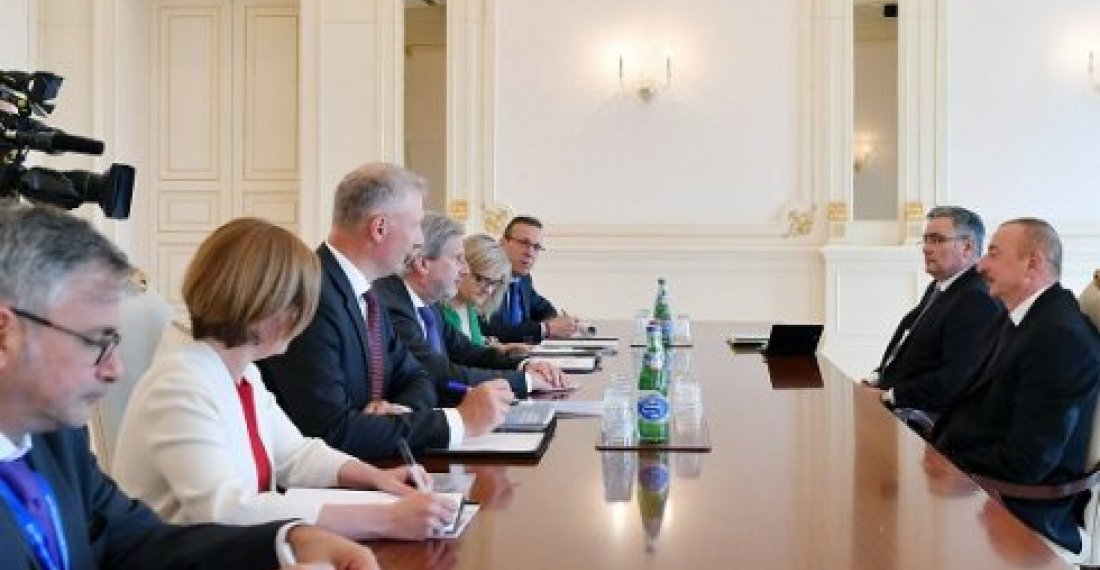
In Baku, Azerbaijani president Ilham Aliyev met with the EU Commissioner for Enlargement and Neighbourhood Policy, Johannes Hahn, whilst nearly at the same time in Brussels, EU High Representative, Federica Morgherini was meeting with Armenian Foreign Minister Zohrab Mnatsakanyan.
Traditionally EU relations with Georgia have been close and deep, even if not without problems. The Association Agreement signed between Georgia and the EU offers the highest level of co-operation possible to a non-candidate country, and provides a very solid basis for EU-Georgian relations going forward. With Armenia and Azerbaijan the pattern of relations has been somewhat more chequered. But in recent years relations have improved considerably, to the point where we can say that they are excellent, which does not mean however that there are not yet problems and issues to be resolved.
In Brussels yesterday, the second Partnership Council meeting between the European Union and Armenia "reaffirmed the commitment of the EU and Armenia to implement effectively the Comprehensive and Enhanced Partnership Agreement (CEPA). This ambitious agreement can play an important role for the modernisation of Armenia, in particular through legislative approximation to EU norms in many sectors. The Council highlighted the paramount importance of the rule of law and respect for human rights, which includes an independent, efficient and accountable justice system."
The European Union has looked sympathetically at the efforts of the new Armenian leadership, led by Nikol Pashinyan, to implement reforms in many sectors. One of these sectors is judicial reform. Here the Partnership Council underlined the importance of an independent, efficient and accountable judiciary which contributes not only to the protection of human rights but also to a business environment favourable to economic development and foreign investment. "The Council welcomed the current efforts aiming at comprehensive judicial reform in Armenia in accordance with the Armenian Constitution and with international standards. Following the launch of an EU-Armenia dialogue on judicial reform in September 2018 the EU stands ready to provide further support for comprehensive judicial reform based on a justice reform strategy." This is not a blank check for the government of Armenia to do what it wants, and should not be read as such. It is a genuine expression of understanding of the difficulties that Armenia faces in this sector, and an offer to use best practices to assist it in dealing with them.
Armenia has high expectations as to what the EU can do to help it economically. It is unlikely that these expectations can ever be fulfilled in full. Yet here also, the EU's hand of help has been generous, consistent and without geo-political strings. Many in Armenia, even if not all, appreciate this.
The meeting between the president of Azerbaijan and Commissioner Johannes Hahn, also yesterday, comes at an important moment in EU-Azerbaijan relations. Relations are better than they have been for many years, but both sides are willing, indeed determined, to move them even more forward. The prospect of a new contractual agreement between Azerbaijan and the EU is now definitely on the horizon. Azerbaijan sees its role as an energy provider from its own natural resources - and as a hub for the transportation and transit of those of others further afield - as key factors in determining its relations with the EU. But both sides appreciate that there is a wider agenda. The development of Azerbaijan's non energy sector; structural reforms, human rights and security are among some of the issues on the agenda as the new agreement is finalised. The contribution that the EU can make in all these areas is enormous, as long as Baku has the political will to engage and respond.
Overshadowing the bilateral relations, between the EU and Armenia and the EU and Azerbaijan, is the issue of the Karabakh conflict and its resolution. The EU supports the efforts of the OSCE Minsk Group co-chair, and articulates its position in terms of those ongoing efforts. That is satisfactory to the sides only to a point. There have been many efforts by both sides to shift the EU position in their favour. The EU's position remains however principled rather than biased, even if the principles sometimes favour one of the sides, and sometimes the other. That is how it is likely to continue. The EU has also the right to have expectations in this regard. It has legitimate interests in being engaged in the process of resolving the Karabakh conflict since the conflict has widespread ramifications for the whole region and beyond. A more positive approach on the part of both Armenia and Azerbaijan on this matter can only be helpful for the overall effort to resolve the conflict.
The European Union is sending a key message to the region, and to those interested in the region. Its engagement with the South Caucasus is ambitious and long lasting. The European Union's friendship and solidarity with Armenia, Azerbaijan and Georgia is unquestionable. Issues in the relations remain. They need to be properly managed and addressed. They certainly should not be allowed to spoil what are clearly mutually beneficial relationships.
source: This is a commentary prepared by the political editor of commonspace.eu
photo: EU Commissioner for Enlargement, Johannes Hahn with President Ilham Aliyev of Azerbaijan at their meeting in baku on 13 June 2019 (picture courtesy of the press service of the president of Azerbaijan)