This commentary first appeared in the 27 June 2023 issue of our newsletter Central Asia Concise. If you would like to subscribe to Central Asia Concise, or any other of our newsletters, please click here.
"Whilst this week’s EU-Tajikistan meeting can be dismissed as another piece of EU bureaucracy at play, for Tajikistan this mechanism is also a lifeline to the wider world," writes commonspace.eu in this commentary. "Tajikistan has a lot of potential, in terms of natural resources, tourism and connectivity which remains untapped. It has in the last couple of years made various overtures to the EU indicating a willingness to engage more. It is right that this week the EU has sent a message that it is interested too." Following an EU-Tajikistan meeting on Monday (26 June), a statement said that “the participants reviewed their cooperation, including economic and trade relations, issues related to the security of energy supply, and connectivity both within Central Asia and between Central Asia and Europe. The two sides assessed progress in implementing the outcomes of both the EU-Central Asia Sustainable Connectivity Conference, and the EU-Central Asia Economic Forum.”
In Central Asia, Tajikistan is often seen as being somewhat apart. Whilst not isolationist, in the way Turkmenistan sometimes is perceived, Tajikistan has certain specificities. Unlike the others it is not a Turkic Republic – Tajik is more akin to Farsi.
It has also quite specific relations with two problematic neighbours: Iran and Afghanistan. Tajikistan experienced a civil war immediately after the collapse of the USSR, and some of the scars of that are still visible. With a population of around ten million, the country is one of the poorest of the former Soviet republics.
Tajikistan has been ruled for nearly thirty years by Emomali Rahmon. That is a record even by Central Asian standards. Whilst a change of guard has taken place in the other four republics, there is no sign of change in Dushanbe. Yet even in Tajikistan the wind of change that has been blowing over Central Asia in the last few years can be felt too. The government is making conscious efforts to reach out to the wider international community, as well as strengthening its position in Central Asia. Relations with the European Union have therefore become increasingly important for Tajikistan. All the signs are that Brussels, whilst very conscious of the structural, deep-rooted problems in Tajikistan, is ready to engage.
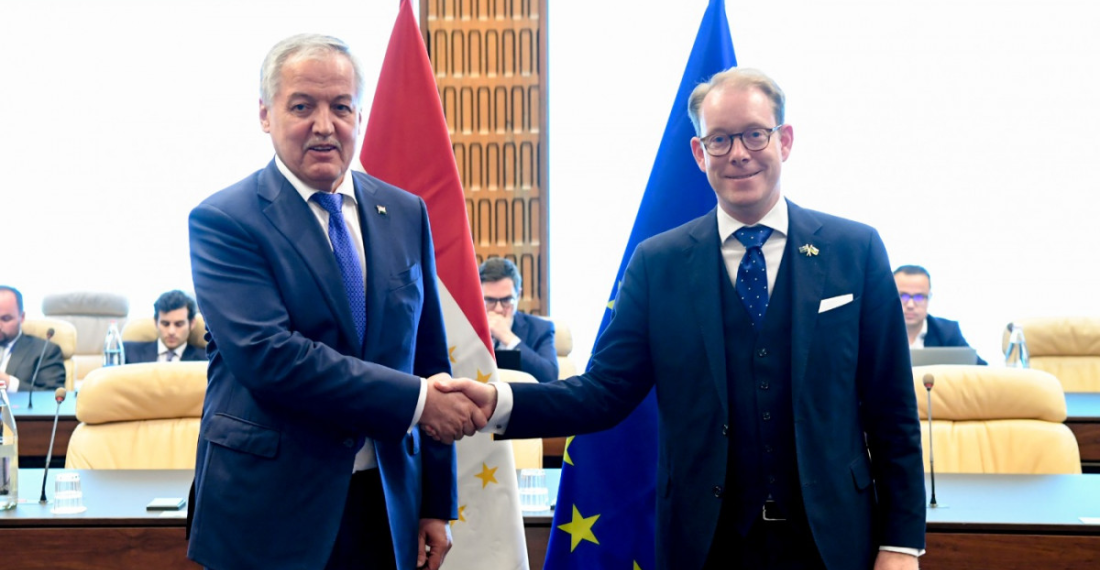
On Monday (26 June) in Luxembourg, “the Cooperation Council between the European Union and the Republic of Tajikistan” held its tenth meeting. The Cooperation Council is a framework the EU uses for holding high level meetings regularly with partner countries with whom it has signed a Partnership and Co-operation Agreement, of which Tajikistan is one. The meeting was co-chaired by Mr Sirojiddin Muhriddin, Minister of Foreign Affairs of Tajikistan, and for the EU by Mr Tobias Billström, Minister for Foreign Affairs of Sweden, (the country holding the rotating presidency of the EU), who replaced EU High Representative Josep Borrell.
In a statement, the EU said that:
“the Cooperation Council reviewed the state of play of bilateral relations, and addressed political and socio-economic developments, trade, investment and energy cooperation, as well as regional and international issues. The two sides expressed satisfaction at the start of the negotiations for a new Enhanced Partnership and Cooperation Agreement (EPCA) and looked forward to continuing the discussions. This agreement represents an important step forward for EU-Tajikistan relations, expanding the cooperation between the two sides into new areas and broadening the scope of their interactions.”
For the EU, Tajikistan is first and foremost part of its Central Asia strategy. The meeting on Monday reflected that. The statement afterwards added:
“The participants reviewed their cooperation, including economic and trade relations, issues related to the security of energy supply, and connectivity both within Central Asia and between Central Asia and Europe. The two sides assessed progress in implementing the outcomes of both the EU-Central Asia Sustainable Connectivity Conference, and the EU-Central Asia Economic Forum.”
Then came the more difficult parts. There is the impression that Tajikistan is lagging behind, even its Central Asian neighbours, when it comes to reforms and good governance. The statement reflected a certain disappointment in Brussels, although in very measured language. It said:
“The meeting also provided the opportunity to discuss issues of good governance, rule of law, human rights protection, and strengthening civil society. The EU encouraged Tajikistan to improve the protection of human rights and fundamental freedoms, emphasising the importance of freedom of expression, and raised the issue of prosecutions targeting certain bloggers and journalists.
Building on positive achievements, such as the upcoming criminalisation of domestic violence, addressing the most salient issues will be important for Tajikistan’s ambition to join the Generalised Scheme of Preferences Plus (GSP+).
In this context, the EU called on Tajik authorities to intensify the reform processes, reiterated the importance of a stability-oriented macroeconomic policy and further progress in public finance management as ways to improve the business environment and attract foreign investment with the potential to bring innovative and green solutions. A successful GSP+ application would mobilise the potential to increase the trade flows between Tajikistan and the EU.
The EU confirmed its continued support to Tajikistan in its reform process while highlighting the need for their intensification, and in its endeavours to improve the socio-economic conditions of the population. The EU welcomed the ongoing reform efforts in the energy and water sectors, encouraging Tajikistan to tap its vast renewable energy potential for greening the Central Asia region’s energy mix. Achievements of bilateral development assistance provided to Tajikistan, particularly in the three key focal sectors of health, education and rural development, were also discussed.”
In the end, the EU could not but recognise the difficult neighbourhood in which Tajikistan is situated, and the hope that some of the positive developments ongoing in other parts of Central Asia will rub off on Tajikistan too. The statement concluded that:
“During their discussions, the two sides also touched on matters of regional and international interest, including the situation in Afghanistan and Russia’s war of aggression against Ukraine.
The EU encouraged Tajikistan’s engagement with Central Asia’s neighbouring countries and welcomed its constructive role for broader cooperation within the Central Asia region and beyond. Tajikistan’s important role in the United Nations with regards to water diplomacy and climate change was acknowledged.”
Whilst this week’s EU-Tajikistan meeting can be dismissed as another piece of EU bureaucracy at play, for Tajikistan this mechanism is also a lifeline to the wider world. Tajikistan has a lot of potential, in terms of natural resources, tourism and connectivity which remains untapped. It has in the last couple of years made various overtures to the EU indicating a willingness to engage more. It is right that this week the EU has sent a message that it is interested too.