Special and Strategic Relations (2)
The choice of which countries or military arrangements to align with should remain first and foremost with the countries of the South Caucasus. No country should have a veto on the choice of another. Each country should however consider its choices wisely and realistically.
Armenia and Azerbaijan have opted for special and strategic relations with Russia and Turkey respectively. Armenia has made its relations with Russia the centrepiece of its foreign and security policy. Azerbaijan, currently with more room for manoeuvre because of its oil revenues, places its relations with Turkey as first amongst several. Yet all four countries are first of all driven by what they perceive to be their pragmatic national interest. The need for these special relations is related to concerns about security and at times hinders the pursuit of wider foreign policy objectives.
The third country in the region, Georgia, has addressed the problem differently.
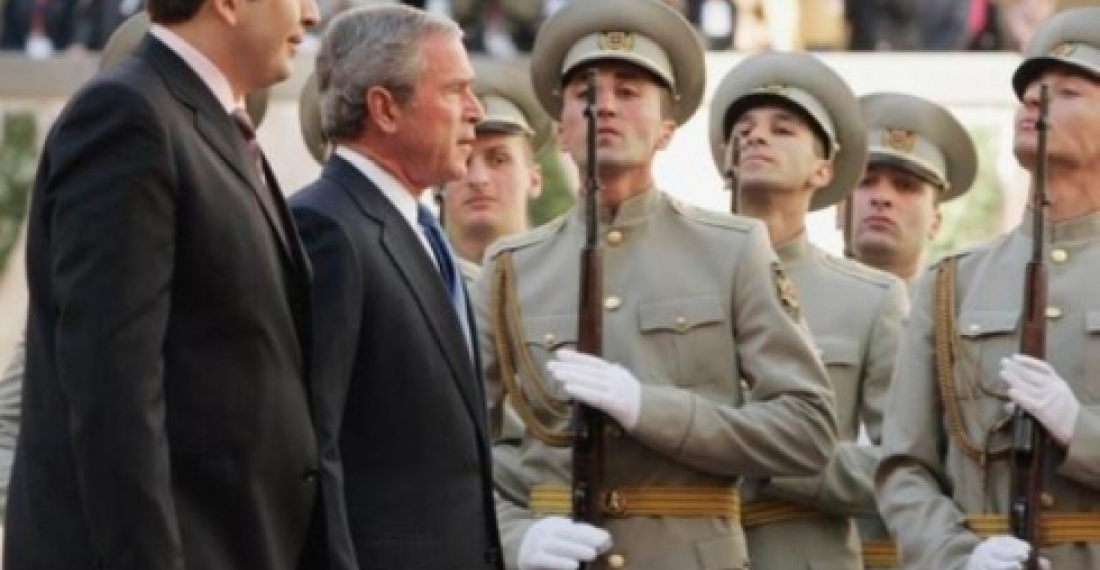
The danger of Russia has been perceived as the main threat for Georgia in the last two decades since independence. Different Georgian governments have approached the problem differently. Under President Shevardnadze the emphasis was to "manage" Russia, whilst building relations with the west as a counterbalance. Under President Saakashvili the policy has been to face Russia more robustly and to seek Western support for the process of doing so. The centrepieces of Georgian foreign policy have therefore been the quest for NATO membership, a strategic relationship with the United States and close political relations with Europe.
In many ways Georgia has posed a dilemma for western governments, torn between a wish to support the country’s aspirations and yet unwilling to engage in the inevitable confrontation with Russia that this entails. In this regard the Georgian leadership in its strategy was too consumed by its own concerns to take into account the concerns of its allies. The result was disappointment, particularly from the 2007 Bucharest NATO summit that failed to give Georgia a clear time table for membership. Some western analysts argue that by accepting Georgia as a member NATO would in fact be signing up to a military confrontation with Russia in the South Caucasus within a short time. The August 2008 war between Russia and Georgia is cited as a proof.
The causes, chronology and consequences of the Georgia-Russia war have been analysed in detail in the one thousand page report of the Tagliavini Commission, established by the European Union for the purpose.
The situation after the 2008 war has become even more complex. By moving to unilaterally recognise the independence of Abkhazia and South Ossetia Russia has confirmed to the sceptics that in the Caucasus it plays only by its own rules. This is not to say that the independence of Abkhazia and South Ossetia should not have in the past, and should not now and in the future, be considered as one of the options in a solution to the conflict of the two entities with Tbilisi. Such a scenario, entailing either full sovereignty, or sovereignty within a loose arrangement with the Georgian state with international guarantees, needs to remain under consideration. By moving unilaterally however, Russia has further destabilised the region and made long term peace more difficult. Russia’s failure to persuade other countries to follow its example confirms that the rest of the world is dissatisfied with the Russian move. The recognition of Abkhazia and South Ossetia by Pacific Micro states - their reasons to do so is best left to imagination, is a proof of the failure of Russian diplomacy in this regard.
By and large the quest of the three South Caucasus states for special and strategic relations with other larger countries, is at best, unsatisfactory, at worst risks weakening them rather than strengthening them.
The choice of which countries or military arrangements to align with should remain first and foremost with the countries concerned. No country should have a veto on the choice of another.
Each country should however consider its choices wisely and realistically. The current situation reflects a wider problem of security concerns in the region. These concerns are the result of real dangers, and in many cases perceptions based on memories of past atrocities, massacres and bloodshed that haunt the Caucasus region and that outsiders should not underestimate or ignore. These concerns need to be addressed by the international community working in harmony, rather than in confrontation. If not, further armed conflict in the South Caucasus is not only possible, but probable.
source: This is the third and final article of a three part series on "special and strategic relations" in the South Caucasus and was prepared for commonspace.eu by the analytical team of LINKS. Opinion expressed does not necessarily reflect the editorial policy of the website.
read the first part of this feature: Armenia in the bosom of Mother Russia
read the second part of this feature: Azerbaijan and Turkey: one nation, two states, seperate chequebooks
photo: President George Bush in Tbilisi with President Saakashvili of Georgia (archive photo)