Armenian, Azerbaijani FMs welcome EU ties

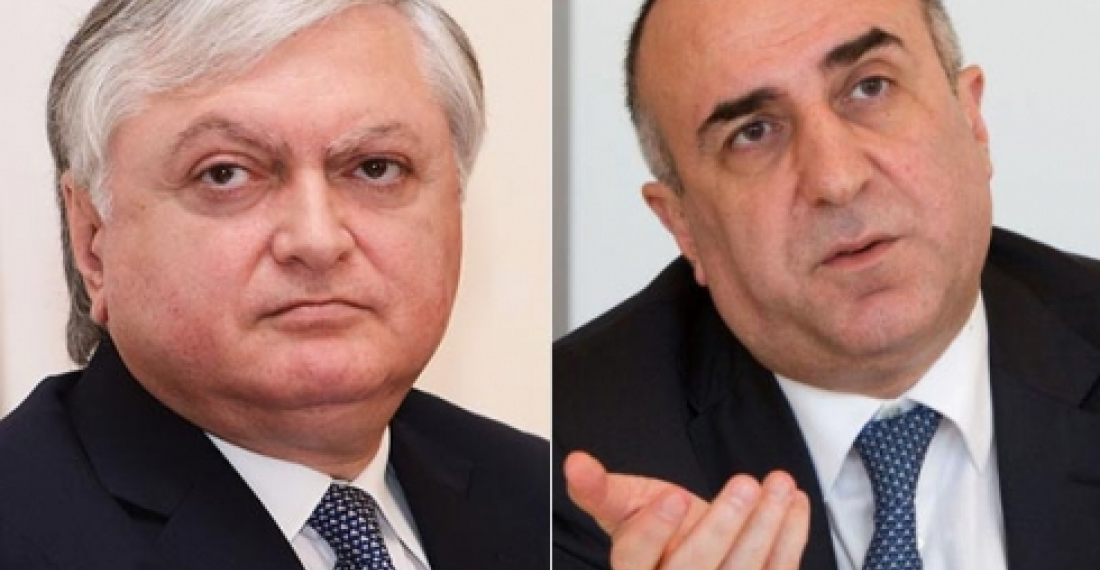
The foreign ministers of Armenia and Azerbaijan took part in a meeting of EU Eastern Partnership's foreign ministers on Monday, with both men voicing support for relations with the European Union.

“We attach great importance to enhancing our bilateral cooperation in many areas of shared interest,” said Azerbaijan’s Elmar Mammadyarov in Brussels. He also mentioned the Strategic Partnership Agreement between Azerbaijan and the EU, which was introduced in draft form at a summit in Riga last year, while praising the new European Neighbourhood Policy document.

“This agreement will lay the solid foundation for upgrading our bilateral relationship to qualitatively new level and for better securing our common interests,” said Mammadyarov, who also spoke positively about European policy chief Federica Mogherini’s recent visit to Baku. He said an important step to closer ties is completing the Southern Gas Corridor, which would enable Azerbaijani natural gas to be sold in Europe.

Armenia in 2013 decided to join the Russian-led Eurasian Economic Union rather than signing a comprehensive free trade agreement with the European Union. However in Brussels, foreign minister Edward Nalbandian gave his support to future bilateral cooperation.

“The European Neighborhood Policy has played a substantial role in promoting and deepening cooperation between Armenia and the EU, he said in Brussels. “We highly appreciate the EU’s continued support and assistance provided to our country over the years, which has been instrumental for the effective implementation and sustainability of the reform process and institutional capacity building in Armenia.”

Nalbandian named the Erasmus international students programme, the agricultural sector, and the EU led Human Rights Dialogue as areas where Armenians benefit from EU involvement. 

“Armenia looks forward to advancing and deepening our comprehensive cooperation both within the Eastern Partnership and European Neighborhood Policy, building upon the achievements that we have reached during recent years,” he said.

SOURCE: commonspace.eu and agencies 

PHOTO: Courtesy of ArmeniaNow
 

Related articles

Editor's choice
News
Aden under curfew, as problem in Yemen's south deepens

Aden under curfew, as problem in Yemen's south deepens

The port city of Aden, in Yemen's south, has been put under curfew, as the rift in the country between  the Saudi led coalition which  backs Yemen's presidential governing council, and the southern forces led by the Southern Transitional Council (STC), deepens. Abdul Rahman al-Mahrami, a member of the Yemeni Presidential Governing Council and commander of the al-Amalik brigades, has ordered a curfew in the temporary capital, Aden, "to maintain security". "A curfew has been imposed throughout Aden Governorate from 9:00 p.m. to 6:00 a.m., in accordance with the instructions of Commander Abdul Rahman al-Mahrami, a member of the Presidential Management Council," the statement said. It states that only security and military personnel, as well as medical and technical teams with approved permits, will be allowed to move in the area during these hours. Yemen's presidential council, which is backed by Saudi Arabia and which already is in a struggle with the Houthi Movement in the north of the country who also occupy the capital Sanaa, two days ago issued an order for the arrest of the head of the Southern Transitional Council (STC),, Aidarous al Zubaidi. The STC have wide support among people in the South, and advocate that South Yemen restores its independence. The coalition warned of further escalation in Aden, long regarded as an STC stronghold, as the Presidential Leadership Council (PLC) chief accused STC leader Aidarous Al Zubaidi of “high treason” and announced the revocation of his membership in the governing body. The moves mark a sharp escalation in tensions within the anti-Houthi camp, despite National Shield Forces, rivals of the STC and former allies, having recently retaken control of Hadhramaut and Mahra from southern fighters. The STC’s takeover of the two regions last month angered Saudi Arabia and contributed to igniting the current internal conflict. (click the picture to read more)

Popular

Editor's choice
News
Aden under curfew, as problem in Yemen's south deepens

Aden under curfew, as problem in Yemen's south deepens

The port city of Aden, in Yemen's south, has been put under curfew, as the rift in the country between  the Saudi led coalition which  backs Yemen's presidential governing council, and the southern forces led by the Southern Transitional Council (STC), deepens. Abdul Rahman al-Mahrami, a member of the Yemeni Presidential Governing Council and commander of the al-Amalik brigades, has ordered a curfew in the temporary capital, Aden, "to maintain security". "A curfew has been imposed throughout Aden Governorate from 9:00 p.m. to 6:00 a.m., in accordance with the instructions of Commander Abdul Rahman al-Mahrami, a member of the Presidential Management Council," the statement said. It states that only security and military personnel, as well as medical and technical teams with approved permits, will be allowed to move in the area during these hours. Yemen's presidential council, which is backed by Saudi Arabia and which already is in a struggle with the Houthi Movement in the north of the country who also occupy the capital Sanaa, two days ago issued an order for the arrest of the head of the Southern Transitional Council (STC),, Aidarous al Zubaidi. The STC have wide support among people in the South, and advocate that South Yemen restores its independence. The coalition warned of further escalation in Aden, long regarded as an STC stronghold, as the Presidential Leadership Council (PLC) chief accused STC leader Aidarous Al Zubaidi of “high treason” and announced the revocation of his membership in the governing body. The moves mark a sharp escalation in tensions within the anti-Houthi camp, despite National Shield Forces, rivals of the STC and former allies, having recently retaken control of Hadhramaut and Mahra from southern fighters. The STC’s takeover of the two regions last month angered Saudi Arabia and contributed to igniting the current internal conflict. (click the picture to read more)