


Armenian Armed Forces General Staff rep.: Armenian army able to hit military and economic, including oil and gas facilities of probable enemy
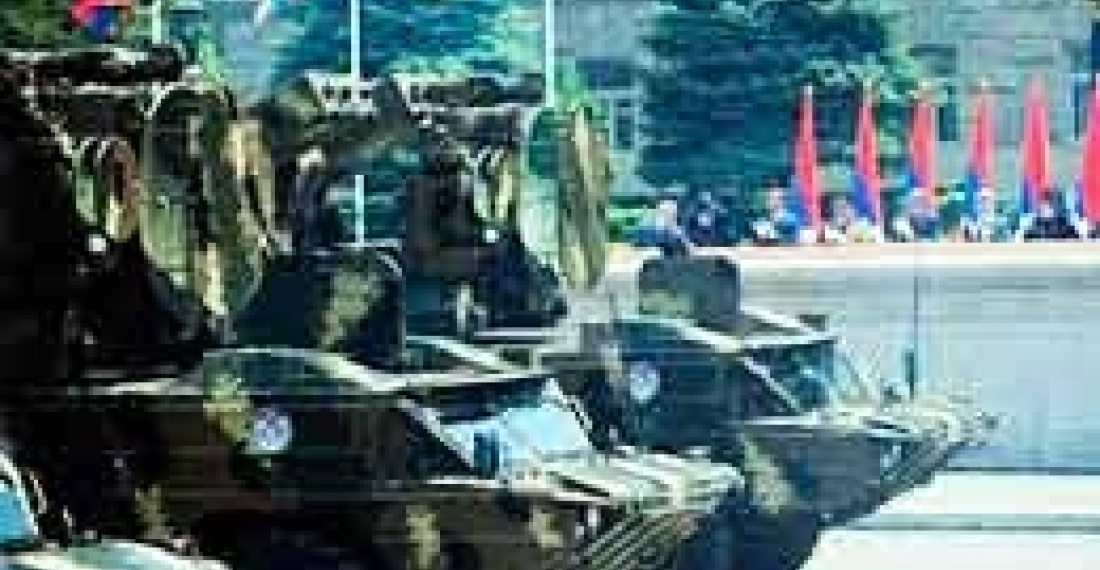

The Armenian army is able to hit military and economic, including oil and gas facilities of probable enemy, Head of the Operative Unit, the Armenian Armed Forces General Staff, Major General Artak Davtyan told media, Monday, when presenting the results of the strategic command and staff exercises of the Armenian Armed Forces on October 1-13. 

He said the Armenian Armed Forces are able to make surgical military strikes against the important facilities of the enemy in a distance of 300km and more. The past exercises included also such maneuvers.  Generally, Davtyan welcomed the high level of the exercises and called them unprecedented due to involvement of up to 45,000 militaries of the National Security and Police troops and nearly 5,000 units of military hardware, aircrafts, drone aircrafts made in Armenia and up-to-date anti-tank weapons.  "The tasks set to the manpower were fulfilled," he said.

In response to ArmInfo's question about the modernization trends of the enemy's armor and military hardware, Davtyan said that the Armenian Armed Forces leadership is following acquisition of new armor by the probable enemy and tries not to yield to it. 

"I'd like to say that the above anti-tank weapons of our army are designed for the fight against up-to-date models of tanks. I think that modernization and improvement of our arms and military hardware will keep growing," he said.

Related articles

Editor's choice
News
Armenia-Azerbaijan Strategic Expert Platform: Members emphasise the importance of the present moment for the South Caucasus and call for the momentum to be used for the long-term peace and prosperity of the region

Armenia-Azerbaijan Strategic Expert Platform: Members emphasise the importance of the present moment for the South Caucasus and call for the momentum to be used for the long-term peace and prosperity of the region

On 27 February 2026, the members of the Armenia-Azerbaijan Strategic Expert Platform met in Antwerp, Belgium, to assess developments in the South Caucasus following the initialling of a peace agreement between Armenia and Azerbaijan on 8 August 2025 at the White House. The members described the present moment as one of major importance for the region and its neighbours, urging leaders and societies alike to use the current momentum to secure long-term peace and prosperity. Established in 2024 with the support of LINKS Europe, the Platform provides a space for direct dialogue and joint analysis between Armenian and Azerbaijani experts. The members also reaffirmed the importance of continued international engagement and expressed strong support for LINKS Europe’s ongoing peacebuilding work in the region. (Click on the image above for the full statement.)

Popular

Editor's choice
Interview
Thursday Interview: Murad Muradov

Thursday Interview: Murad Muradov

Today, commonspace.eu starts a new regular weekly series. THURSDAY INTERVIEW, conducted by Lauri Nikulainen, will host  persons who are thinkers, opinion shapers, and implementors in their countries and spheres. We start the series with an interview with Murad Muradov, a leading person in Azerbaijan's think tank community. He is also the first co-chair of the Action Committee for a new Armenian-Azerbaijani Dialogue. Last September he made history by being the first Azerbaijani civil society activist to visit Armenia after the 44 day war, and the start of the peace process. Speaking about this visit Murad Muradov said: "My experience was largely positive. My negative expectations luckily didn’t play out. The discussions were respectful, the panel format bringing together experts from Armenia, Azerbaijan, and Turkey was particularly valuable during the NATO Rose-Roth Seminar in Yerevan, and media coverage, while varied in tone, remained largely constructive. Some media outlets though attempted to represent me as more of a government mouthpiece than an independent expert, which was totally misleading.  Overall, I see these initiatives as important steps in rebuilding trust and normalising professional engagement. The fact that soon a larger Azerbaijani civil society visits to Armenia followed, reinforces the sense that this process is moving in the right direction." (click the image to read the interview in full)


