The governments of Armenia and Azerbaijan have joined other countries in welcoming the framework agreement signed yesterday between Iran and the world powers that aims to end the stand-off on Iran's nuclear programme. In separate but very similar statements, the Foreign Ministries of Armenia and Azerbaijan hailed the agreement as a step towards regional peace and stability.
In his statement, Armenian Foreign Minister Edward Nalbandian said:
"Armenia welcomes the framework agreement on Iran's nuclear program reached as a result of long lasting constructive efforts exerted by Iran and the international mediators - Russia, USA, China, France, the United Kingdom, Germany and European Union, that gives an opportunity to reach а comprehensive settlement. This will contribute to the strengthening of stability and cooperation in the region. This significant progress in the process of resolution of Iran's nuclear issue once again displays that it is possible to solve even the most complex issues through negotiations. We are confident that this political framework will open up an opportunity for the development of peace, security and stability in the region and beyond".
In Azerbaijani, the Ministry of Foreign Affairs also commented on the Iranian nuclear program agreement. The statement, posted on the Ministry's website said:
"The Ministry of Foreign Affairs of the Republic of Azerbaijan welcomes the progress on negotiations between the P5+1, the European Union and the Islamic Republic of Iran on the key parameters for a joint Comprehensive Plan of Action. We believe that this political framework will provide an opportunity for furthering the peace, security and stability in the region and beyond. The Republic of Azerbaijan supports the efforts and political will of the international community aimed at the resolution of international issues based on the Charter of the United Nations, and the norms and principles of international law, in a constructive and goodwill manner."
Commonspace.eu political editor said in a comment: "At the height of the stand-off between Iran and the international community on the nuclear issue, a few years back, there was grave concern in the Caucasus Region about the possible fallout from any military confrontation. The countries of the region have a complex relationship with Iran - a lot of it based on centuries long history of interaction. However in the last two decades Iran has been largely isolated by the international community, and the countries of the South Caucasus have been very cautious in their dealings with it lest they provoke the ire of the United States and Europe. The situation calmed down in recent years whilst negotiations were going on, and is expected to improve further now that a framework agreement has been reached, which, it is hoped, will lead to a final resolution of the problem - namely by ensuring that Iran does not develop a military nuclear capability. We may therefore in the future see a more assertive Iranian foreign policy in the South Caucasus. It is known that the Iranian leadership seeks a more prominent role in the region. That may not happen for some time, and when it happens it will no doubt raise other concerns. However engaging constructively with Iran now seems possible, and the governments of the region were right to welcome the agreement reached in Lausanne on Thursday".
Source: commonspace.eu
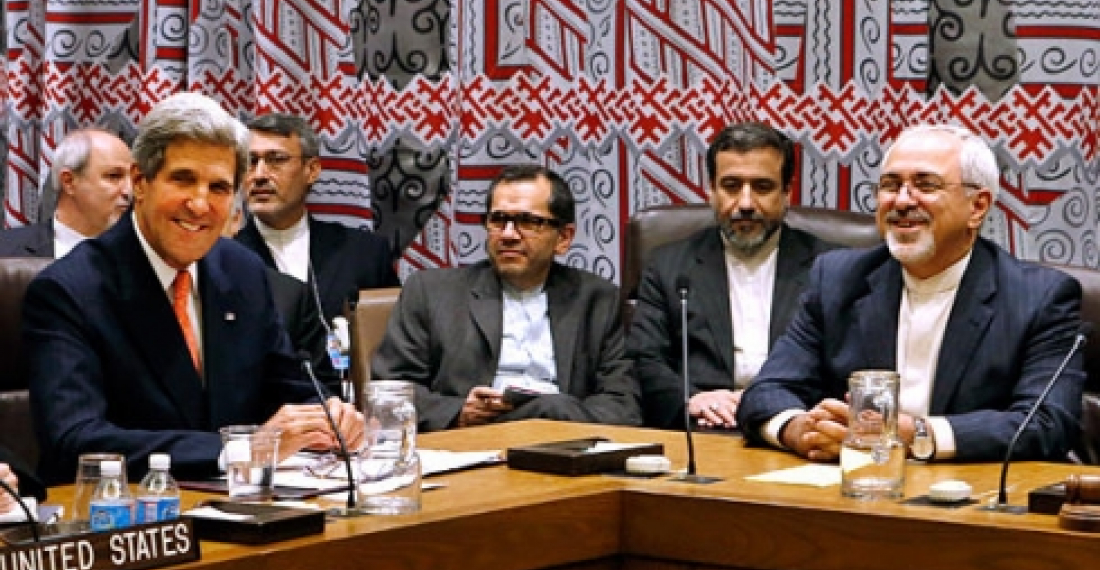
Photo: US and Iranian officials at the meeting in Lausanne on 2 April 2015