


The re-election of Emmanuel Macron as President of the French Republic was the occasion for many congratulations from African heads of state. From Senegal's Macky Sall to Côte d'Ivoire's Alassane Ouattara and Gabon's Ali Bongo or Niger’s Mohamed Bazoum, most leaders have hailed the French president's "brilliant" election.
Yet on the continent, not everyone is so enthusiastic, and speculation is high how France’s Africa policy will play out during Macron’s second term. The silence of Bamako, Conakry and Ouagadougou reflects the challenges of Emmanuel Macron's African policy in the years to come.
Safely redeploying French troops from Mali to neighbouring countries, to continue fighting Islamist militancy will be prominent on Macron's African agenda. The recent announcement of the withdrawal of French and European forces from Mali after a breakdown in the relationship with the military government is a blow to Macron’s efforts in the Sahel region.
Some 2400 French troops are expected to leave Mali in the coming months, and Paris hopes to redeploy some of them to Niger or Benin, Ghana and Cote d'Ivoire.
If military operations had some success in countering terrorist groups, they were not accompanied by significant political reforms and development outcomes on the ground, suggesting that the diplomacy and development pillars could have been used more effectively.
In the Sahelian zone of the "three borders", Niger is the privileged interlocutor of Paris and Europe, thanks to its stability and its willingness to collaborate militarily with Europeans. A bill authorising the redeployment of European special forces on its territory, approved by Nigerien legislators on 22 April, is a step in this direction.
Indeed, the intelligence activities and air support provided by the European forces seem crucial to Niger in order to fight efficiently on the ground. Yet the comparative military advantages of Mauritania and Chad give them a natural leadership, and for Paris they are thus two partners of choice in the fight against terrorism.
Improving the effectiveness of anti-terrorist operations while building trust with the new transitional authorities such as Burkina Faso and Guinea are not the only challenges Emmanuel Macron will have to face. He will also have to heal the wounds from French colonial past, and strengthen the dialogue with African civil society.
Since his first election in 2017, ‘memorial work’ has been a central thread of the French president's policy. Unlike past right-wing presidents such as Jacques Chirac and Nicolas Sarkozy, Mr Macron considers that recognising the wrongs France did in its past interaction with African people is crucial in redefining the type of dialogue necessary for the new relationship with the continent.
During a visit to Algeria when he was still a presidential candidate, Macron described colonisation as a 'crime against humanity', which prompted considerable criticism at home, especially from the French political right-wing parties. He then persevered this memorial duty by commissioning the historian Benjamin Stora to make recommendations to resolve the memorial paralysis that plagues relations between Algiers and Paris. This second mandate will be the opportunity to apply some of these suggestions.
On the Rwandan subject, President Macron commissioned a report from Professor Vincent Duclert concerning the French archives on the Tutsi genocide, which concludes that France bears a heavy and damning responsibility.
Aware of the anger of African civil society, weary of a foreign army presence amid growing public anger about France's military involvement in its former colonies, Macron intends to renew exchanges between France and African civil society.
The prominent role of the Malian population's support for the decision of the country’s military rulers to forego French military support is just one expression of the resentment of the many people in the Sahel towards the French.
According to Brice Makosso, a Congolese civil society leader, the Chadian and African populations expressed frustration when France publicly supported the dynastic succession of the Chadian leadership in 2021. Frustration and skepticism towards Emmanuel Macron are reinforced by the French inaction in the face of constitutional changes that allow for leaders to hold on to power in places such as Côte d'Ivoire and Guinea.
A clearer discourse, condemnations in case of rigged elections, and support for constitutional principles that favour democratic transitions between different forces is wanted and expected. However there is also a risk that a greater involvement of the French state in the African democratic process would also be seen as a return to the era of France-Africa, and the colonisation debate would resurface.
Emmanuel Macron has therefore opted for the power of entrepreneurship to restore dialogue and partnership with the African civil society. The new Africa-France summit in Montpellier in October 2021, bringing together only African civil society figures and Emmanuel Macron, highlighted the entrepreneurial power of the continent.
Choose Africa, an initiative led by AFD and its private sector arm Proparco, will provide technical support and €2.5 billion in financing over 2018–2022 – through equity investment, loans and guarantees - to African start-ups and SMEs.
Digital Africa will deploy €130 million by 2025 in support of African digital start-ups. This focus on entrepreneurs is consistent with Macron’s more direct engagement with people in Africa rather than their leaders but will take time and require significant funding to have a sizeable and visible impact.
On the economic front, Paris has managed to increase its global aid budget even amid the pandemic with development spending rising from 10.9 billion euros in 2019 to 12.8 billion euros in 2020 and plans to increase it further. Macron did not express himself on the Capital Frontex project, through which several African civil society leaders want to revise the principle of capital transfer freedom for multinationals in Africa. The abrogation of this principle could encourage multinationals to reinvest part of their profits in Africa, which would help build fairer relations between France and African countries.
During the Covid crisis, Macron has also pushed for more financial support to African developing countries and to enable an equitable recovery, whether through debt cancellation via the Paris Club or debt suspension through the G20’s Debt Service Suspension Initiative.
Macron has put a great deal of energy into opening a new chapter in the relationship between France and Africa, but the results have been below expectations.
A sustainable and mutually beneficial relationship is very important in these new, uncertain times. Whether it is through the gas alternative proposed by some North African countries, or the emergence of new partnerships in the Sahel and in English-speaking Africa, France will have to play a prominent role and has much to gain from being close with Africa.
Sources: CommonSpace.eu with BBC (London), RFI (Paris), France 24 (Paris), TV5 Monde (Paris), Euractiv (Brussels)
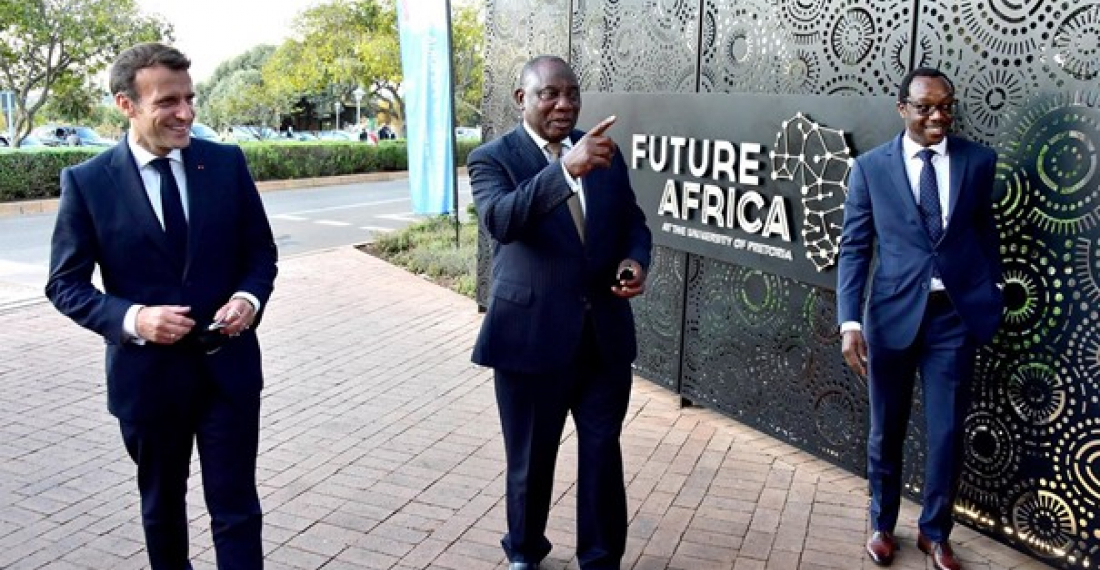
Picture: French President Emmanuel Macron pictured with President Cyril Ramaphosa and Vice-Chancellor of the university of Pretoria Tawana Kupe ahead of the dialogue on the manufacturing of vaccines in Africa in May 2021; Twitter: @martaforesti



