Opinion: In this op-ed for commonspace.eu on the occasion of Georgia's independence day, Dennis Sammut warns against understanding Georgia through simple cliches, and argues that after twenty five years of statehood it is now time to modernise Georgian politics
Many countries lend themselves to clichés, but perhaps none more so than the Republic of Georgia, the South Caucasus state today celebrating the 25th anniversary of its statehood. Georgia was an independent state briefly between 1918-20, and today's celebration is in fact the anniversary of the declaration of Georgian independence that took place on 26 May 1918. However, that independence was too short-lived and too fragile to draw too many conclusions from. It has been in the last quarter century, since emerging from the ashes of the USSR in 1991, that Georgia took its place among the community of nations. In the process, many have become acquainted with this country and its people, and most emerge from the experience holding very fixed perceptions.
Those who know Georgia tend to either love or hate it, and two sets of clichés have developed around the country. Those who like it think of it as a land of milk and honey, with beautiful scenery, plentiful and delicious food, and friendly and hospitable people. Others, though by far a minority, think of Georgia as a dysfunctional failed state where corruption is rampant, where politicians squabble for power and wealth but have contributed little to good governance, and where intolerance - often expressed through violence - is prevalent,
As somebody who has been to Georgia quite a lot in the last twenty-five years, experiencing both its pleasant and unpleasant sides, I can understand where these simplistic clichés come from. But ultimately, the Georgian people have struggled over the last twenty-five years to establish and develop their state, with a degree of success, in extremely difficult circumstances. History provides the Georgians with a beacon of past glories that many hope will be repeated, but also acts as baggage that sometimes seems to drag the country down. Georgia's complicated relationship with its huge neighbour Russia has clouded its history for centuries, and continues to play a determining role. Georgia is rich in agriculture, hydropower and tourist potential, but its economy remains underdeveloped.
It is often in the field of governance that Georgia is subjected to most criticism, even though it compares favourably with its immediate neighbours. Since 1991 Georgia has had four governments, each with its own particular style, and all with weaknesses and shortcomings, but none have been totalitarian. The first president, Zviad Gamsakhurdia, was a romantic nationalist who had no idea of government and led the country to chaos. Edward Shevardnadze, a reconstructed communist who presided over a laissez-faire government as an antidote to Georgia's recent past, succeeded him. Shevardnadze was unceremoniously pushed out by Mikheil Saakashvili, an impulsive and somewhat angry man in a hurry, who shook Georgia out of its lethargy but in the process rode roughshod on his own people. He was pushed out, in an equally unceremonious fashion, this time through the ballot box. Georgia's 2012 parliamentary election may have been Saakashvili's worst defeat, but it was also his biggest success. The country had learnt how to change governments democratically.
Since then, Georgia has had a somewhat lacklustre government that has put state consolidation and economic development as a priority. It is less ideological than its predecessor, more in control than Shevardnadze's government, and not into the disastrous romantic politics of Gamsakhurdia. The man behind the current Government is Bidhzina Ivanishvili, mastermind of Saakashvili's 2012 electoral defeat. He swept into power at the head of a ramshackle coalition of disparate political groups and personalities, but who for the last three years has held no official position in the Georgian state.
Georgians have much to thank Gamsakhurdia, Shevardnadze, Saakashvili and Ivanishvili for, despite their various shortcomings, in their own way they all took crucial steps that were decisive to ensure Georgian statehood. In due course future generations of Georgians will probably come to love them all. Gamsakhurdia and Shevardnadze are now dead. Saakashvili is very much alive, having re-invented himself as a Ukrainian, currently governing the region of Odessa. Some think Saakashvili may make a comeback into Georgian politics. Frankly I think the Georgian people do not want him, and do not need him. In 2003 Saakashvili was the man of the moment. That moment has now passed.
Much has been done to modernise the Georgian state in the last two decades. Now it is time to modernise Georgian politics, tangibly rather than cosmetically. The person who many expected to do this was Ivanishvili. Often he says he wants to do so, but frankly he does not seem to have a clue how. It is a pity, because time is running out. Ivanishvili may not have held an official position since resigning as prime minister in 2013, yet had moral authority conferred on him by the 2012 election victory which he spearheaded. This moral authority will soon expire when Georgians go back to the polls next October. Even if his party wins that election, Ivanishvili's own authority will be much less.
Georgian politics now needs to consolidate around ideas rather than personalities, offering the electorate clear choices on economic, social and foreign policy issues. State institutions need to be strengthened so every government is held accountable and in check, through legal and legitimate means.
A lot of the onus lies with politicians, yet every Georgian citizen also bears his or her share of responsibility. Tolerance remains a somewhat abstract concept in the thinking of most Georgians, the product of a conservative Church and a communist legacy. Old people may have excuses, but young people do not. They need to be the driving force for the deep-rooted changes that are now necessary to secure not just Georgian statehood, but also its success as a modern, prosperous and democratic state. October's elections need to be even better than those in 2012. Anything less will be very disappointing indeed.
In facing its current and future challenges Georgia, is now not alone. The process of formalising its association agreement with the European Union has taken an irritatingly long time to be completed, but should be in place in five weeks' time. The EU must step up its work in Georgia and deliver, on the visa liberalisation issue, on economic support and on political mentoring.
Georgia is not a land of milk and honey, but neither is it a dysfunctional failed state. It is a normal country that has passed difficult tests over the last twenty-five years, and is now on its way to a better future despite the challenges ahead. To all Georgians, Happy Independence Day!
The author: Dennis Sammut has been a regular visitor to Georgia, and observer of Georgian life and politics, for many years. He is Director of LINKS (Dialogue, Analysis and Research) and contributed this op-ed to commonspace.eu on the occasion of Georgian independence day. He may be contacted at dennis@links-dar.org.
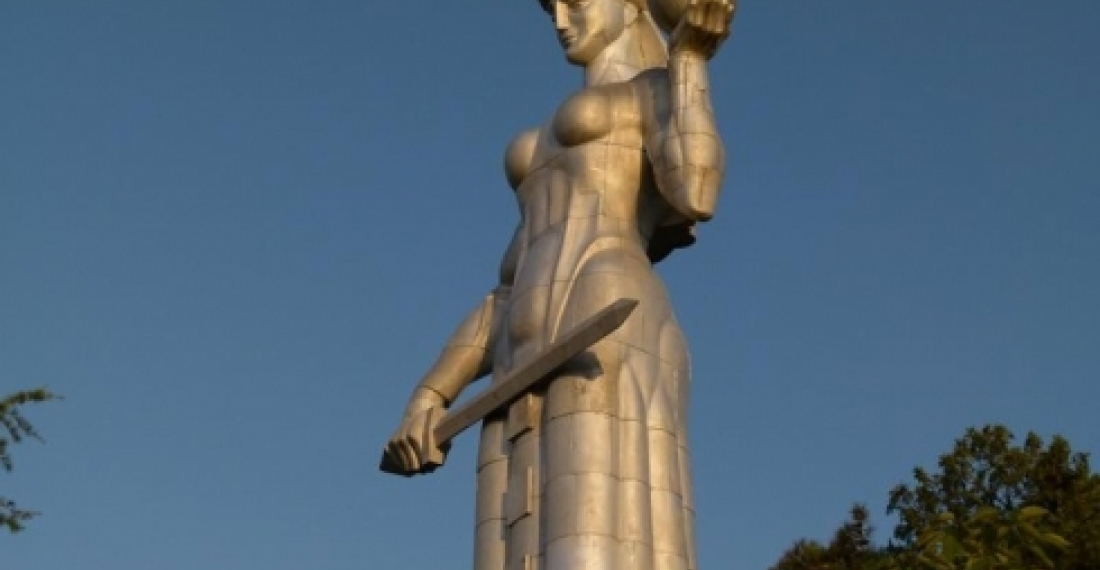
photo: The statue of Mother of Georgia looks down over the Georgian capital Tbilisi. "History provides the Georgians with a beacon of past glories that many hope will be repeated, but also acts as baggage that sometimes seems to drag the country down".